
 English

Table of Contents
You're about to book a hair transplant. The clinic quotes you a number let's say 2,000 grafts. It sounds reasonable. You say yes.
Six months later, your results are thin. Patchy. Nothing like the before-and-after photos you were shown. Why? Because 2,000 grafts was never enough for your level of hair loss. Someone just gave you a number without doing the analysis.
It occurs more frequently than you might imagine. Being aware of the number of grafts that you really require before you settle yourself down in that chair means the difference between a wonderful outcome and one that requires correction.
How Many Grafts Do I Need? Here's the Direct Answer
A typical hair transplantation process will include between 1,500 and 4,500 grafts. In some cases where the person has suffered advanced hair loss, it might even require as many as 5,000-6,500 grafts per session.
There is no such thing as an average number. This depends on three major factors: the size of the area that needs covering, the density of the graft supply, and how natural the results should look.
The best way to get your real number is through a proper hair analysis not a clinic's online estimate tool. But the table below will get you close.
How Many Grafts Do I Need? Breaking It Down by Hair Loss Stage:
Norwood scale is the classification most commonly employed when assessing male hair loss problems. It was introduced by Dr. O'Tar Norwood in the 1970s and it is still the benchmark used.
Here's the average number of grafts needed at each stage:
| Norwood Stage | Hair Loss Pattern | Estimated Grafts Needed |
| Norwood 1 | Minimal recession, barely noticeable | 0 – 500 (if any) |
| Norwood 2 | Slight temple recession | 500 – 1,000 |
| Norwood 3 | Defined temple recession, early thinning | 1,000 – 1,500 |
| Norwood 4 | Significant front and crown loss | 2,000 – 3,000 |
| Norwood 5 | Connecting front and crown loss | 3,000 – 4,000 |
| Norwood 6 | Large bald area, narrow donor band | 4,000 – 5,000 |
| Norwood 7 | Extensive loss, thin donor supply | 5,000 – 6,500 |
Important: These are estimates. A patient at Norwood 4 with fine hair will need more grafts to achieve the same visual density as someone with thick, coarse hair at the same stage. The numbers above assume average donor density and hair calibre.
What Is the Norwood Scale and Why Does It Matter for Your Graft Count?
The Norwood Scale is a seven-stage classification system. Your surgeon uses it to map where your hair loss currently sits and, crucially, where it is likely to progress.
This matters because a good surgeon doesn't only transplant for today. They plan for where your hair loss will be in 10 or 15 years.
If you're at Norwood 2 right now but genetically likely to progress to Norwood 5, transplanting only a front hairline without reserving donor supply for the crown is a planning error. You'll look great at 35 and patchy at 45.
The Norwood Scale gives your surgeon the map. Your donor density is the budget. How well those two are matched is what separates an average result from an excellent one.
What Factors Actually Determine Your Graft Number?
There are five things that go into your final graft count and none of them can be assessed from a photo or a chat message.
- Size of the recipient area Larger bald zones require more grafts to cover. A Norwood 4 patient has roughly 50–80 cm² of thinning or bald scalp. At a target density of 40–50 grafts per cm², that's 2,000–4,000 grafts for that zone alone.
- Your desired density Natural-looking coverage typically requires 35–50 grafts per cm². The hairline area (the first 1–2 cm) needs higher density 60–100 grafts per cm² to look soft and undetectable rather than pluggy.
- Hair calibre and curl Thick, coarse, or curly hair provides better visual coverage per graft than fine, straight hair. Someone with fine hair may need 20–30% more grafts to achieve the same appearance.
- Donor supply The average scalp has between 6,000 and 10,000 extractable grafts in the permanent zone (sides and back of the head). Your surgeon can only safely harvest a fraction of those typically up to 50–60% to avoid visible thinning in the donor area. This is your ceiling.
- Graft survival rate Not every transplanted graft survives. Industry averages hover around 85–90%. At clinics using microscopic donor analysis and precise placement, survival rates can reach 95% or higher which directly affects how many grafts you need to transplant to hit your target density.
How Graft Quality Changes Everything This Is What Most Guides Skip
Raw graft numbers are only half the story. Where each graft comes from and how it's placed determines whether 2,500 grafts looks like 1,500 or 4,000.
At Istanbul Vita, this is the core philosophy behind their proprietary Vita Technique® a method built around microscopic donor analysis before a single graft is harvested.
The donor area is divided into four zones (D1 through D4), each containing grafts of different thickness and follicle count. Fine single-follicle grafts from D1 go to the hairline where they create a soft, natural edge. Thicker multi-follicle grafts from D3 go to the crown, where density matters most.
The result: hairline density of 80–100 grafts per cm² (the industry average is 30–40), achieved with 1.1–1.2 mm micro sapphire blades. This isn't just a higher graft count it's smarter graft distribution.
When planning is this precise, patients often need fewer total grafts to achieve the same visual density. That protects the donor supply for potential future sessions if hair loss progresses.
How Many Grafts Can Be Transplanted in One Session?
In any hair restoration procedure, the safe number of transplanted hair follicles should not exceed 4,000 to 6,500. Here's how much each type of procedure can yield:
| Technique | Max Grafts Per Session | Best For |
| Standard FUE | 3,000 to 4,000 | Mild to moderate loss |
| Sapphire FUE | 3,500 to 5,000 | Moderate to significant loss |
| DHI (Choi Pen) | 2,000 to 3,500 | Regional density, no-shave cases |
| Combined (FUE + DHI) | 4,500 to 6,500 | Advanced loss, maximum coverage |
Exceeding 6,500 grafts per session is also discouraged. The overharvesting of the donor site results in noticeable hair thinning at the crown and temples. For those who have Norwood 6/7 hair loss and require a greater number of grafts than what can be performed in one session, a two-session approach done at 12 to 18 months apart is medically the best solution.
Can an Online Calculator Tell You How Many Grafts You Need?
Honestly? No not with enough accuracy to make a treatment decision.
Online calculators use averages. They don't know your hair thickness, your donor density, your scalp elasticity, or your rate of progression. They can give you a ballpark, but a ballpark isn't a surgical plan.
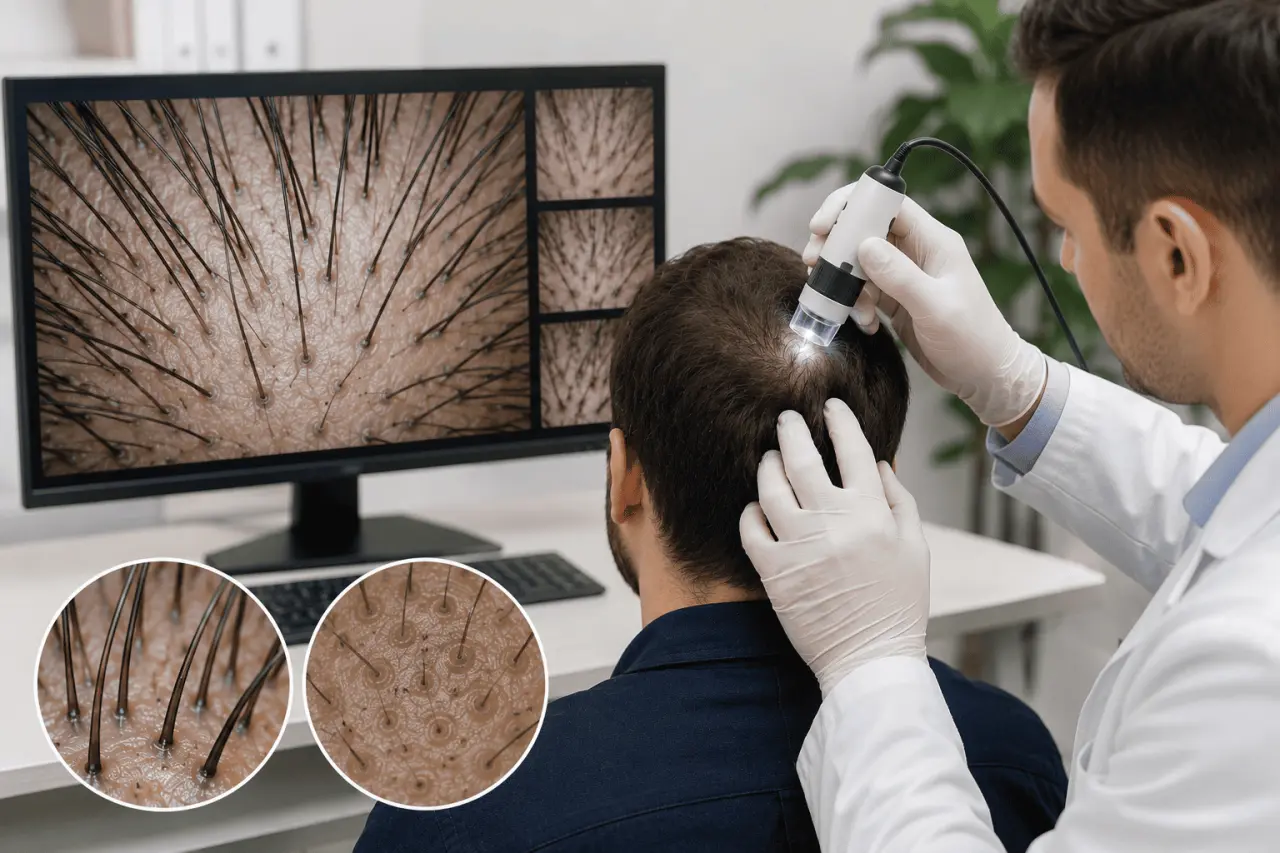
The only reliable way to know your graft count is a proper donor assessment. This involves measuring the density of follicular units per cm² in your donor zone, evaluating hair calibre under magnification, and mapping the recipient area against your Norwood stage.
At Istanbul Vita Clinic, every patient receives a free hair analysis before any plan is discussed. Their team reviews your photos, maps your hair loss stage, assesses your donor potential, and gives you a personalised estimate not a generic number pulled from a chart.
This takes about 15 minutes. And it's the difference between walking into surgery informed or walking in hoping for the best.
A Note on Donor Capacity: The Number Nobody Talks About
Here's what most guides bury at the bottom: your graft count isn't only about what you need. It's about what you have.
The average scalp holds 6,000–10,000 grafts in the safe donor zone, according to data published by the International Society of Hair Restoration Surgery (ISHRS). Surgeons can typically extract 50–60% of those safely without causing visible donor depletion.
If your hair loss requires 5,000 grafts but your donor capacity is limited to 4,500, a successful hair transplant depends on adapting the treatment plan instead of chasing a higher graft count. Surgeons who promise a 6,000-graft hair transplant from a weak donor area may be prioritizing impressive numbers over safe, sustainable results.
What to Ask Before You Agree to a Graft Count
Before you accept any quote, ask your clinic these five questions:
- How was my donor density measured and by what method?
- What is my safe extractable graft limit given my donor supply?
- Is your hair transplant plan based only on my current hair loss, or does it also take future hair loss into account?
- What graft survival rate do you typically achieve in your hair transplant procedures, and how is this evaluated?
- If I require another hair transplant in the future, will my donor area still have enough healthy grafts available?
A clinic that can answer these questions with clear, evidence-based explanations rather than vague promises is far more likely to deliver a well-planned and realistic hair transplant experience. Vague answers or pressure to book before the analysis is complete are warning signs.
Your Personalized Hair Transplant Assessment at Istanbul Vita
If you've been reading generic articles and trying to estimate your Norwood stage, you've probably realized that there's no universal answer to how many grafts you'll need for a hair transplant. The right number depends on your donor area, the extent of your hair loss, and what can be achieved safely over the long term.
Comparing graft numbers between clinics can be confusing, especially when each clinic recommends something different for what appears to be the same level of hair loss. In reality, the final number is influenced by much more than the visible bald area. Donor density, hair calibre, scalp characteristics, the desired level of density, and the likelihood of future hair loss all play a role in the planning process. This is why two patients with similar-looking hair loss may receive completely different recommendations. Rather than relying on a standard chart or an online calculator, a detailed hair analysis provides a far more accurate estimate based on your individual hair characteristics.
At Istanbul Vita, every patient starts with a personalised hair analysis instead of a standard estimate. The medical team assesses your donor capacity and hair loss pattern before recommending a treatment plan. Unlike clinics that charge by graft number, the cost of hair transplantation at Istanbul Vita does not increase as the number of grafts increases; this ensures that patients receive a treatment plan based on their medical needs, not on pricing tiers. Backed by more than 15 years of experience, over 12,000 hair transplant procedures, and a boutique model limited to just 1–3 patients per day, the clinic focuses on careful planning rather than high patient volume.
If you'd like a more detailed evaluation of your hair loss and a personalised graft estimate, you can contact the Istanbul Vita team through the contact page to arrange your consultation.
Have Questions? Let's Chat on WhatsApp!
Get instant answers 24/7. Receive your doctor-led hair analysis within 1 day, plus pricing and booking support.
Start WhatsApp ChatFrequently Asked Questions
Can I have a second hair transplant in the future?
Yes, if your donor area still has enough healthy grafts.
Do people with fine hair need more grafts?
Usually, yes, because fine hair provides less visual coverage.
Does age affect how many grafts I'll need?
Yes, ongoing hair loss can increase your future graft requirements.
Does a larger graft count mean a longer recovery?
Not always, but larger procedures may require more healing time.
Should all available grafts be used in the first session?
No, preserving donor hair for future needs is often recommended.
Does a higher graft count guarantee better results?
No, proper planning and graft placement matter more.
Is graft planning different for women?
Yes, because female hair loss patterns are often different.
Does the number of grafts affect the cost?
In many clinics, yes, although some offer fixed-price packages.
 conversation


