
 English
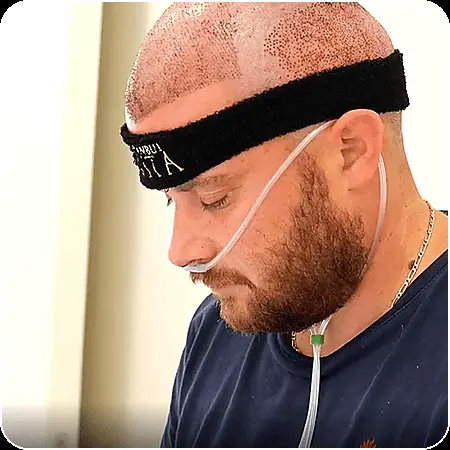
Table of Contents
Placing the last graft isn't the finish line. Once that happens, both the donor and recipient areas move into an early healing window, where the scalp starts reacting to thousands of tiny extraction points and implantation sites created during surgery.
At Istanbul Vita, supplemental oxygen gets built into this window. Every patient goes through two sessions: one right after the operation, before leaving the clinic, and a second the next day, once the first hair wash is done.
These sessions play a supporting role only. They don't substitute for careful surgical work, proper graft handling, or the rest of the aftercare routine — and oxygen alone isn't what determines how the final result turns out.
Why Does Oxygen Matter During Tissue Healing?
The body's healing response already relies on oxygen.
Repairing damaged tissue takes energy at the cellular level, and oxygen plays a role in several parts of that process — collagen formation, new blood vessel growth, skin repair, and immune activity. Wound-healing literature generally treats sufficient tissue oxygenation as a normal part of how injuries heal.
That doesn't translate into "more oxygen equals faster healing," though. Wound repair depends on circulation, inflammation, nutrition, cellular behavior, and plenty of other variables working together. Oxygen availability is simply one piece of that larger picture. This becomes relevant after a hair transplant because both treated zones have experienced controlled injury. Follicular units leave the donor area through small openings, and grafts get placed into freshly prepared sites in the recipient area.
Healing begins the moment surgery wraps up.
How Is Oxygen Therapy Used at Istanbul Vita?
The protocol splits into two separate sessions.
They're not scheduled back to back — each one lands at a different point during the patient's first 24 hours of recovery.
| Session | When It's Given | Recovery Stage |
|---|---|---|
| First oxygen session | Right after the hair transplant | Before leaving the clinic on operation day |
| Second oxygen session | The next day | Following the first post-operative hair wash |
Spacing them this way lets oxygen support both the immediate aftermath of surgery and the patient's return visit to the clinic.
First Session: Immediately After the Operation
This session happens once the hair transplant itself is finished.
By this point, extraction and implantation are complete, and the scalp has entered its earliest recovery phase. The team runs the standard post-op checks, then administers oxygen before the patient heads out. No graft work happens during this stage.
The point of the session is simply to layer supportive oxygen delivery onto the immediate post-op care already provided at the clinic.
Afterward, the patient gets guidance for the first night — how to keep the recipient area protected and which activities to steer clear of.
Second Session: After the First Hair Wash
This one takes place the following day.
Patients come back to Istanbul Vita for their first wash after surgery. That visit doubles as a check-in — the team gets to see how the donor and recipient areas look on day one and reinforce the washing and aftercare instructions already given.
Once the wash is done, the second oxygen session follows, given together with a laser therapy session as part of the same visit.
Why Are There Two Oxygen Sessions?
The first 24 hours break down into two distinct phases of care.
The first starts the moment surgery ends — the scalp is freshly treated, the patient is still on-site, and immediate checks are underway.
The second kicks in the next day, once the scalp has made it through its first night, the wash has happened, and the treated areas can be looked at again.
Istanbul Vita places one oxygen session inside each of those phases.
This two-session structure isn't a claim that a specific number of sessions guarantees stronger growth. It's part of a broader supportive protocol, not a standalone growth treatment.
What Can Oxygen Therapy Support After Hair Transplantation?
The reasoning behind supplemental oxygen comes from general tissue-repair biology — not from any claim that oxygen directly triggers transplanted follicles to grow.
Normal Tissue Repair
Studies of wound healing have shown that oxygen plays a role in processes such as collagen deposition, fibroblast activity and blood vessel growth as damaged tissue regenerates itself.
A hair transplant creates injuries far smaller than the chronic wounds typically studied in this research, but the underlying need for oxygen during tissue repair still applies.
Early Scalp Recovery
Temporary redness, sensitivity, mild swelling, or crust formation are all common right after transplantation. Oxygen therapy isn't a guarantee against any of these — they can still show up as part of ordinary healing.
At Istanbul Vita, oxygen sits alongside the other early recovery measures rather than replacing the body's own repair process.
Overall Post-Operative Care
The oxygen sessions are just one piece of the puzzle.
During this same period, patients also need to keep the transplanted area free from rubbing or pressure, stick to their medication schedule, sleep the recommended way, and follow the washing method shown by the clinic.
Recovery comes down to several things working together, not oxygen on its own.
Does Oxygen Therapy Increase Graft Survival?
No single factor — including oxygen — determines whether a graft survives.
A follicular unit goes through several critical stages before it's even back in the scalp: careful extraction, proper handling outside the body, and precise depth and placement during implantation.
After that, things like blood supply to the recipient area and how well post-op healing goes also come into play.
Given how many variables are involved, it wouldn't be accurate to say an oxygen session guarantees higher graft survival.
At Istanbul Vita, supplemental oxygen supports recovery — it doesn't substitute for skilled graft handling.
Have Questions? Let's Chat on WhatsApp!
Get instant answers 24/7. Receive your doctor-led hair analysis within 1 day, plus pricing and booking support.
Start WhatsApp ChatDoes Oxygen Therapy Make Transplanted Hair Grow Faster?
No — oxygen therapy isn't meant to speed up the natural hair-growth cycle.
Transplanted hair shafts typically shed within the first few weeks after surgery. The follicles then move through their own growth cycle, with new visible hair emerging gradually over the following months.
A post-op oxygen session doesn't skip ahead through any of these biological stages.
At Istanbul Vita, oxygen's role is tied to supporting early recovery — not to producing faster visible growth.
Is Oxygen Therapy Painful?
The session itself doesn't create any new wounds.
There's no extraction, incision, or implantation involved. Patients might still feel some sensitivity from the transplant itself, simply because the donor and recipient areas were only recently treated.
If pain spikes unexpectedly or comes with symptoms outside the usual recovery pattern, that's worth flagging to the medical team rather than assuming it's just part of the process.
Oxygen Therapy Within the Istanbul Vita Recovery Process
Post-op care functions as a sequence, not a single isolated step.
At Istanbul Vita, that first stretch looks roughly like this:
Hair transplant → post-operative check → first oxygen session → first-night recovery → next-day clinic visit → first hair wash → second oxygen session (with laser therapy) → continued aftercare
The oxygen sessions slot into that sequence — they don't replace any of the other steps.
Patients still need to follow guidance on washing, medication, sleep position, physical activity, and protecting the newly transplanted area.
The overall goal is giving the scalp the right conditions to heal normally while the transplanted follicles settle into their new location.
Frequently Asked Questions About Oxygen Therapy
How many oxygen therapy sessions are given after a hair transplant at Istanbul Vita?
Two. The first happens right after surgery, before leaving the clinic; the second follows the next day, after the first hair wash.
Why is oxygen given immediately after the hair transplant?
That first session fits into the immediate post-op window, right as the scalp begins recovering from extraction and implantation.
Why is the second session performed after the first wash?
It's built into the next day's care — once the wash and scalp check are done, oxygen is given alongside a laser therapy session as another supportive step in early recovery.
Does oxygen therapy guarantee that transplanted grafts will survive?
No. The survival of the graft depends on many surgical and biological factors, and oxygen therapy alone cannot guarantee it.
Does oxygen therapy prevent swelling or crusting?
No. Swelling, redness and crusting are normal after a hair transplant, and oxygen sessions won't prevent them.
Will oxygen therapy speed up the growth of my transplanted hair?
There is no visible speeding up of the normal growth cycle. These sessions can help the early recovery process, not the visible hair growth process.
Is oxygen therapy a substitute for normal hair transplant aftercare?
No. The normal aftercare routine is still paramount, including washing instructions, scalp protection, medication guidance, and more.
 conversation


