
 English
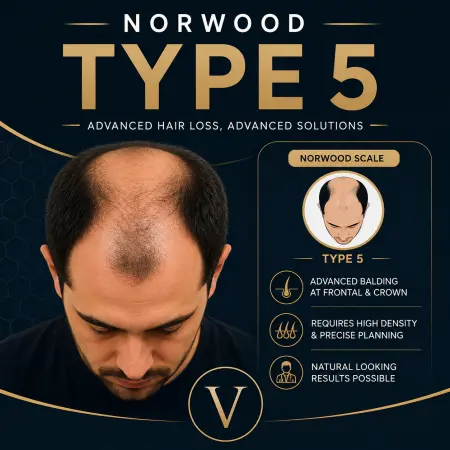
Table of Contents
Loss of hair up until Norwood Class 5 will normally be the period wherein the individual will start to seek out lasting and effective solutions. With the hairline having shifted further back and the appearance of balding areas in the crown region, this would lead to increased concern for the appearance and confidence of the patient. This is when the process of hair loss must be well understood to make a sound decision for the future.
This may start from the recognition of signs of Norwood Class 5 up until the determination whether hair transplant surgery would be needed. As each patient varies in his/her donor supply and hair density, the choice of the correct course of treatment must always be considered.
What Is Norwood Type 5 on the Norwood Scale?
The fifth stage of male pattern baldness as per the Norwood classification system is seen as a relatively more advanced level. In this stage, the recession of the frontal hairline is observed to be quite far, along with significant hair thinning in the crown region. The strip of hair separating the front hairline from the crown region also starts thinning, which makes the scalp more visible. This is usually the stage where the patient struggles with covering their hair loss using hair styling techniques. Among all Norwood types, Norwood Type 5 represents a stage where hair loss becomes much more visible and difficult to manage with temporary solutions alone.
For treating hair loss at the Norwood 5 stage, the patient would require a more intense treatment approach compared to the lower stages. Medication could provide some relief by delaying hair loss; however, the majority of patients tend to explore the option of Norwood 5 hair transplantation.

Norwood Type 5 Hairline and Common Signs
A hairline characterized by Norwood Type 5 can be easily detected due to the deepening of the recession around the temples, along with thinning of the crown. In addition, there is a retreat in the frontal hairline, which causes increased balding on the top region of the scalp. This means that the strip of hair between the frontal and crown sections gets smaller and thinner.
The presence of a connection between frontal recession and crown thinning is one of the main features associated with the Norwood Type 5 hairline. In addition, it can also lead to hair thinning, enlargement of the forehead region, and inability to properly cover the scalp using common hairstyles.
Norwood Type 5 Examples: How to Identify This Stage
Norwood Type 5 cases are generally marked by the obvious difference that exists between the receding front hairline and crown region. The temples have also pulled back significantly at this point, while the bald spot on the top of the head becomes increasingly prominent. There is still some hair left between the front hairline and the crown region, but it is not as thick as before.
It is common for many individuals to mistake a Norwood 4-5 stage for an actual example of Norwood Type 5 because of the increasing thinning of hair in the crown region. An example of a genuine Norwood Type 5 case will include a combination of severe frontal hairline recession as well as thinning of the crown.
Norwood 4 vs 5 and Norwood 5 vs 6
The main factor that differentiates Norwood 4 vs 5, as well as Norwood 5 vs 6 hair loss types, is the amount of advancement of the process and the degree of connection between the frontal hairline and the crown area. If you have Norwood 4, your frontal recession and crown thinning can be observed; however, the bridge connecting the two areas will still be relatively strong. In Norwood 5 stage, the link between the two areas becomes significantly thinner, and the patches of baldness get closer to each other.
Norwood 5 vs 6 hair loss types are characterized by further progress of the process. Namely, if you have Norwood 6, you will have a very weak link between the crown and the frontal hairline, or there may not be any at all. Consequently, you will get one bald patch instead of two.
Norwood 4 vs 5: Key Differences
Norwood 4 and Norwood 5 have one major difference that lies in their degree of progression and the thickness of the hair bridge joining the frontal hairline and crown. In Norwood 4, the hair loss is already observable, but the bridge joining the hairlines is thick. It can be said that the two hairlines are still separate from each other, so the hair loss condition is not yet considered severe.
In Norwood 5, the hair bridge joining the two is already thin and balding areas are getting closer to each other. The hair loss in the crown part progresses further, making it harder to conceal through ordinary hairstyles. It can be concluded that at this point, people usually realize that the hair loss problem cannot be solved using temporary solutions anymore.
For that reason, most patients consider Norwood 5 as the stage when they should take action to solve their hair loss problems. They tend to look for ways to treat it with medicine or even try to undergo hair transplant surgery, especially if they have entered Norwood 5 stage.
Norwood 5 vs 6: When Hair Loss Becomes Advanced
The differentiation between Norwood stages 5 and 6 lies in the amount of hair present between the frontal hairline and the crown region. In stage 5, despite the thinning of the hair, there is a continuous strip of hair joining the two zones; however, at stage 6, this strip is absent. The extent of hair loss is considerable and, at stage 6, the two zones merge to form one bald area on top of the scalp. At this stage, hair loss becomes very extensive making treatment options even more complicated.
The requirement for grafts is significantly greater because, at this stage, the donor zone needs to cater to a larger restoration site. This is why, at Norwood 6, patients usually require more grafts. For most people, stage 5 to stage 6 marks the point where early action becomes more important in order to improve the results of Norwood stage 5 hair transplant.
Can Norwood Type 5 Be Treated Without Hair Transplant?
Norwood 5 hair loss may sometimes be treated using non-surgical methods, but the outcomes obtained through such treatment are limited when compared with surgery. The condition at this level is already quite developed, and both the frontal hairline and the crown area have significantly thinned. While medications can prevent hair loss from progressing any further, it becomes increasingly difficult to increase density through other means without resorting to a Norwood 5 hair transplant.
In order to treat their problem effectively, people affected by Norwood 5 tend to use medications like minoxidil and finasteride that are meant to reduce hair shedding. Such medications are rather efficient in halting the process of hair loss but are unable to reverse or even improve the damage caused by it.
Hair transplantation is often regarded as one of the best treatment options for achieving long-term results. The decision is made after an evaluation of the patient's health condition and determining whether or not medication will do the job.
Does Norwood 5 Finasteride Work?
It is possible that Finasteride will be helpful in treating hair loss at Norwood 5 stage, but the effectiveness of such treatment will depend largely on the advancement of the disease and its early diagnosis. Due to the fact that at the fifth Norwood stage, the recession of the frontal hairline is quite significant, and the thinning process at the crown is quite pronounced, Finasteride can only prevent further hair loss.
Using Norwood 5 Finasteride as part of hair therapy helps many men to maintain their hair at this stage and prevent further progression to the next stage. In addition, using Finasteride helps to fight with the level of DHT, which is one of the main reasons for alopecia in men.
However, in advanced stages, Finasteride is unlikely to reconstruct the hairline or restore hair density. Therefore, in addition to taking medications, hair transplantation is often recommended to patients who have visible bald areas.
Medical Treatment vs Hair Transplant
As far as choosing between medical hair loss treatment and hair transplantation for Norwood 5 type of hair loss, one needs to distinguish the purposes of each method. Finasteride and Minoxidil are used to prevent additional hair loss and help maintain the existing hair. These medications are helpful when hair loss is still progressing but cannot bring back lost hair in advanced cases.
In contrast, hair transplantation works as the procedure that can help recover what was already lost through transferring healthy grafts to the affected areas. In case a person suffers from significant front balding and crown thinning, the effect of hair transplantation becomes visible even faster than during medical treatment.
In most cases, it is highly recommended to use both methods since the former helps maintain the remaining hair while the latter is focused on reconstructing hair density and improving aesthetics. Consulting a professional specialist can help decide whether medical treatment or hair transplant for Norwood 5 is better in your particular case.
Norwood Type 5 Hair Transplant: Is It the Best Solution?
Among other treatments, hair transplant for Norwood Type 5 patients can be seen as one of the most efficient due to the fact that at this point hair loss is quite severe. By that time, the frontal hairline has already been substantially receding, and the thinning of hair in the crown has become quite noticeable. Medical treatment will only allow one to delay hair loss rather than prevent it.
Norwood 5 hair transplantation is aimed at restoring a patient's frontal hairline as well as increasing density within the crown region by transferring healthy grafts from the donor region to another part of the head. The efficiency of the hair transplant largely depends on several factors like donor region strength, healthy grafts, and successful planning of the transplantation process.
That is why the individual evaluation plays an important role prior to the surgery. For those with sufficient donor regions and realistic expectations, hair transplantation may prove to be the best option.
How Many Grafts Are Needed for Norwood Type 5?
Norwood 5 transplantation requires a certain number of grafts, which is determined by the degree of alopecia, the condition of the donor area, and the desired hair density. As Norwood Type 5 entails considerable recession in the front part of the scalp and alopecia of the vertex, the total number of required grafts is usually much higher compared to earlier Norwood stages.
Generally, patients undergoing treatment for Norwood 5 alopecia require 3,500 to 5,500 grafts. The specific number of grafts that can be used during one procedure varies greatly from patient to patient, as donor areas differ significantly in density.
It is important to note that the objective of hair transplantation in such cases is not only to cover bald spots, but also to create a natural-looking frontal hairline.
Therefore, the preliminary analysis of a patient’s donor area should be carried out by experienced specialists who can determine exactly how many grafts are needed.
Have Questions? Let's Chat on WhatsApp!
Get instant answers 24/7. Receive your doctor-led hair analysis within 1 day, plus pricing and booking support.
Start WhatsApp ChatFUE vs DHI for Norwood Type 5 Hair Transplant
While comparing FUE vs DHI in the case of Norwood Type 5 hair transplant, it should be noted that the best option depends on the amount of hair loss, the condition of the donor area, and the desired density. Since Norwood 5 usually includes hair loss in both the frontal region and the crown, treatment planning should focus not only on coverage but also on natural appearance.
As for the method, FUE transplant is most often used when the bald area is relatively large. Therefore, the FUE technique is considered the most appropriate when it comes to covering wider areas of the frontal hairline and crown. However, DHI transplant is mainly preferred to achieve denser results, especially in the hairline area.
Often, clinics combine both transplant techniques. After an expert consultation, patients may be advised to choose one method or use both techniques during the hair transplant process.
Hair Transplant Success Rate for Norwood Type 5
The success rate of a Norwood Type 5 hair transplant surgery also depends on some critical elements, such as donor area health, graft quality, the skills of the doctor, and the treatment plan itself. As for Norwood 5 hair transplantation, it requires more advanced hair restoration, as there are severe signs of hair loss in the frontal hairline and crown area.
In general, patients who have enough donor material with high-quality grafts are likely to receive satisfactory outcomes. It is essential not just to cover bald spots but also to establish a natural-looking hairline and sufficient hair density. Moreover, success also depends on proper graft survival and healthy hair growth.
It should be noted that the majority of people with Norwood 5 hair loss can achieve excellent results. If they visit a professional doctor with relevant experience and expertise in hair transplantation, the process becomes much more successful.
Why Choose Istanbul Vita for Norwood Type 5 Hair Transplant?
Selecting the correct clinic for a hair transplant of Norwood 5 type is among the key criteria for getting a natural-looking result. At such a stage of hair loss, where the process occurs in both the frontal hairline and the crown, it becomes important to properly plan the entire procedure, manage the donor area and provide highly professional medical support. It becomes not just about growing back the lost hair, but also ensuring their proper distribution in order to create the necessary balance and naturalness in relation to the face shape.
At Istanbul Vita, each Norwood 5 hair transplant is carried out according to the individual plan of the patient, which includes his degree of hair loss, the possibilities of the donor area, and future goals. From the creation of the natural hairline to the placement of high-density grafts and personalized analysis of their growth, the entire process aims at ensuring aesthetic and long-lasting results.
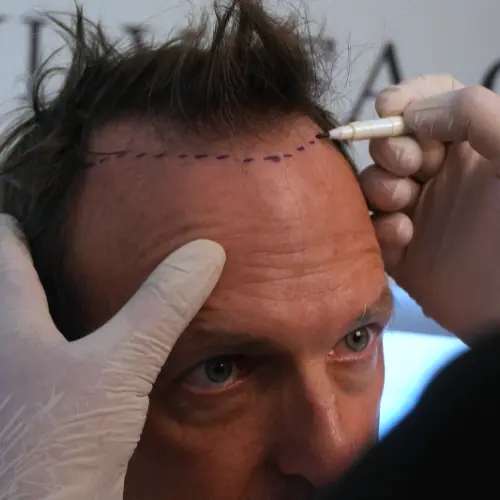
- Natural Hairline Design: Creating a natural-looking frontal hairline is one of the most important parts of a Norwood 5 hair transplant. Since hair loss at this stage is more advanced, the new hairline must be designed carefully according to the patient’s facial structure, age, and donor capacity. The goal is not only to restore hair, but also to achieve a balanced and realistic appearance.
- High-Density Results with Vita Technique®: Vita Technique® is a microscopic planning method developed to achieve both higher density and a more natural appearance in hair transplantation. The donor area is divided into specific zones based on graft thickness and quality, allowing single grafts to be used for a softer frontal hairline and thicker grafts for stronger density in the crown and middle areas. This technique helps protect the donor area while creating balanced, dense, and long-lasting results, especially for advanced Norwood Type 5 cases.
- Free Online Consultation and Personalized Graft Analysis: Every Norwood 5 case is different, which is why a personalized graft analysis is essential before surgery. A free online consultation helps evaluate the level of hair loss, donor area strength, and the estimated number of grafts needed. This allows patients to receive a realistic treatment plan before making a final decision.
Advanced stages often need more grafts than a single technique handles best, which is why FUE and DHI are sometimes combined in one plan. See how the combined FUE and DHI hair transplant works at Istanbul Vita, with graft ranges and package prices.
Frequently Asked Questions
Is Norwood Type 5 too late for a hair transplant?
No, Norwood Type 5 is not too late for a hair transplant. Although hair loss is already advanced at this stage, many patients can still achieve successful results if the donor area is strong enough. The key factor is the quality and availability of healthy grafts, not only the stage of hair loss itself.
Can Norwood Type 5 progress to Norwood 6 quickly?
Yes, if hair loss continues without treatment, Norwood Type 5 can progress to Norwood 6 over time. The speed of progression depends on genetics, hormone levels, age, and whether the patient receives medical treatment such as finasteride or minoxidil.
Is Norwood Type 5 reversible naturally?
No, Norwood Type 5 is usually not reversible naturally. At this stage, hair loss is already significant, and natural methods cannot restore lost density or rebuild the hairline. Medical treatments may help slow further loss, but hair transplantation is often the most effective option for visible restoration.
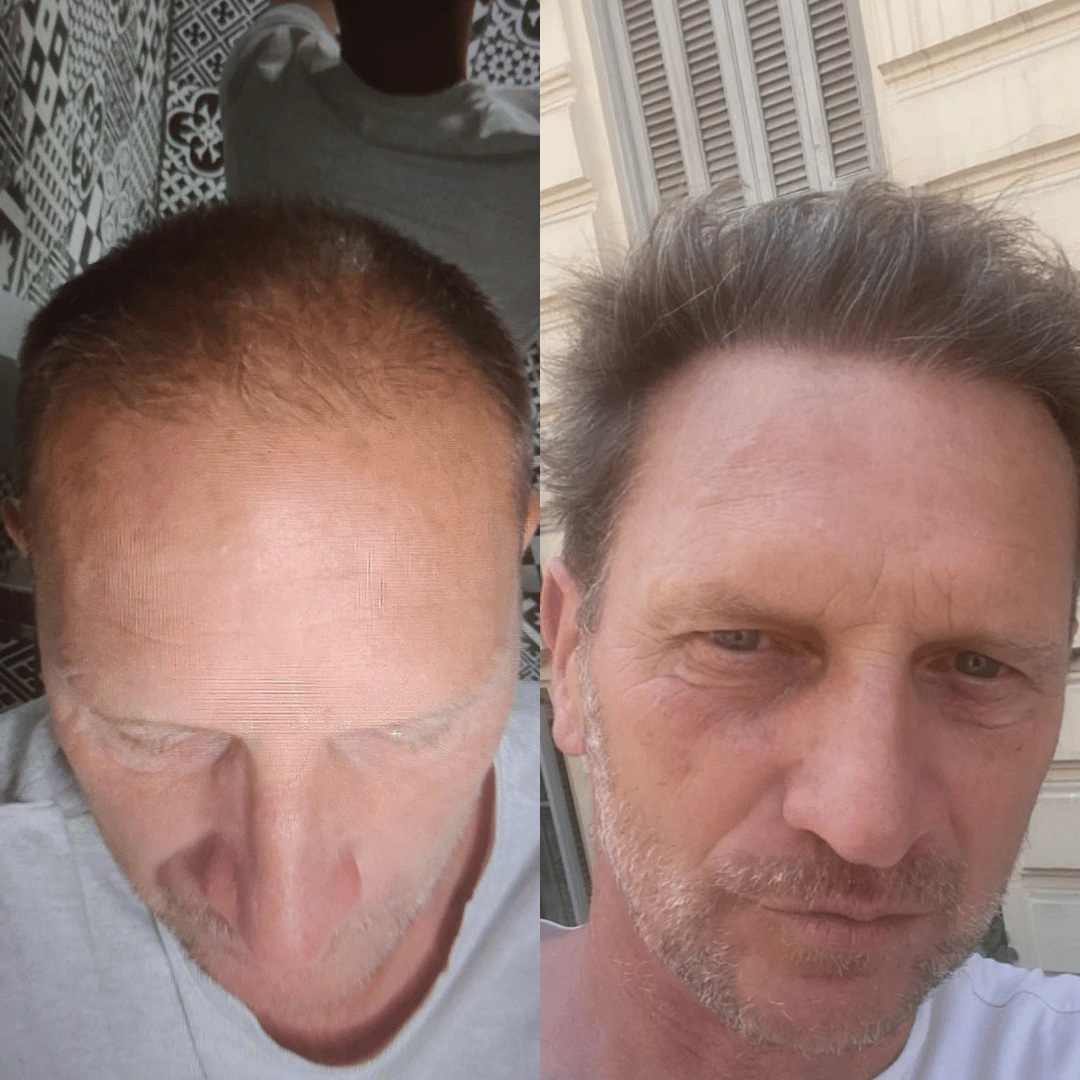
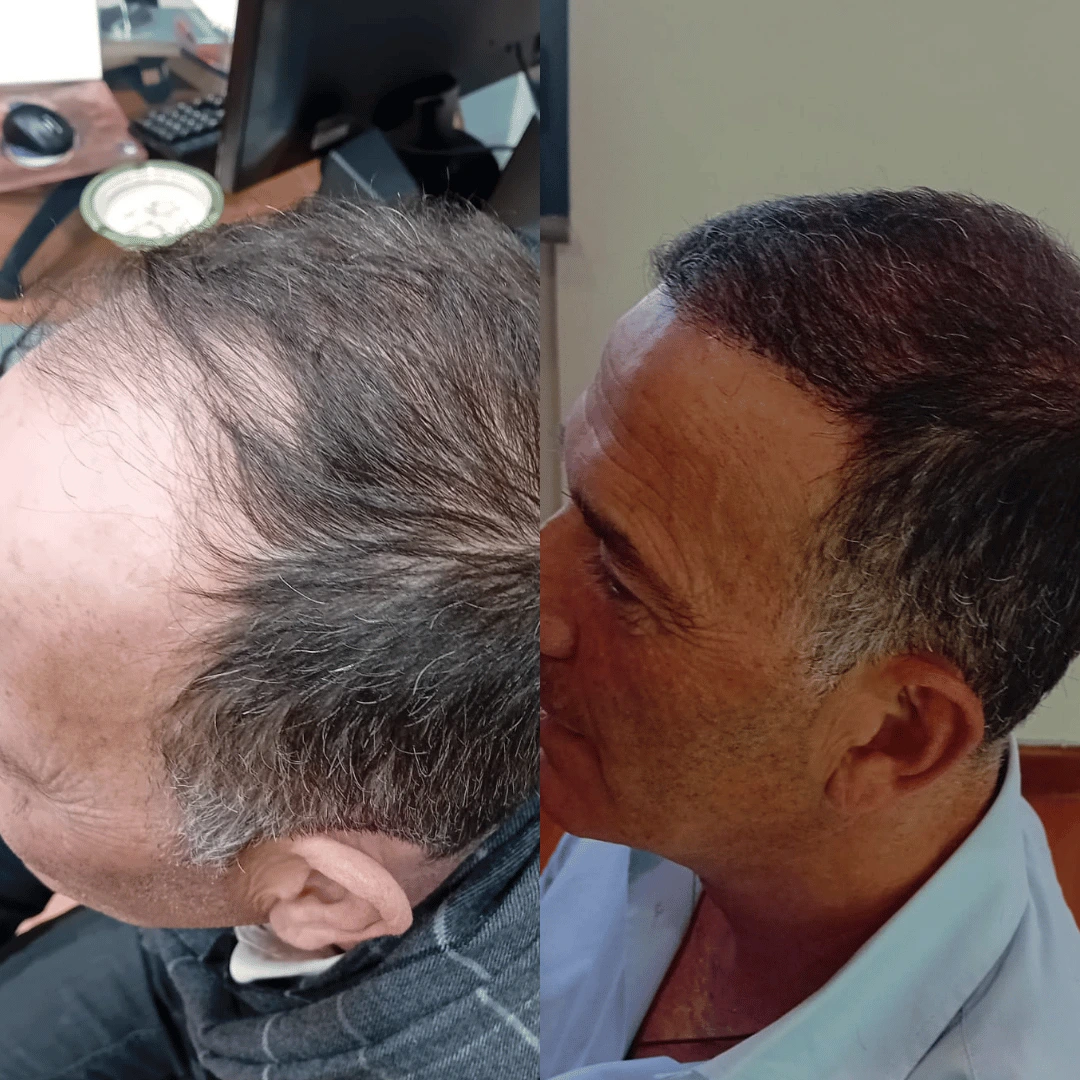
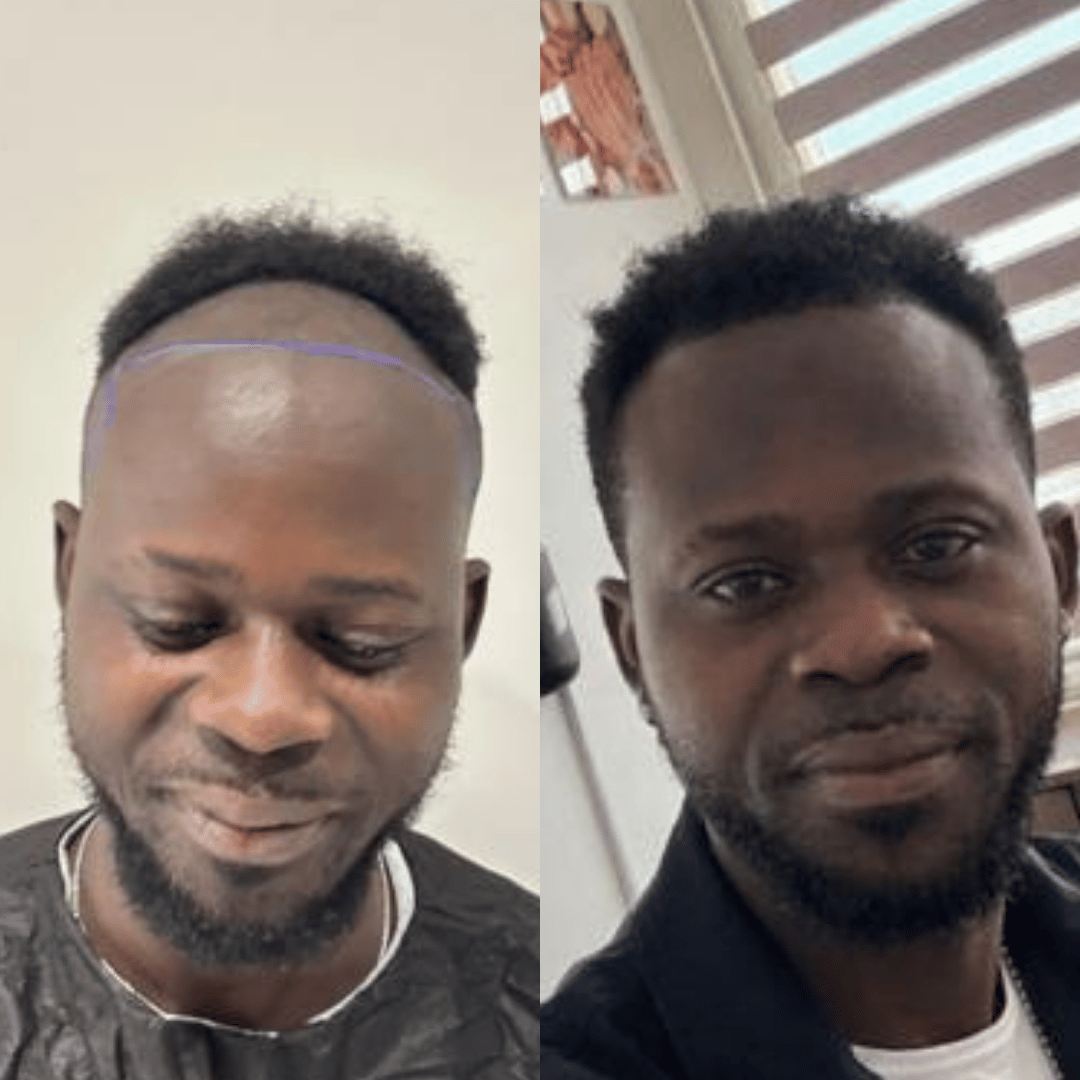
Real Norwood 5 Hair Transplant Results
These are Istanbul Vita patients graded at this stage before surgery, photographed before the procedure and at the result. Graft numbers and technique differ with donor capacity and goals.
 conversation


