
 Deutsch
  English
  Español
  Français
  Italiano
  Română
  русский
  Türkçe
Table of Contents
TDF Hair Transplant: The Two-Day Approach
A TDF hair transplant (Two-Day FUE) is a hair transplant technique performed on two consecutive days. It is designed for patients with extensive hair loss who need more coverage than one session can reasonably deliver. Grafts are extracted with FUE. What defines TDF is the two-day surgical protocol: how extraction, graft handling and implantation are split between the days.
The main practical benefit is simple. A large treatment plan can be completed in a single trip. For suitable patients, this can avoid the need for a separate staged procedure and another trip months later.
Two days do not automatically mean better results. They also do not create extra donor hair. Whether TDF fits depends on hair loss, donor capacity, the size of the treatment area and the number of grafts required.
What Is a TDF Hair Transplant?
A TDF hair transplant is an FUE-based technique carried out across two consecutive treatment days. Individual follicular units are taken from the donor area. They are implanted into areas affected by hair loss.
The technique is usually considered when the frontal area, mid-scalp and crown all need treatment. Covering these areas in one day is often not realistic. Splitting the work into two days allows a larger plan to be completed in one visit.
What Does TDF Stand For?
TDF stands for Two-Day FUE. At Istanbul Vita, TDF is the technique used for larger treatment plans that are better organized across two consecutive days.
You may also see it called the TDF technique, the Two-Day FUE method or a two-day hair transplant.
How Is TDF Different From Standard FUE?
TDF uses FUE extraction. Follicular units are still removed one by one from the donor area and placed into the recipient area.
The difference is the protocol. Standard FUE is usually completed in one treatment day. TDF divides the donor area, the extraction and the implantation across two days according to a set plan. This is what allows a larger area to be treated without a second trip months later.
Why Is a TDF Hair Transplant Performed Over Two Days?
Some treatment plans involve more surgical work than fits comfortably into one session. High graft requirements, extensive hair loss and large recipient areas all push a plan in that direction.
The number of days is one part of the plan. Donor capacity, recipient-area needs and the patient's own characteristics matter just as much.
High Graft Requirements and Extensive Hair Loss
Patients with advanced hair loss may need coverage across the hairline, mid-scalp and crown. A bigger recipient area means more grafts. It also means more extraction, graft handling and implantation.
Spread over two days, this workload becomes manageable. The surgical team can keep the same level of care on the second day as on the first.
A high-graft plan still has to fit the donor supply. A large bald area does not mean an unlimited number of grafts can be taken.
No 8–12 Month Wait Between Sessions
Patients who require very large coverage may sometimes be treated in separate staged procedures. In these cases, the second operation is performed after an appropriate healing interval, often 8–12 months later, which means returning for another trip.
For suitable patients, TDF allows the planned treatment to be completed across two consecutive days within the same trip. For international patients, this can mean one flight, one stay and one recovery period instead of returning for a separate operation.
This does not suit everyone. If the donor area cannot support the full plan, a staged approach may still be the safer choice.
Does Two-Day FUE Create More Donor Hair?
No. A second day in the chair doesn't add a single graft to your donor supply. Every transplanted follicle still comes from the patient's own donor area.
The second day changes the schedule. It does not change how much donor hair is available. That is why donor assessment is central to planning a TDF hair transplant.
How Does a TDF Hair Transplant Work?
TDF follows the main stages of FUE: consultation and planning, donor assessment, graft extraction, graft handling, recipient-site preparation and implantation. The difference is how these stages are split across the two days.
Consultation and Treatment Planning
Planning starts with an assessment of hair loss, the donor area, the recipient areas and the patient's goals.
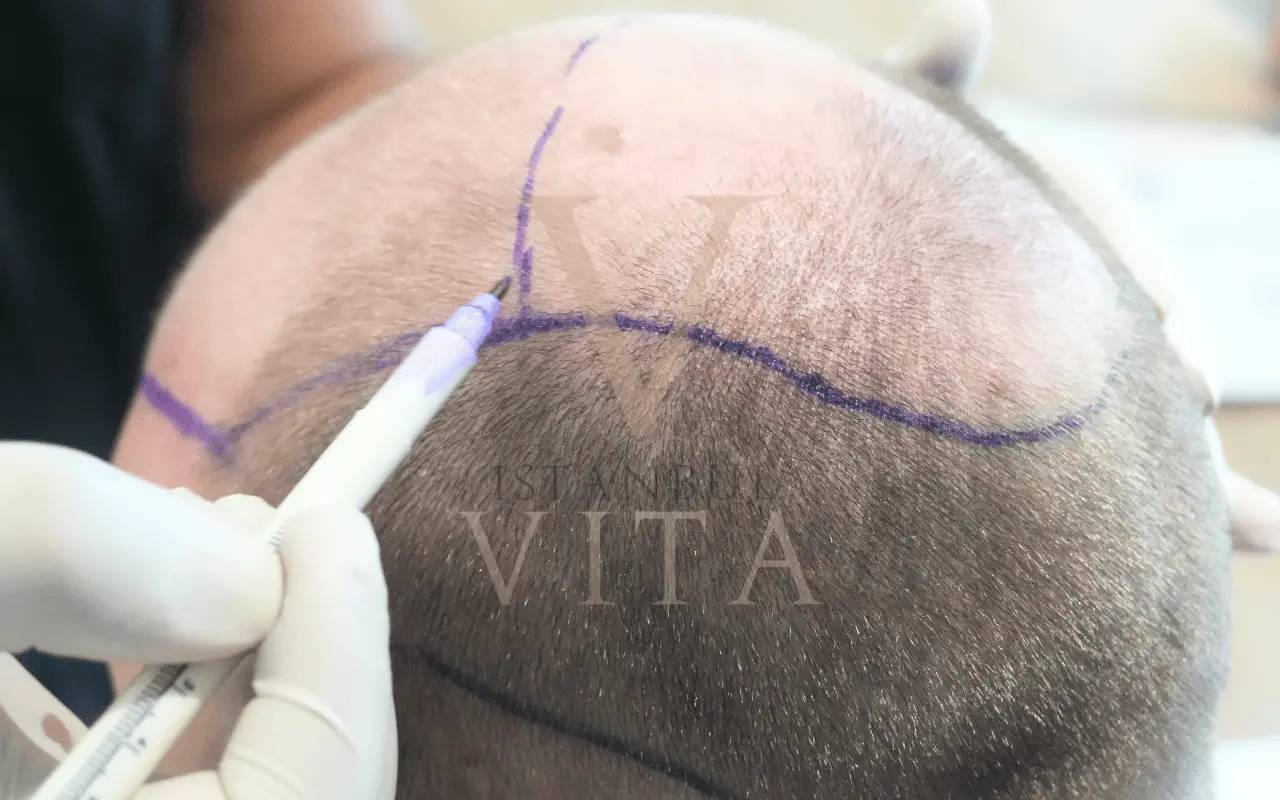
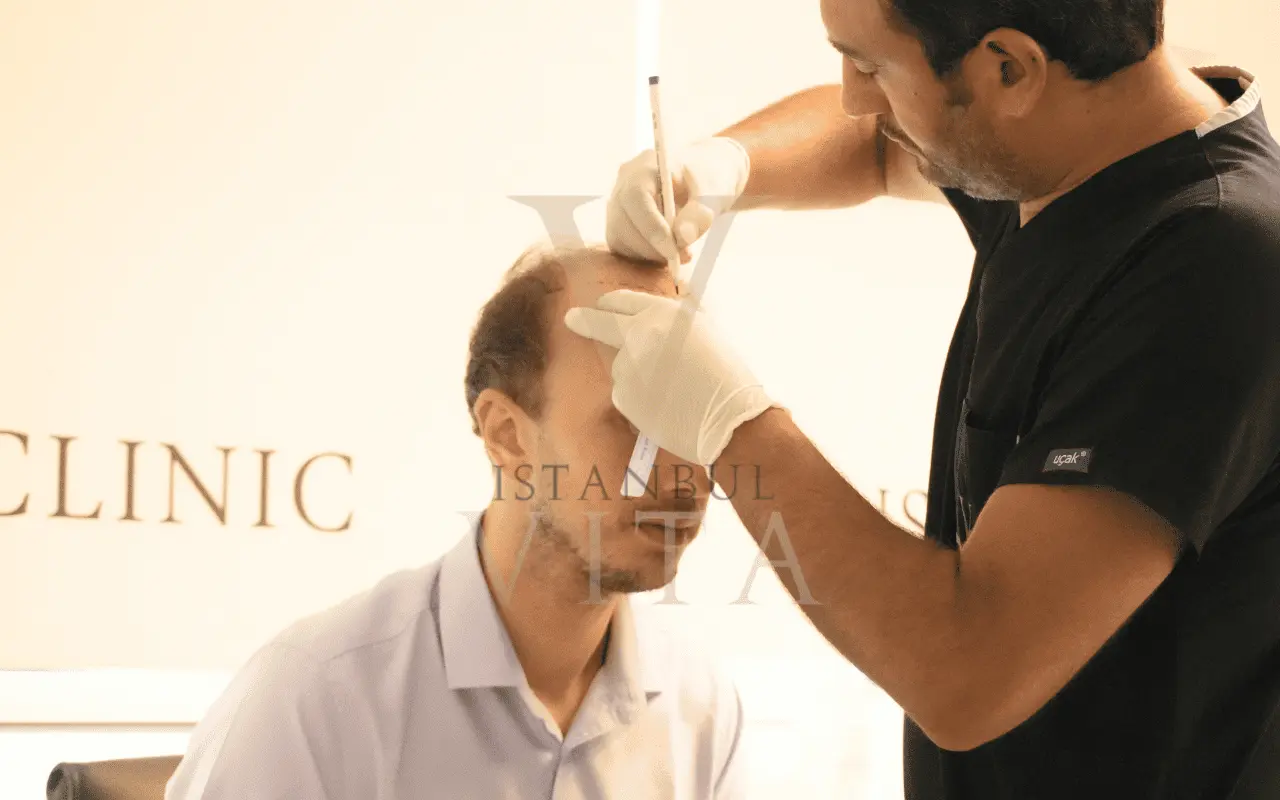
Your doctor takes a close look at the back and sides of your head: how dense the hair is, what it's like, how many grafts can be spared. Then the thinning area. Which parts get treated, and how full can they realistically look?
This is also when your new hairline gets drawn and the doctor decides where the grafts will go. So is the split between Day 1 and Day 2. The plan should reflect the individual patient, not a fixed graft number.
Graft Extraction, Handling and Implantation
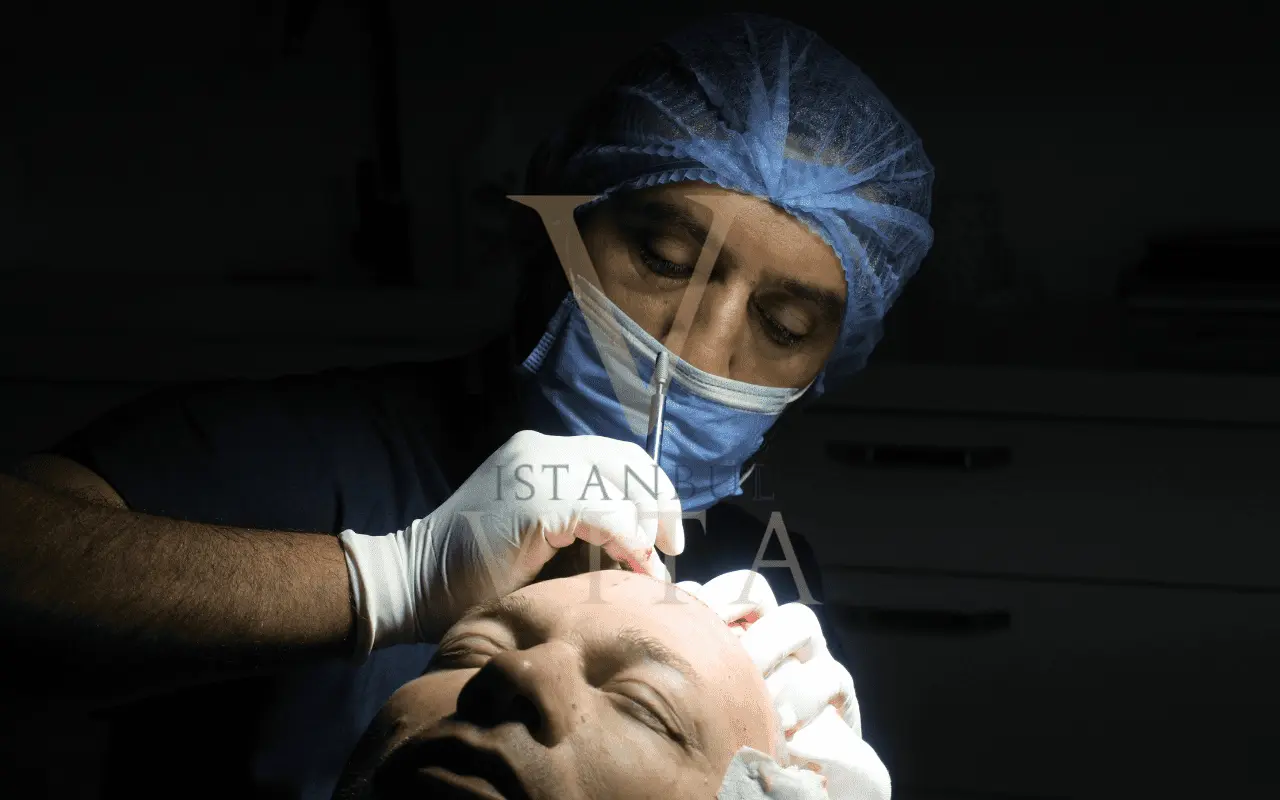
Follicular units are removed from the donor area according to the plan. They are then sorted and prepared for transplantation.
Recipient-site preparation depends on the treatment plan. In Sapphire FUE areas, channels are opened by the doctor with sapphire blades according to the planned hairline, direction, angle and coverage. Depending on the plan, TDF can follow the Vita Technique®, with microscopic donor analysis and zone-based graft selection, or be combined with DHI in the Combined FUE & DHI Method, where selected grafts are implanted using the DHI method. Your doctor decides this during planning based on the recipient area and the density being targeted.
Graft handling matters throughout. A follicle out of the scalp is fragile. It has to be kept in good condition until the moment it is implanted.
Day 1: What to Expect
The morning begins with prep. Both areas are made ready, and local anesthesia numbs the scalp before any grafts are taken.
In a typical TDF plan, the donor area is divided into two sides. Grafts are extracted from one side on Day 1. These are implanted into the first planned region, often the hairline and frontal area, where natural design matters most.
The rest of the recipient area is left for the next day. By the end of Day 1, roughly half of the procedure is complete.
You receive postoperative instructions before leaving. They cover care of the donor and recipient areas overnight.
The Night Between Treatment Days
After Day 1, you head back to your hotel and take it easy. Stay nearby. Sleep the way you've been shown, keep the treated areas from rubbing against anything and skip anything strenuous.
Some tightness or mild soreness that night is normal. Take pain relief only as your medical team has told you.
Day 2: What to Expect
The second day opens with a look at yesterday's work.
Then the team moves to the other side of the donor area, the side nobody touched on Day 1. The remaining recipient area is treated according to the planned technique. In Sapphire FUE areas, channels are opened that day, while selected areas may be treated with DHI when this is part of the plan. The new grafts are then implanted accordingly.
Once the plan is complete, aftercare instructions are reviewed again. The exact split between the two days varies from patient to patient.
| Stage | Day 1 | Day 2 |
|---|---|---|
| Donor side | First side | Other side, untouched on Day 1 |
| Recipient area | Often the hairline and frontal area | The remaining area, such as mid-scalp and crown |
| Recipient-site preparation | According to the planned technique | According to the planned technique |
| Grafts | Extracted and implanted the same day | Extracted and implanted the same day |
| Ends with | Overnight care instructions | Full aftercare instructions |
Who Is a Suitable Candidate for a TDF Hair Transplant?
Suitability is decided through individual assessment. Graft count or duration alone does not decide it.
The assessment looks at the hair loss pattern, donor capacity, recipient areas, hair characteristics, goals and the amount of work required.
Extensive Hair Loss and Larger Graft Requirements
TDF is most often considered for patients whose frontal area, mid-scalp and crown are all affected. These plans involve a larger recipient area and a higher graft requirement.
Patients who want to complete a large plan in one trip, rather than two operations months apart, may also be considered when their donor area allows it.
Donor Capacity and Individual Assessment
Donor capacity is one of the most important factors in any hair transplant.
The donor area has to contain enough usable follicular units for the planned treatment. It also has to leave room for a realistic approach to future hair loss.
Donor density, hair characteristics, available grafts and the size of the recipient area are all part of the assessment. TDF is not defined by a set number of grafts. The right plan is decided case by case.
When TDF May Not Be the Right Choice
TDF is not for everyone. It may not suit you if:
- your donor area is too thin to support a large plan
- you are young and your hair loss is still progressing quickly
- your thinning is spread across the whole scalp, including the back and sides
- you have a health condition that rules out elective surgery
- your expectations go beyond what your donor area can deliver
In these cases a smaller one-day plan, a staged approach or medical treatment may fit better. Some patients are not candidates for a hair transplant at all. An honest assessment should tell you that too.
How Many Grafts Can Be Transplanted With TDF?
There is no universal graft number for a TDF hair transplant. The right figure depends on donor capacity, extent of hair loss, recipient-area size, hair characteristics and coverage goals.
TDF plans usually involve more grafts than a standard one-day session. Some clinics advertise fixed totals. A responsible plan starts from the donor area instead.
What Determines the Graft Count?
The number of grafts in a TDF plan may depend on:
- donor density and available donor capacity
- the size of the recipient area
- the pattern and extent of hair loss
- hair characteristics
- the level of coverage required
- the patient's overall goals
A larger recipient area may need more grafts. The donor area still sets the practical limit.
More grafts do not automatically mean a better result. The aim is to use donor hair well, reach realistic coverage and keep the donor area healthy.
TDF vs One-Day FUE
The main difference is the schedule and the protocol behind it. One-Day FUE is completed in one treatment day. TDF is organized across two consecutive days.
Side by Side: One Day vs Two
In One-Day FUE, all planned surgical work happens in one day.
With TDF, the donor area is usually split in half, and each day covers its own part of the recipient area.
| Factor | Standard FUE | TDF (Two-Day FUE) |
|---|---|---|
| Treatment days | 1 day | 2 days in a row |
| Best for | Small to moderate treatment plans | Larger treatment plans and extensive hair loss |
| Areas treated | Often one or two areas | May include hairline, mid-scalp and crown |
| Donor area | Harvested in one session | Split between two treatment days |
| Large coverage | May require a separate staged procedure | May allow a larger plan to be completed in one trip |
| Extraction method | FUE | FUE |
| Graft limit | Set by the donor area | Set by the donor area |
Some things stay the same either way. Both use FUE extraction. In both, the donor area caps how many grafts you can get. And both start with an individual assessment.
Have Questions? Let's Chat on WhatsApp!
Get instant answers 24/7. Receive your doctor-led hair analysis within 1 day, plus pricing and booking support.
Start WhatsApp ChatDoes TDF Mean Better Results?
No. A TDF hair transplant does not automatically produce better results than One-Day FUE.
Outcomes depend on patient selection, donor characteristics, graft handling, recipient-site planning, implantation and aftercare. The number of days is one piece of that.
Is a TDF Hair Transplant Safe?
Safety depends on patient selection, planning, surgical technique, graft handling and aftercare. The number of treatment days alone does not decide it.
Like any surgical procedure, FUE carries potential risks. These include swelling, bleeding, infection, scarring and, in some cases, poor graft growth.
Some side effects are common and usually temporary. Shock loss is one. Existing hairs near the treated area may shed in the weeks after surgery. They typically grow back within a few months. It is more likely when grafts are placed between existing hairs. Numbness in the donor or recipient area usually settles within a few months. Folliculitis may also appear: small pimple-like bumps where new hairs push through the skin. Tell your team if it happens. It is usually easy to manage.
What Can Affect Safety and Outcomes?
The donor area should be assessed properly. Extraction should be careful. Follicles need correct handling. Implantation should follow the planned design.
Aftercare matters too. A two-day schedule does not by itself decide graft survival or the final result. The overall process and the patient's own circumstances matter more.
Graft Handling and Preservation
After extraction, follicular units need to be preserved until they are implanted. Their condition throughout extraction, preparation and implantation affects how well they survive and grow.
In TDF, each day's grafts are extracted and implanted within that same day's surgical workflow. No grafts are stored overnight, allowing graft handling and out-of-body time to be managed separately on each treatment day.
Recovery and Results After a TDF Hair Transplant
Recovery is gradual. Most of the surface healing, on the back and on top, is done within the first few weeks. Hair growth develops over the following months.
Recovery after TDF is broadly similar to a standard FUE procedure. The exact timeline varies and should follow the clinic's aftercare instructions.
First Few Days and First Week
The first days are about protecting the donor and recipient areas while the scalp begins to heal.
Redness and swelling are common early on. Handle the scalp only as instructed.
Healing continues through the first week. Follow the washing, sleeping and activity instructions from your clinical team. There is no single schedule that fits every patient.
Shedding and Hair Growth
Temporary shedding can happen after FUE. It does not mean the transplant has failed.
Some existing or transplanted hairs may fall out in the weeks after treatment. The follicles stay in the scalp. New growth appears as they enter a new growth cycle.
When Will You See the Results?
Around month 4, you may spot the first new hairs. By months 6 to 9, most people see a clear change in the mirror. Growth and maturation can continue for up to 12 months. The crown is slower. Grafts there often need 12 to 18 months to reach their final look. Many TDF plans include the crown, so judge that area last.
| Time after TDF | What to expect |
|---|---|
| First few days | Early healing and postoperative care |
| First week | Donor and recipient areas keep healing |
| Following weeks | Temporary shedding may occur |
| Around month 4 | Early new growth may become visible |
| Months 6–9 | Noticeable growth and improvement |
| Up to 12 months | Further growth and maturation |
| 12–18 months | Crown results continue to mature |
Growth cycles differ between patients. Judge TDF results over months, not during early recovery.
When Should You Contact Your Medical Team?
Call the clinic if pain is getting worse instead of better, if bleeding won't stop or if swelling keeps spreading. The same goes for redness, heat or discharge around the treated areas, anything that looks like infection, or any change in the donor or recipient area you weren't told to expect.
If something feels off, don't wait it out. Ask your team.
TDF Hair Transplant Results: What to Expect
Your result shows up slowly, one growth cycle at a time. The final outcome becomes clearer over several months.
How the result looks depends on donor characteristics, hair loss pattern, graft placement, healing and individual hair growth.
Before-and-after photos are a useful reference. Results vary between patients and cannot be guaranteed.
Want to see a relevant patient case? Explore the Istanbul Vita Two-Day FUE case study to see the treatment approach and documented result.
Want to see more hair transplant results? Explore the Istanbul Vita Before & After Gallery for more patient results across different cases.
Does a TDF Hair Transplant Leave Scars?
Yes, but they're small. FUE leaves tiny dot-like marks in the donor area. On some people they're easier to see than on others.
FUE takes follicles one at a time. Nothing is cut out as a strip, so there's no long line across the back of the head. What's left is a scatter of small extraction points.
What Kind of Scarring Can Occur?
FUE does not guarantee completely invisible donor marks for every patient.
Extraction sites may heal as tiny marks. How much they show comes down to your donor area and how your skin heals. Claiming that FUE leaves no marks at all would be inaccurate.
What Influences Donor-Area Marks?
The number and spread of extracted grafts, the way the donor area heals and individual skin characteristics all affect how visible marks become.
Planning how many grafts to take, and from where, goes a long way toward keeping them hard to spot.
TDF Hair Transplant Cost in Turkey
A TDF hair transplant at Istanbul Vita starts at €3,500.
Where your price ends up depends on your plan: how much work it involves and how the two days are set up.
What Factors Affect the Cost?
The final price may depend on:
| Factor | Why it matters |
|---|---|
| Number of grafts | More grafts mean more surgical work |
| Scope of the treatment | Larger areas take more time |
| Number of surgical days | Two days may need more resources |
| Medical team | Who performs each stage |
| Treatment plan | How the work is structured |
| Package services | What's included beyond the procedure |
Depending on the package, services may include consultation and planning, the procedure, accommodation, transfers, medication and postoperative support. Confirm what is included in your own plan.
When comparing TDF hair transplant costs in Turkey, look at the whole plan. A headline price or a fixed price per graft tells only part of the story.
Is TDF More Expensive Than One-Day FUE?
Not necessarily. Two treatment days do not automatically mean a higher price.
Cost depends on graft requirements, treatment scope, the medical team, procedure structure and included services. A two-day schedule may need more resources in some cases. The final price follows the individual plan.
Compared with two separate operations, TDF can also reduce travel costs. One trip replaces two.
TDF Hair Transplant in Turkey: What Should International Patients Consider?
If you are considering a TDF hair transplant in Turkey, look at the medical plan, donor assessment, graft planning, aftercare and included services. The number of treatment days and the headline price are not enough.
Recovery continues after you leave the clinic. The practical side of treatment matters for patients traveling from the US and elsewhere.
How Long Should You Stay in Istanbul?
Plan for more than the two treatment days. Your stay should cover the clinical consultation and final planning, both treatment days, and the postoperative check and first wash before you fly home.
| Stage | What happens |
|---|---|
| Before treatment begins | Clinical consultation and final planning |
| Day 1 | First treatment day |
| Night between | Rest near the clinic |
| Day 2 | Second treatment day |
| Before flying home | Follow-up check and first wash |
Your clinic should confirm the exact itinerary before you book flights.
Choosing a Clinic for TDF in Istanbul
Look at who performs the procedure, how the donor area is assessed and how clearly the plan is explained.
A transparent plan should explain:
| What the plan covers | Why it matters |
|---|---|
| Expected graft count | Shows the plan fits your donor area |
| Areas planned for treatment | Tells you what will and won't be covered |
| Available donor capacity | Sets realistic limits |
| How the work is split across two days | Shows how the TDF protocol applies to you |
| Included services | Avoids surprise costs |
| Postoperative support | Matters once you're back home |
The number of treatment days alone is not a measure of quality.
TDF at Istanbul Vita
At Istanbul Vita, each TDF plan starts with a clinical assessment. The doctor evaluates the hair loss pattern, donor density and the extent of the recipient area. Graft numbers follow from these findings. They are not set in advance.
Both the donor and recipient areas are divided between two consecutive treatment days. On each day, follicular units are harvested from one side of the donor zone and implanted the same day. No grafts are kept overnight, which keeps out-of-body time short and supports graft viability.
The technique used for recipient-site preparation depends on the treatment plan. In Sapphire FUE areas, channels are opened by the doctor with sapphire blades according to the planned angle, direction and distribution. DHI may be incorporated for selected areas when a Combined FUE & DHI plan is used.
Donor preservation guides the entire plan. The donor supply is finite, and hair loss may progress over the years. Harvesting is kept within what the donor area can safely provide, so future treatment options are not compromised.
Hair transplanted from a stable donor area is generally more resistant to further hair loss, while native hair in untreated areas may continue to thin over time. Your doctor can discuss medical treatment options to help protect your native hair. This is part of long-term planning, not an extra.
Aftercare and Follow-Up
Clear aftercare instructions and accessible follow-up matter most for international patients.
Before traveling, find out what aftercare is included, how questions are handled once you are home and what follow-up is available.
Whether you choose a TDF hair transplant in Istanbul or another FUE-based procedure, keep expectations realistic about recovery, hair growth and the gradual development of results.
Have Questions? Let's Chat on WhatsApp!
Get instant answers 24/7. Receive your doctor-led hair analysis within 1 day, plus pricing and booking support.
Start WhatsApp ChatFrequently Asked Questions About TDF Hair Transplant
What Does TDF Mean in Hair Transplantation?
TDF stands for Two-Day FUE. It's a hair transplant done over two days in a row. Grafts are taken one by one with FUE, and the work is split between the two days, so a large bald area can be covered in a single trip.
Is Two-Day FUE the Same as FUE?
TDF uses FUE extraction. Follicular units are taken individually from the donor area and implanted into the recipient area. The difference is the two-day protocol that allows a larger area to be treated in one visit.
Why Does a TDF Hair Transplant Take Two Days?
TDF is planned over two days when the treatment involves a high graft requirement, extensive treatment areas or a surgical plan better organized across two sessions. The decision depends on the individual case.
Why Not Just Have Two Separate Sessions?
Separate staged procedures may require the patient to return months later, often after 8–12 months, once the first treatment has healed. TDF completes the larger treatment plan in one visit when the donor area and the individual case allow it. For some patients, a staged approach may still be more appropriate.
Which Areas Are Treated on Which Day?
This depends on the plan. Often the hairline and frontal area come first on Day 1. The remaining area is treated on Day 2 according to the planned technique, which may include Sapphire FUE channel opening or DHI for selected areas.
Does Two-Day FUE Increase Donor Capacity?
No. The extra day adds time, not hair. Your donor area still decides how many grafts you can have.
How Many Grafts Are Needed for a TDF Hair Transplant?
There is no fixed number. It depends on hair loss, recipient areas, desired coverage, hair characteristics and available donor capacity.
Is a TDF Hair Transplant Painful?
The procedure is performed under local anesthesia. Most patients feel the anesthetic injections and then pressure rather than pain. Mild discomfort after each day is managed with the medication provided.
Can I Go Out Between the Two Treatment Days?
Better not. Spend the evening resting near the clinic, keep physical effort to a minimum and stick to the instructions you got at the end of Day 1.
How Long Does a TDF Procedure Take?
Duration varies with graft count, treatment areas and the individual plan. The exact schedule of each day differs from patient to patient.
How Long Is Recovery After TDF?
The scalp settles within a few weeks. The hair itself takes months. Recovery is broadly similar to standard FUE and should follow the clinic's instructions.
When Can I Return to Work After TDF?
Most people with office or remote jobs go back within a week. Scabs and redness can still be visible then, so some take a few extra days off, or wear a loose hat if it's allowed. Physical work is different. Heavy lifting, sweating and dusty sites put the grafts at risk, so plan on about two weeks off. Your doctor will set the date at your follow-up, based on how your scalp is healing.
Does a TDF Hair Transplant Leave Scars?
FUE can leave small extraction marks in the donor area. How noticeable they are depends on how your skin heals and on your donor area.
Is TDF More Expensive Than One-Day FUE?
Not necessarily. The final cost depends on graft requirements, treatment plan, medical team, procedure structure and included services. It is not decided by the number of treatment days alone.






 conversation


