
 English
  Français
Table of Contents
An Afro hair transplant, also called an African American hair transplant or a Black hair transplant in the US, is a procedure adapted to tightly coiled, Afro-textured hair, where the follicle curves under the skin and a standard punch can cut the root. It works when the surgeon matches the punch and the extraction angle to that curve. An Afro hair transplant in Turkey typically costs $2,000-$5,500 as an all-inclusive package (indicative range, 2026). At Istanbul Vita the price is a fixed package, $2,500, $3,200 or $4,000, and it does not change with the number of grafts.
The free online analysis is the first step: the doctor reviews your photos and replies with a treatment plan and a graft estimate.
Can Black People Get a Hair Transplant?
Yes, Black people can get a hair transplant, and the result depends on three things: a surgeon who adapts the extraction to the curved follicle, a donor area with enough healthy hair, and hair loss that has stopped progressing or is under control.
The curve is the challenge. In Afro-textured hair the follicle bends under the skin, so a punch pushed straight in along the visible hair can cut through the root before it is out. Our doctors work around this with a slightly wider punch, a shallow first cut and an extraction angle that follows the hair, by hand where the curl demands it. The same adaptations have been studied: in a multicenter series that used punches shaped for the curve, transection stayed in the low single digits, 3-6% on average across seven clinics and 64 patients.
The procedure works. What a clinic has to answer is who does the extraction and how it is adapted. At Istanbul Vita the doctor plans the case, opens every channel and supervises extraction and placement.
Who Is a Good Candidate
Most good candidates share four things:
- Pattern hair loss (androgenetic alopecia) at the hairline, temples or crown. This is the most common reason men come to us, and it responds well.
- A stable pattern. Hair loss that is still progressing fast makes planning unreliable.
- A donor area at the back and sides with healthy, stable density. The transplanted hair comes from here, so this is the supply.
- Realistic expectations: a natural hairline and solid coverage, not maximum density.
Two situations specific to Afro-textured hair also qualify, with conditions. Late-stage traction alopecia, where the edges have thinned to smooth skin and have not regrown after the tension stopped, can be treated with a transplant, and at that stage surgery may be the only effective option. Central centrifugal cicatricial alopecia (CCCA), a scarring hair loss seen mostly in Black women, can be transplanted case by case once the disease has been quiet under treatment.
Bad Candidates and Who Should Wait
Some patients should wait, and some should not have a transplant at all:
- Active traction alopecia. If the tension is still there (tight braids, weaves, ponytails, locs that pull at the edges), the first step is to stop it. Early-stage traction alopecia can regrow on its own once the pulling stops, and surgery into a scalp that is still being pulled does not hold.
- Active CCCA or any other active scarring alopecia. Tenderness, scaling or a thinning patch that keeps spreading from the crown are signs of active disease, and treatment comes before surgery.
- A history of keloids. Keloid and hypertrophic scars are more common in Black patients (2.4% versus 0.4% in a UK study of 230,000 people), but they are not expected in every Black patient. We ask about old scars, examine them and decide case by case; in some cases we advise against surgery.
- A thin donor area. If the thinning includes the back and sides, there is not enough donor hair to transplant.
Hair Transplant for Black Men: Hairline, Crown and Fade Haircuts
Most men with Afro-textured hair come to us for a receded hairline or a thinning crown from pattern hair loss, and the plan is built around the hairline shape and the density that suit coiled hair.
Many of our Black patients ask for a straighter, more defined hairline with squarer corners at the temples, and the curl lets a natural result sit at a lower density than straight hair needs. We draw the line with you on the morning of surgery and plan it for the long term, because the hair behind the new line can keep thinning.
A note for patients who wear a fade. FUE leaves small dot scars where the grafts were taken, and the punches used for Afro-textured hair are a little wider, so the dots are a little larger. In our experience they blend into darker skin, and a number 1 or 2 guard usually hides them. A skin fade in the first months after surgery is not realistic, and a very low fade may show the dots later. Many of our patients wear a fade, so we discuss this before booking.
The areas we treat most often in men, with the graft range and the technique for each. These are planning ranges from our own cases, not quotes, and at Istanbul Vita the graft count does not change the package price.
| Area | Typical graft range | Technique we usually use | What decides it |
|---|---|---|---|
| Hairline and temples (frontal recession) | 1,000-2,000 grafts | Sapphire FUE; DHI for the front edge in selected cases | Hairline shape, donor density, how low you want the line |
| Temple points only | 500-900 grafts | Sapphire FUE | Angle of the existing hair, face shape |
| Crown (whorl) | 1,000-1,800 grafts | Sapphire FUE | Size of the whorl, donor supply, whether the front is done |
| Front and crown together | 3,000-4,500 grafts | Sapphire FUE, often in two sessions | Donor supply; the front comes first |
| Edges after late-stage traction alopecia (locs, braids, tight cuts) | 500-1,200 grafts | Sapphire FUE; DHI in selected cases | Tension must have stopped; donor at the back must be healthy |
Why Afro-Textured Hair Is Different
Afro-textured hair (type 4 hair, from 4A to 4C) is different for a hair transplant because the follicle curves under the skin, so the tools and the pace of the surgery have to change with it.
In this video, our doctor explains the three things that change the plan for Afro-textured hair: the curved follicle, the punch and the extraction angle.
The Curved Follicle and Transection Risk
The curl starts at the root. The follicle of Afro-textured hair curves under the skin, and the hair leaves it already bent. A standard FUE punch is a small straight cylinder. Pushed in along the angle of the hair above the skin, it can slice a root that bends away below it.
Three adjustments lower that risk:
- A slightly wider punch, up to about 1.3 mm, where FUE punches generally run 0.75-1.25 mm.
- A shallow first cut, so the punch frees the top of the follicle without chasing the curve.
- An extraction angle that follows the hair as it exits the skin, graft by graft, which is why the extraction is done by hand where the curl demands it.
With punches shaped for the curve, the multicenter series reported transection of 3-6%, and it added a useful finding: the thickness and firmness of the scalp predicted difficulty better than how tight the curl was. The skin is part of the plan, not only the hair.
This is why extraction takes longer in Afro-textured hair, and why we do not plan it by grafts per hour. Transection is not visible on the day of surgery; it shows at month 12 as hair that never grew.
Density, Growth Rate and Why Each Graft Covers More
Afro-textured hair grows at a lower density and more slowly than straight European hair. In a comparative study, the donor area carried about 190 hairs per cm² versus about 227, roughly 16% fewer, and the hair grew about 256 µm a day versus 396, roughly 35% slower.
The curl has an advantage. Because coiled hair covers more scalp per strand, the same number of grafts looks fuller than it would in fine, straight hair. The number of grafts still depends on the area, the pattern and your donor supply. Two expectations follow. Donor planning is more conservative, because the supply is a little smaller. And the result shows later, because the hair grows more slowly and a coil sits close to the scalp. The result should be judged at 12-18 months, not at six.
What Changes in a Hair Transplant for Afro Hair
Each difference in the hair changes one step of the surgery or one expectation afterward. The curve decides the punch and the angle, the density and the growth rate shape the donor plan and the timeline, and the skin sets the rules for scar risk and sun protection.
| Feature | Afro-textured hair | What it changes in surgery |
|---|---|---|
| Follicle shape | Curved under the skin | Punch size and angle matched to the curve; slower, often manual extraction |
| Donor density | About 190 hairs per cm² versus about 227, roughly 16% lower | More conservative donor planning |
| Growth rate | About 256 µm a day versus 396, roughly 35% slower | Visible length comes later; judge the result at 12-18 months |
| Coverage per graft | A coil covers more scalp per strand | The same graft count looks fuller than in straight hair |
| Skin | Keloid and hypertrophic scars in 2.4% of Black versus 0.4% of White participants; post-inflammatory hyperpigmentation more common and more persistent in darker skin | Keloid history asked before booking and examined at the clinic; channels kept as small as the graft allows; strict sun protection after surgery |
Hair Transplant for Black Women: Edges, Traction Alopecia and CCCA
Women with Afro-textured hair most often come to us for thinning edges, and whether a hair transplant helps depends on two things: whether the pulling that caused the loss has stopped, and whether the follicles are scarred or only resting.
The numbers explain why edges come up so often. In a study of 874 African adults in Cape Town, traction alopecia was found in 31.7% of women and 2.2% of men. CCCA, the scarring hair loss that begins at the crown, affected 2.7% of the women in the Cape Town study, and extensive central hair loss was found in 5.6% of 529 African American women in a US study. Pattern hair loss happens in women too, usually as diffuse thinning on top with the hairline kept.
Edges and Traction Alopecia: Early vs Late Stage
Traction alopecia has two stages, and the stage decides the treatment. In the early stage the follicles are still there. The edges look thin, there may be small bumps or tenderness along the hairline, and the hair can grow back once the tension stops. In the late stage the follicles are gone. The edges are smooth, sometimes shiny, and nothing grows back no matter how long you wait. At that stage a transplant is often the only effective treatment, and women with late-stage traction alopecia are usually good surgical candidates when the donor hair at the back is healthy.
Have Questions? Let's Chat on WhatsApp!
Get instant answers 24/7. Receive your doctor-led hair analysis within 1 day, plus pricing and booking support.
Start WhatsApp ChatCCCA: Why We Wait Until It Is Quiet
CCCA (central centrifugal cicatricial alopecia) starts at the crown and spreads outward, it scars the follicles as it goes, and it is seen mostly in Black women. Because it is an inflammatory, scarring disease, surgery into active CCCA fails. Medical treatment comes first to settle the inflammation, and we ask for at least 9-12 months of treatment before any surgery, as most hair transplant surgeons do. Once the disease is quiet, a small test session before a full session is the usual way to check that the scalp holds grafts.
If you have a CCCA diagnosis, include your dermatologist's notes with your photos. When the disease is quiet, a test session comes first; when it is active, treatment comes first and the transplant waits.
Hair Transplant for African American Women: Which Types of Hair Loss Respond
Each type of hair loss gets a different answer, and only some of them are surgical. The two questions that decide it are whether the cause has stopped and whether the follicles are still there, which is why the stage matters more than the diagnosis itself.
| Type of hair loss | Transplant | What we do |
|---|---|---|
| Traction alopecia, early stage (thin edges, tension still present, bumps or tenderness at the hairline) | Not yet | Stop the tension; regrowth is possible at this stage |
| Traction alopecia, late stage (smooth edges, tension stopped, no regrowth) | Yes | Usually a good candidate when the donor hair at the back is healthy; DHI or Sapphire FUE, 500-1,200 grafts |
| CCCA, active (crown thinning spreading outward, tenderness, scaling) | No | Medical treatment first; 9-12 months is the usual minimum before surgery |
| CCCA, quiet under treatment | Case by case | A small test session first, then a full session if the grafts hold |
| Female pattern hair loss (diffuse thinning on top, hairline kept) | Yes, if the back and sides are stable | Standard planning; Long Hair FUE or partial shave |
| Shedding after childbirth, illness or a new medication | No | Usually recovers on its own; nothing to transplant into |
FUE, Sapphire FUE or DHI: Which Technique Suits Afro-Textured Hair?
The technique that suits Afro-textured hair is the one that adapts the extraction to the curved follicle, because extraction is where grafts are won or lost in coiled hair.
A hair transplant has three steps: the grafts are taken out of the donor area, channels are opened in the recipient area, and the grafts are placed into them. Sapphire FUE and DHI describe the second and third steps; both begin with FUE extraction, and in coiled hair that first step is the hard one. That is why extraction comes first in planning: how it is adapted and who does it, and only then which blade or pen is used afterward.
FUE for Coiled Hair: The Extraction Step
Every Afro-textured case starts with FUE extraction, one graft at a time through a small round punch. FUE punches generally run 0.75-1.25 mm; for coiled hair the punch is a little wider, up to about 1.3 mm, the first cut is shallow, and the punch follows the angle at which each hair leaves the skin. Recipient sites are wider too, about 1.3-1.6 mm against 0.8-1.3 mm for straight hair, because the grafts are bulkier. FUE leaves no linear scar, only small dots at the back.
Sapphire FUE or DHI: Which Is Better for Afro-Textured Hair?
Neither is better in every case; each has the situations where it is the right choice.
Sapphire FUE opens the channels with a V-shaped sapphire blade. It suits larger areas and the crown, and it fits the bulkier grafts of coiled hair because the channel width can be matched to the graft; the V-shaped tip also displaces less tissue, which matters in skin prone to post-inflammatory hyperpigmentation and keloid-type scarring. Every channel is opened by the doctor at the angle of the curl around it. Details are on our Sapphire FUE page.
DHI places each graft with an implanter pen, without a pre-opened channel. It suits the hairline edge, small areas between existing hairs and women who keep their length, since the surrounding hair stays untouched. The limit is the loading: a bulky, curved graft is harder to load without bending it, so DHI is used where the graft shape allows. Details are on our DHI page; the two are combined in our Combined FUE and DHI method, and unshaven extraction is explained on our Long Hair FUE page.
Published evidence on blade material is limited, and the doctor's planning and the handling of each graft matter more than the name of the tool. That is the thinking behind Afro Technique®, which brings extraction, channel opening and placement into one plan built for coiled hair.
Afro Technique®: Developed with Care for Afro-Textured Hair
Afro Technique® is a hair transplant technique developed by Istanbul Vita for Afro-textured hair, built around the curved follicle rather than adapted to it after the fact. The donor area is mapped in four zones so the doctor can take the most grafts without thinning any one spot. The recipient area is mapped in six zones, with single-hair grafts along the front edge so the hairline looks like it grew there. The punch is matched to the curve of the follicle, the grafts rest in IceGraft solution and are checked under magnification before they go back in, and the doctor opens every channel at the angle, direction and depth of the curl around it. From the first mark on the scalp to the last graft, everything is planned for coiled hair. It is the technique we are proudest of, because it treats Afro-textured hair as the design brief rather than as a complication.
Your Day at Istanbul Vita: The Procedure Step by Step
An Afro hair transplant at Istanbul Vita takes 6-8 hours in one day under local anesthesia that starts with the needle-free Comfort-In injector, and the same doctor plans the case, opens every channel and supervises extraction and placement.
Two operations per doctor per day is the limit we set, so your doctor can plan your case, open every channel and stay with you through the day.
| When | What happens |
|---|---|
| Before you fly | Online analysis: the doctor reviews your photos and replies with a treatment plan and a graft estimate. We ask about keloids, scalp conditions, medications and your usual hairstyle |
| Arrival day | VIP transfer from the airport to the hotel with Premium and Deluxe. Standard patients book their own hotel and transfer |
| Morning of surgery, first hour | Consultation with the doctor (40-60 minutes), EKG and blood tests, hairline drawn and agreed with you, photos, shaving as planned (full, partial or donor-only) |
| Anesthesia | Local anesthesia with the needle-free Comfort-In injector for the numbing step. Sedation with Deluxe |
| Extraction | Punch size chosen for your follicle curve. Grafts come out one by one, at the angle of each hair, and go straight into IceGraft chilled holding solution, counted and sorted by hair number |
| Channel opening | The doctor opens every channel with a sapphire blade, at the angle and direction of the curl around it |
| Placement | Grafts placed into the channels, or with the DHI pen in selected areas, under the doctor's supervision |
| End of the day | PRP and mesotherapy, the first of two oxygen therapy sessions, a headband, your aftercare kit and medications, and the instructions explained through the in-clinic translator |
| Day after surgery | Check-up and first wash at the clinic, second oxygen therapy session |
| Going home | Most patients fly home after 2-3 nights. From then on: 24/7 medical support line and online follow-up for 1 year, with photo check-ins at the months that matter |
African American Hair Transplant Recovery Time
Recovery after an African American hair transplant takes about a week for desk work, 3-5 months until new growth starts and 12-18 months for the final result, and the curl hides the progress for longer than straight hair does.
The biology is the same for every hair type. The transplanted hairs shed in the first weeks, the follicles rest, and new hair grows from them over the following months. What is different with Afro-textured hair is how it looks along the way. The hair grows more slowly, and a coil sits close to the scalp, so a hair that measures two centimeters can look like a stubble. Month six is too early to judge the result; month twelve is the first real checkpoint, and month eighteen the last.
Skin needs more care than hair in the first months. Post-inflammatory hyperpigmentation, the dark marks that follow any inflammation, is more common and lasts longer in darker skin. Sun on a healing scalp is the main trigger we can control, which is why sun protection is a firm rule in the first months.
Recovery Timeline at Istanbul Vita
This is the timeline we use for Afro-textured hair, with what to expect and what to do at each stage. The first two weeks are about protecting the grafts, the months after that are about patience, and the photo check-ins let the follow-up team adjust the advice along the way.
| When | What happens | What you do |
|---|---|---|
| Day 0-3 | Mild swelling of the forehead is common; the grafts are at their most fragile | Sleep with your head raised, do not touch the grafts, keep the headband on as instructed |
| Day 1 to week 2 | First wash at the clinic on day 1; crusts form, loosen and are gone by day 10-14 | Daily gentle wash with the medical shampoo; fly home from day 2-3 with your aftercare kit |
| Week 2-8 | Shock loss: most transplanted hairs shed, which is normal, and the donor dots heal over | Light exercise from day 10, full training from week 4; no sauna or pool for a month; keep the scalp out of direct sun |
| Month 3-9 | New growth, thin and short at first; the coil makes it look shorter than it is, and in our experience the first hairs come in finer before the full curl settles | Send your photo check-ins; sunscreen on the scalp once the crusts are gone |
| Month 12-18 | Final result | Final photos and, if a second session was foreseen, the time to plan it |
The full day-by-day aftercare, from washing to sports, is in our recovery guide.
Styling after surgery follows the same timeline as any hair transplant, with two Afro-specific rules: no tension on the transplanted edges from braids, locs, weaves or wigs until the grafts are established, and no relaxer on the new hair until the doctor clears it. Everything else about life after surgery is in our patient guide.
Have Questions? Let's Chat on WhatsApp!
Get instant answers 24/7. Receive your doctor-led hair analysis within 1 day, plus pricing and booking support.
Start WhatsApp ChatAfro Hair Transplant Before and After: Istanbul Vita Cases
Every before and after case below is an Istanbul Vita patient with Afro-textured hair, labeled with the stage of hair loss, the graft count, the technique and the month of the after photo.
Two details matter when you look at the photos. First, the hairline: the line, the corners at the temples and the way the first rows sit at a low angle. Second, the way the new hair takes the curl of the hair around it, which is what the angle and direction of each channel are for. A photo at month six looks thinner than the result at month twelve.
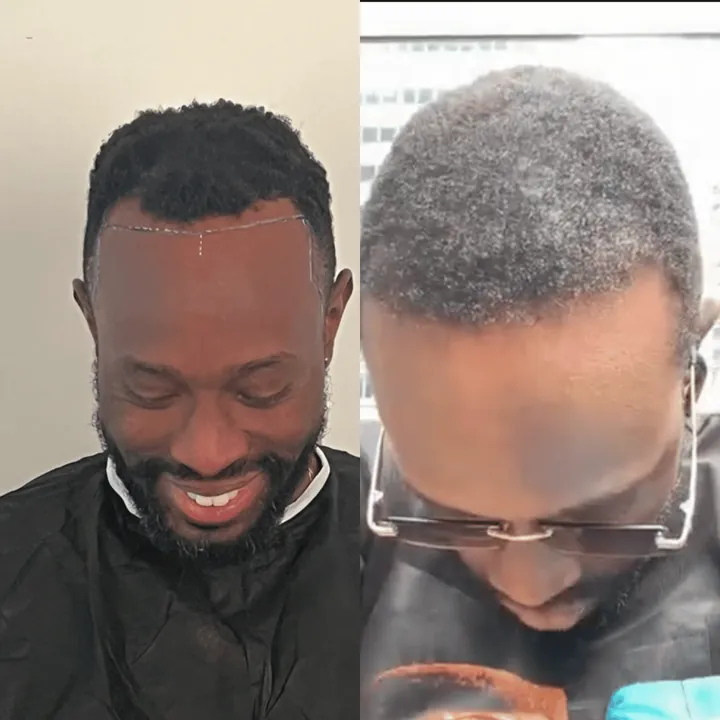
Man · Norwood 3Sapphire FUE
- Months later
- 10
- Grafts
- 3,000
- Stage
- Norwood 3
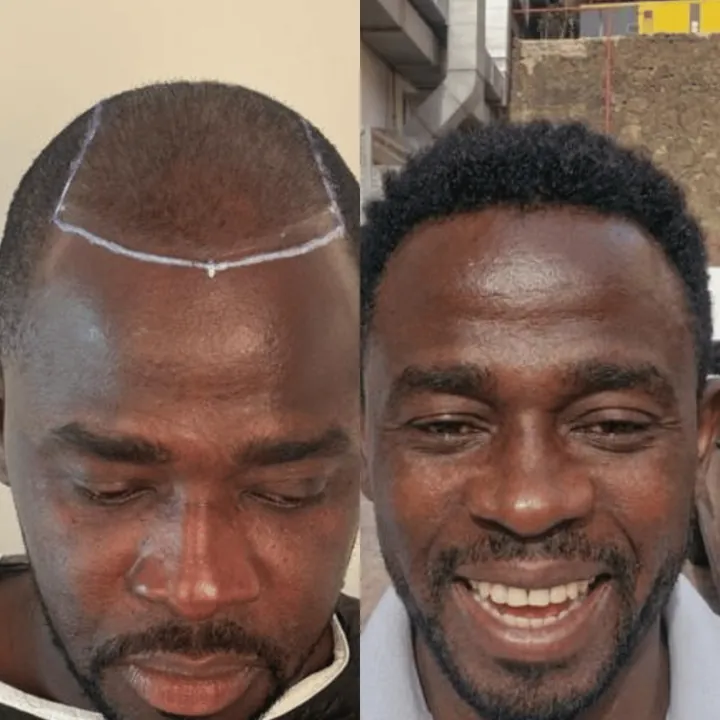
Man · Norwood 3Sapphire FUE
- Months later
- 11
- Grafts
- 3,000
- Stage
- Norwood 3
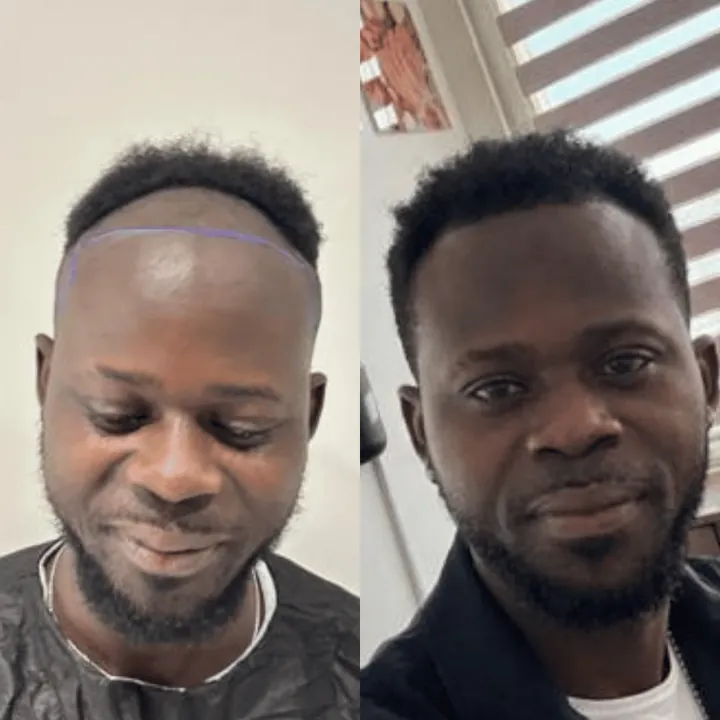
Man · Norwood 5Sapphire FUE
- Months later
- 12
- Grafts
- 3,500
- Stage
- Norwood 5
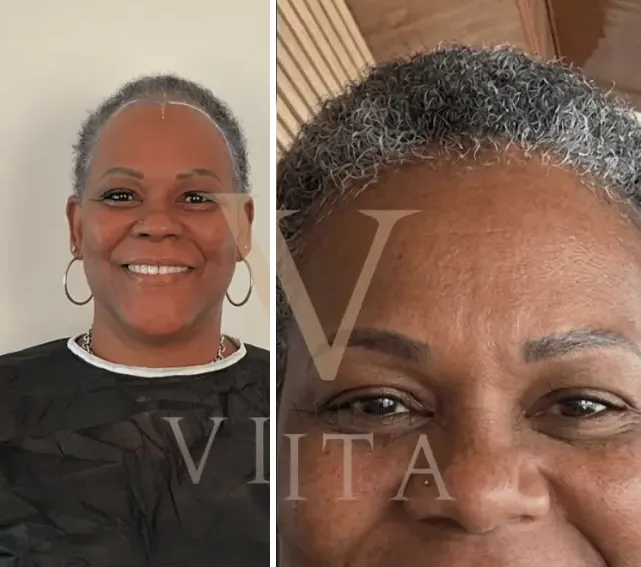
Woman · Ludwig 2Sapphire FUE
- Months later
- 10
- Grafts
- 3,000
- Stage
- Ludwig 2
How Much Does an Afro Hair Transplant Cost in Turkey?
An Afro hair transplant in Turkey typically costs $2,000-$5,500 as an all-inclusive package (indicative, 2026). Offers below and above that range exist, and the price usually says more about the package than about the hair.
What Affects Afro Hair Transplant Prices in Turkey
Afro hair transplant prices in Turkey depend on who performs the extraction, whether the clinic charges per graft or per package, what the package includes and how many patients the clinic treats a day. Some clinics also charge more for Afro-textured hair, because the extraction takes longer. The table shows what moves the price, and the figures are indicative.
| Factor | What it does to the price |
|---|---|
| Who performs the extraction | Technician-run extraction is the cheapest model. A doctor who performs or supervises each step costs more and takes longer |
| Per graft or per package | Per-graft pricing rises with the count, and a front-and-crown case in Afro-textured hair can run to 3,000-4,500 grafts. A package price does not move |
| Technique | DHI and Combined FUE and DHI are usually priced above Sapphire FUE |
| Afro-textured hair | Some clinics add a surcharge for coiled hair because the extraction is slower |
| Daily patient volume | High-volume clinics keep prices low by treating more patients per doctor per day |
| Anesthesia | Sedation adds to the price; local anesthesia is the standard |
| Hotel and transfers | A 5-star hotel and VIP transfers raise the package; a basic hotel or no hotel lowers it |
| Follow-up after you fly home | Some packages end when you fly home; a year of online follow-up is part of the price at others |
| Offers far below the range | Afro packages listed at $950-$1,500 on booking platforms (2026). Ask who performs the extraction, how many patients the clinic treats a day and what is excluded |
At Istanbul Vita the price is a fixed package: Standard $2,500 / €2,000, Premium $3,200 / €2,800 or Deluxe $4,000 / €3,500. It does not change with the graft count or the technique, and there is no surcharge for Afro-textured hair. The doctor plans the case and supervises every step, with two patients per doctor per day. Everything included in each package is listed on our hair transplant cost page.
African American Hair Transplant Cost: USA vs Turkey
In the US the same procedure is priced per graft, surgery only. Clinics that publish Afro-specific pages mostly charge their standard rate, $4-$8 per graft, and a few experienced surgeons charge a premium above that. A typical Afro-textured case of 1,500-3,000 grafts lands at $6,000-$15,000 before anesthesia and facility fees, which are often billed separately. The model itself is fine; it means the number on the quote is not the final number. The figures below are indicative.
| Area | Typical grafts | US, at $4-$8 per graft, surgery only | Istanbul Vita, fixed package |
|---|---|---|---|
| Edges or temples | 500-1,200 | $2,000-$9,600 | $2,500 / $3,200 / $4,000 |
| Hairline and temples | 1,000-2,000 | $4,000-$16,000 | $2,500 / $3,200 / $4,000 |
| Front and crown | 3,000-4,500 | $12,000-$36,000, often in two sessions | $2,500 / $3,200 / $4,000, sometimes a second package for a second session |
The US keeps one advantage: your surgeon is nearby for follow-up. At Istanbul Vita that distance is covered by the 24/7 support line and a year of online follow-up.
For your own treatment plan and graft estimate, start with the free online analysis.
Why Is an Afro Hair Transplant Cheaper in Turkey?
An Afro hair transplant is cheaper in Turkey because the clinic's costs are lower, not because less is done. Staff salaries and rent are a fraction of what they are in the US, the Turkish lira keeps those costs low in dollar terms, and hundreds of clinics in Istanbul compete on all-inclusive packages. Health tourism is also regulated and supported by the state, and licensed clinics are listed in a Ministry of Health registry. The surgery itself is the same procedure. What changes between clinics is who performs it and how many patients they treat a day, and that is a better guide than the price.
Afro Hair Transplant Cost by Country: USA, Canada, UK, France, Mexico and Turkey
Indicative ranges in US dollars for the countries our patients compare most often, with the billing model and what is usually included in each. The billing model matters as much as the number: a per-graft, surgery-only quote and an all-inclusive package are not the same product.
| Country | Billing model | Indicative range (USD) | Afro-specific price published | What is usually included |
|---|---|---|---|---|
| United States | Per graft, surgery only | $4-$8 per graft; a typical Afro-textured case $6,000-$15,000; premium surgeons $20,000 and up | Yes; most clinics charge their standard per-graft rate | Surgery; anesthesia and facility fee often separate |
| Canada | Per graft, surgery only | C$4-C$8 per graft; 2,500-3,000 grafts about C$8,500-C$16,000 (about $6,000-$11,500) | No; general range shown | Surgery |
| United Kingdom | Per graft or per session, surgery only | £3,500-£12,000 (about $4,500-$15,500); £3-£7 per graft | Yes; several London clinics | Surgery, first wash |
| France | Per session, surgery only | €4,000-€10,000 (about $4,500-$11,000) | Partly | Surgery |
| Mexico | Mostly packages | $3,000-$6,000 | Partly; booking platforms list Afro cases | Varies; medication and check-ups usually included, hotel sometimes |
| Turkey, market | All-inclusive packages | $2,000-$5,500 | Yes | Surgery, hotel, transfers, translator, medication, follow-up; varies by clinic |
| Istanbul Vita | Fixed package | $2,500 / $3,200 / $4,000 | Yes; same price for Afro-textured hair | Surgery, aftercare, follow-up; hotel with Premium and Deluxe |
Indicative ranges compiled from publicly listed clinic prices in each country, 2026. Where no Afro-specific price is published, the general hair transplant range is shown. Istanbul Vita prices are fixed package prices.
What Is Not Included: What to Budget From the US
An example total for a Premium package patient flying from the US, indicative. Flights are the one large item outside the package, and they vary more by season and departure city than anything else on the list.
| Item | Premium package example |
|---|---|
| Package | $3,200 |
| Round-trip flights, economy, from a major US hub | Budget separately; typically $700-$1,500 depending on city and season. Nonstop flights take about 9-13 hours |
| Extra hotel nights beyond the 2 included | Ask us for the partner rate if you want to stay longer |
| Possible second session for a large front-and-crown case | A second package, planned at month 12 or later |
| Example total for one session | About $3,900-$4,700, plus meals and any extra nights |
A total that leaves out the flights is not a complete total; budget for them from the start.
Why Istanbul Vita for Afro-Textured Hair
Istanbul Vita is a Ministry of Health authorized clinic where a physician plans and supervises every stage of the surgery, and every Afro-textured case we show is one of our own patients.
What that means in practice:
- Licensed. Istanbul Vita is listed in the Ministry of Health's registry of authorized health tourism facilities.
- A doctor who specializes in Afro-textured hair. Dr. Harun Alakaya, hair transplant physician and Afro hair specialist, plans your case, opens every channel and supervises extraction and placement. His profile and the full team, with each person's role, are on our team page.
- Two operations per doctor per day, with a 40-60 minute consultation before each.
- A fixed package price. No per-graft pricing, no extra charge for Afro-textured hair, and the inclusions in writing.
- Comfort-In needle-free anesthesia for the numbing step.
- A graft guarantee certificate, a 24/7 medical support line, one year of online follow-up and an in-clinic translator in every package.
- Before and after results of our own Afro-textured patients, with the stage of hair loss, graft count, technique and month for each case, and the doctor's video on how the surgery is planned for coiled hair.
To find out whether you are a candidate, start with the free online analysis.
Is an Afro Hair Transplant in Turkey Safe?
Yes, an Afro hair transplant in Turkey is safe when the clinic is licensed and a physician performs or supervises the surgical steps; the risk sits with the clinic you choose, not with the country.
The license can be checked online in the Ministry of Health registry; who performs each step comes from asking. The risks below are the ones that matter most for Afro-textured hair and darker skin.
Risks Specific to Afro-Textured Hair and Skin
What the evidence says about each risk, and what we do about it at Istanbul Vita. Two of the five are specific to darker skin, one is specific to the curved follicle, and the other two are part of every hair transplant.
| Risk | What the evidence says | What we do at Istanbul Vita |
|---|---|---|
| Transection (grafts cut during extraction) | 3-6% with punches adapted to the curve in a multicenter series; higher with standard punches and fast extraction | Punch size chosen for your follicle, slow extraction at the angle of each hair, the doctor supervising |
| Keloid and hypertrophic scars | 2.4% of Black versus 0.4% of White participants in a UK study of about 230,000 people | Keloid history asked before booking, old scars examined; we may decline or suggest a small test session first |
| Post-inflammatory hyperpigmentation | More common and longer lasting in darker skin | Channels kept as small as the graft allows, gentle washing, strict sun protection for three months |
| Shock loss of the transplanted hair | Expected in most patients; the hair regrows from the follicle | Explained before surgery so it is expected |
| Infection and swelling | Uncommon with proper aftercare | Aftercare kit, wash protocol, 24/7 line for any concern |
The one risk no screening can remove is the extraction itself, which is why who performs it matters more than any other question.
Have Questions? Let's Chat on WhatsApp!
Get instant answers 24/7. Receive your doctor-led hair analysis within 1 day, plus pricing and booking support.
Start WhatsApp ChatHow to Choose the Best Afro Hair Transplant Clinic in Turkey
The best Afro hair transplant clinic in Turkey for you is the one that can show you its own Afro-textured cases and tell you who performs each step of your surgery.
Reviews and rankings rarely answer those two questions. The list below does, and any clinic should be able to answer it clearly.
| Ask | A good answer sounds like |
|---|---|
| Who extracts the grafts, who opens the channels, and who places them? | Names and roles, with the doctor's part stated |
| Can I see your own Afro-textured cases, with graft counts and months? | Labeled photos of the clinic’s own patients |
| Which punch sizes do you use for coiled hair, and why? | A range of about 1.0-1.3 mm and a reason tied to the curved follicle |
| Is the price per package or per graft, and what is excluded? | A written list of inclusions and exclusions |
| Is the clinic licensed by the Ministry of Health? | A registry entry you can check yourself |
| How many patients does the clinic operate on per day? | A clear number; two per doctor per day is our limit |
| What happens if I have a keloid history or active CCCA? | A clear policy: screening first, then a test session or a refusal when needed |
| How does follow-up work after I fly home? | A named channel, a schedule of photo check-ins, and a person who answers |
| How is the anesthesia done? | A described method; needle-free local anesthesia is one option |
Sources
- Singh MK, Avram MR. Technical considerations for follicular unit extraction in African-American hair. Dermatol Surg. 2013;39(8):1282-1284.
- Umar S, Khanna R, Lohlun B, et al. Follicular unit excision in patients of African descent: a skin-responsive technique. Dermatol Surg. 2023;49(10):949-955.
- Jimenez F, Alam M, Vogel JE, Avram M. Hair transplantation: basic overview. J Am Acad Dermatol. 2021;85(4):803-814.
- Avram MR. Hair transplantation. Cutis. 2012;90(6):317-320.
- Akingbola CO, Vyas J. Traction alopecia: a neglected entity in 2017. Indian J Dermatol Venereol Leprol. 2017;83(6):644-649.
- Ung CY, Warwick A, Onoufriadis A, et al. Comorbidities of keloid and hypertrophic scars among participants in UK Biobank. JAMA Dermatol. 2023;159(2):172-181.
- Loussouarn G. African hair growth parameters. Br J Dermatol. 2001;145(2):294-297.
- Davis EC, Callender VD. Postinflammatory hyperpigmentation: a review of the epidemiology, clinical features, and treatment options in skin of color. J Clin Aesthet Dermatol. 2010;3(7):20-31.
- Khumalo NP, Jessop S, Gumedze F, Ehrlich R. Hairdressing and the prevalence of scalp disease in African adults. Br J Dermatol. 2007;157(5):981-988.
- Olsen EA, Callender V, McMichael A, et al. Central hair loss in African American women: incidence and potential risk factors. J Am Acad Dermatol. 2011;64(2):245-252.
- Rogers NE, Callender VD. Advances and challenges in hair restoration of curly Afrocentric hair. Dermatol Clin. 2014;32(2):163-171.
- Atodaria PR, Venkataram A, Mysore V, Atodaria KP. Optimal hair transplant recipient site slit design: minimizing vascular damage. Indian J Plast Surg. 2021;54(4):471-476.
- Republic of Türkiye Ministry of Health, General Directorate of Health Services. Registry of authorized health tourism facilities, Istanbul Vita entry TR-94837. shgmturizmdb.saglik.gov.tr





 conversation


