
 English
  Français
  Italiano
Table of Contents
What Is Red Light Therapy (LLLT)?
The scalp gets exposed to controlled, low-intensity red or near-infrared light. Nothing gets cut or removed — the light comes from an external device while the scalp itself stays untouched.
"Red light therapy," "LLLT," and "low-level light therapy" often describe the same thing, since devices vary between actual lasers, LEDs, or a mix of both. The light is thought to shift cellular signaling rather than generate heat, touching on blood flow and follicular activity in the process.
That mechanism has a limit: it can only work where a follicle still exists in some form. A patch of scalp with zero remaining follicles gives the light nothing to act on — which is the core difference from a transplant, where working follicular units get physically relocated rather than revived in place.
This makes LLLT most relevant for areas dealing with androgenetic alopecia — gradual thinning, not spots that are already completely bare.
How Is Laser Therapy Used at Istanbul Vita?
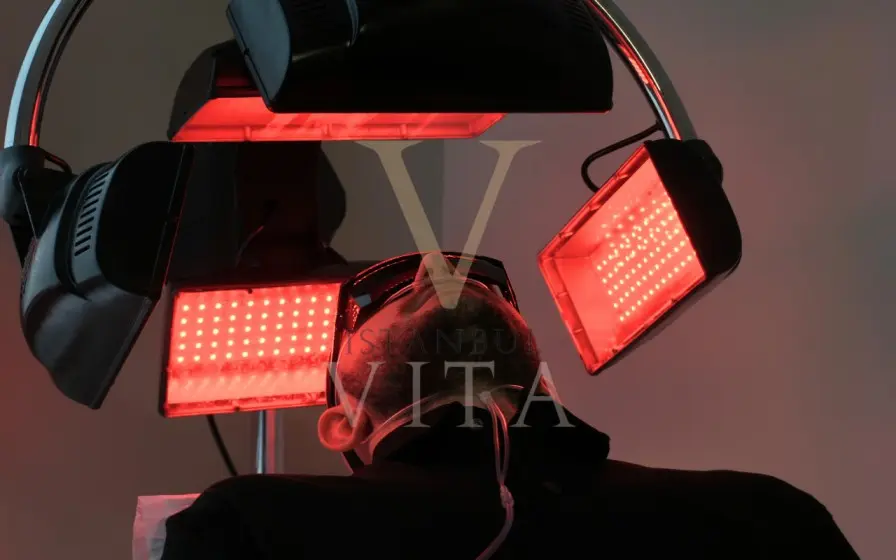
Instead of scheduling it as its own trip to the clinic, Istanbul Vita attaches the red light session to a visit the patient's already making. That's only possible because the treatment doesn't cut into the body anywhere — no incisions, no injections, nothing that would justify a dedicated appointment on its own.
When Is Laser Therapy Performed at Istanbul Vita?
It happens on the day the patient comes back for the first post-surgery wash. That single visit typically covers:
- A look at how the donor and recipient areas are healing
- The actual first wash
- Instructions for continuing to wash at home
- The red light session
- The second oxygen therapy session
- Any leftover questions about recovery
None of this needs a separate appointment. Roughly speaking, the timeline looks like:
Surgery day → recovery overnight → return visit → first wash → red light session → second oxygen session → wrap-up for that visit
What Happens During a Laser Therapy Session?
A device delivers the light externally — the patient doesn't get touched with needles, nothing gets extracted or reopened. Exact settings (wavelength, output strength, how long it runs) differ from one device to the next, so nobody should assume every LLLT machine works identically. Istanbul Vita follows its own internal protocol for how long and how intense the exposure is during this specific post-op stage.
Laser Therapy as Part of Istanbul Vita's Aftercare Protocol
Right after surgery, a patient's dealing with several things simultaneously: keeping the recipient area away from friction or pressure, getting the washing routine right from day one, sticking to whatever medication and activity restrictions apply, and letting the clinic track how the scalp is healing. Red light therapy is one thread woven into that whole fabric — it doesn't override or substitute for the surgical work, the donor-area management, or how carefully the grafts were handled.
Why Is Laser Therapy Used After a Hair Transplant?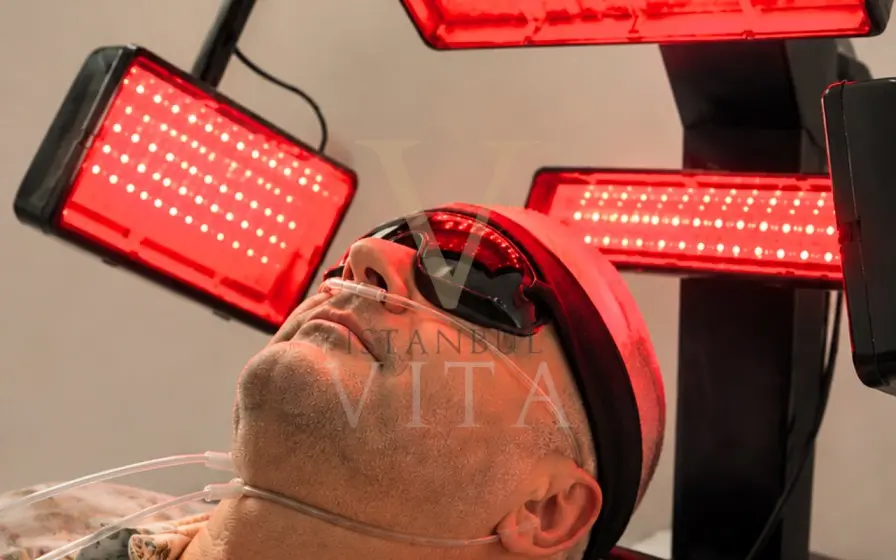
There are really two separate conversations happening under the same acronym. One is LLLT as a standalone, ongoing treatment for hair that's still there but thinning — androgenetic alopecia is the classic case. The other is LLLT tacked onto post-transplant recovery, which is what's relevant here.
A transplant produces two sets of small, deliberate wounds: extraction sites in the donor zone, and new openings wherever the grafts go in. Both start healing the instant the surgeon finishes. Since red light therapy doesn't add any new trauma to that process, it can be introduced without competing with the healing that's already underway.
There's also a practical overlap worth noting: most people getting a transplant still have plenty of native hair surviving elsewhere on the scalp. Androgenetic alopecia rarely clears an entire head at once — it usually creeps, thinning some regions while leaving others intact. Those surviving-but-thinning zones are exactly where LLLT has something to grab onto.
What Does LLLT Actually Do for Hair Loss?
Outside of the transplant context, red light therapy shows up frequently as a device-based approach specifically aimed at androgenetic alopecia, typically used over a sustained period rather than as a one-off fix. That's an important caveat: whatever benefit gets attributed to ongoing LLLT use doesn't automatically apply to a single session tacked onto a hair transplant recovery plan. The two situations aren't really comparable.
Does Laser Therapy Improve Graft Survival?
Nothing — including a laser session — single-handedly decides whether a graft survives. A long chain of factors matters more:
- how good the donor follicles were to begin with
- the extraction technique used
- how much trauma occurred during handling
- how long grafts sat outside the body
- storage conditions during that window
- how the recipient sites were prepped
- the actual implantation technique
- blood flow to the recipient area afterward
- the quality of post-op care overall
A laser session can't fix bad extraction or grafts that were mishandled, and nobody should market it as a survival guarantee. At Istanbul Vita, it's positioned as an add-on to aftercare — not the thing propping up graft survival.
Does Laser Therapy Make Transplanted Hair Grow Faster?
A single session isn't going to jumpstart visible growth. Transplanted follicles follow their own biological timeline: the visible hair shaft typically sheds in the first few weeks, the follicle itself sticks around under the skin, and eventually a new growth phase kicks in — with visible results building gradually over several months.
Red light therapy doesn't override that sequence. Whatever density improvements show up in the literature tend to come from repeated sessions stretched over weeks or months, not a one-time application right after surgery. Istanbul Vita's approach treats the post-op session as recovery support, full stop — not a shortcut through the normal growth timeline.
Is One Laser Session the Same as LLLT Treatment for Hair Loss?
They're different things entirely. A committed LLLT regimen for androgenetic alopecia usually means going back for repeated sessions over an extended stretch. What happens at the first-wash visit at Istanbul Vita is a single touchpoint inside a broader aftercare plan — not the start of an ongoing treatment course. Anyone expecting one post-op session to match what a dedicated LLLT program delivers is comparing two different things. If someone wants to pursue LLLT longer-term for existing hair loss, that decision should be made separately, based on their specific situation.
Is Red Light Therapy Safe After a Hair Transplant?
At the low-intensity levels used for aftercare, yes. There's no heat output strong enough to damage tissue, and nothing about the treatment disturbs a graft that's still in the process of settling into place. Still, the specifics — how it's timed, what settings are used — aren't arbitrary, which is exactly why Istanbul Vita administers it under its own clinical protocol rather than leaving it to chance.
Can I Use Red Light Therapy at Home After a Hair Transplant?
Anyone thinking about an at-home device should raise it with the medical team before trying it solo. Distance from the scalp, how long a session runs, and how soon after surgery it happens all carry more weight during early healing than they would for someone treating long-established hair loss. Sticking with whatever the clinic recommends is the safer path while grafts are still new.
Is Laser Therapy Painful After a Hair Transplant?
No needles, no cutting, nothing touching the grafts directly. If the scalp feels tender, that's more likely leftover sensitivity from the surgery itself rather than anything the light treatment introduces — the session itself doesn't add its own recovery time. Anything unusual, though — sudden pain spikes, discharge, symptoms that don't fit the normal pattern — should go straight to the medical team rather than getting written off as expected.
Laser Therapy vs. PRP vs. Oxygen Therapy After Hair Transplant
These three tend to appear in the same recovery plan, but they're doing different jobs.
| Treatment | How It's Applied | Role |
|---|---|---|
| Red Light Therapy (LLLT) | External low-intensity light on the scalp | Supportive photobiomodulation |
| PRP | Platelet-rich plasma drawn from the patient's own blood | Biological support |
| Oxygen Therapy | Supplemental oxygen delivery | Early post-op support |
At Istanbul Vita, PRP usually happens right at the end of surgery, oxygen therapy is split across two sessions in the first day, and red light therapy comes in at the first-wash visit. Three treatments, three different moments — none of which touches how well the grafts were extracted, handled, or placed. That part of the outcome is locked in during surgery itself.
Can LLLT Replace Minoxidil or Finasteride?
No, not as a like-for-like swap. All three operate through different biological mechanisms, and each comes with its own evidence base and limitations. Some patients do combine LLLT with medication, but whether that makes sense depends heavily on the individual — there's no universal combination that works best across the board. Decisions about medication belong in a conversation separate from the post-op laser session, shaped by the person's specific pattern of hair loss, their medical background, and their doctor's input.
What LLLT Cannot Do After a Hair Transplant
Red light therapy can't bring back follicles that have already stopped functioning, can't repair a graft that was damaged during extraction, and can't promise every graft will take. It doesn't block the shedding that normally happens after transplantation, doesn't produce overnight results, and doesn't replace the actual washing and scalp-care routine a patient needs to follow. It also won't permanently stop future hair loss on its own. All of these limits are exactly why it sits in the "supportive" bucket rather than being treated as a core part of the procedure.
Frequently Asked Questions About Laser and Red Light Therapy After Hair Transplant
What type of laser therapy is used after a hair transplant?
At Istanbul Vita, it's low-level laser therapy — commonly called red light therapy — used purely for post-op support. This has nothing to do with the higher-powered lasers used in actual surgical cutting.
Is red light therapy safe after a hair transplant?
Yes, at the low intensity used for this purpose. It's non-invasive, doesn't damage tissue, and doesn't interfere with grafts still in the process of settling.
Can I use red light therapy after a hair transplant on my own?
Talk to the medical team before trying an at-home device. Session timing, intensity, and how close the device sits to the scalp all matter more while healing is still early than they would for someone managing long-term hair loss.
When is laser therapy performed at Istanbul Vita?
During the follow-up visit for the first post-operative hair wash — it's bundled into that same appointment.
Does laser therapy damage newly transplanted grafts?
No — it's non-invasive, with no extraction, incisions, or physical implantation involved. It is given under the clinic's protocol while the area is still healing.
Does LLLT guarantee better graft survival?
No. Survival depends on many surgical and biological variables, and a single post-op session can't guarantee a better outcome on its own.
Have Questions? Let's Chat on WhatsApp!
Get instant answers 24/7. Receive your doctor-led hair analysis within 1 day, plus pricing and booking support.
Start WhatsApp ChatCan laser therapy prevent shock loss?
No — it shouldn't be marketed as something that reliably prevents the temporary shedding that's a normal part of post-transplant recovery.
Is laser therapy painful?
No — it's non-invasive, no needles, no cutting. Any discomfort during this period is more likely tied to the underlying transplant.
How many laser sessions are needed?
It depends on the goal. Istanbul Vita includes just one session as part of early post-transplant care, while a dedicated LLLT program for androgenetic alopecia involves repeated sessions over a much longer period — the two aren't comparable.
Can laser therapy replace a hair transplant?
No. LLLT only works on follicles that are still functioning; a transplant physically moves working follicular units from a donor site to wherever more coverage is needed.
 conversation


