
 English

Table of Contents
Is Type 4 Hair Suitable for a Hair Transplant?
Yes, type 4 hair transplant procedures work well when the plan actually accounts for the curl. The problem is not the hair it is clinics that treat coily and afro-textured hair the same way they treat straight hair.
Type 4 hair (4A, 4B, 4C on the Andre Walker hair typing scale) grows from a follicle that curves beneath the scalp, not just above it. If the surgeon extracts and implants grafts using a straight-hair protocol, survival rates drop and the hairline can end up looking patchy instead of natural.
That is the mistake many patients make: they book based on price alone, without asking whether the clinic has real experience with afro-textured or tightly coiled hair. The result is often a thin-looking hairline, wasted donor grafts, and a second procedure that costs more than doing it right the first time.
So the real question is not "can 4C hair be transplanted." It can. The real question is whether your 4A, 4B, or 4C hair type is being planned for correctly before a single graft is removed.
4A vs. 4B vs. 4C: Understanding the Type 4 Hair Chart
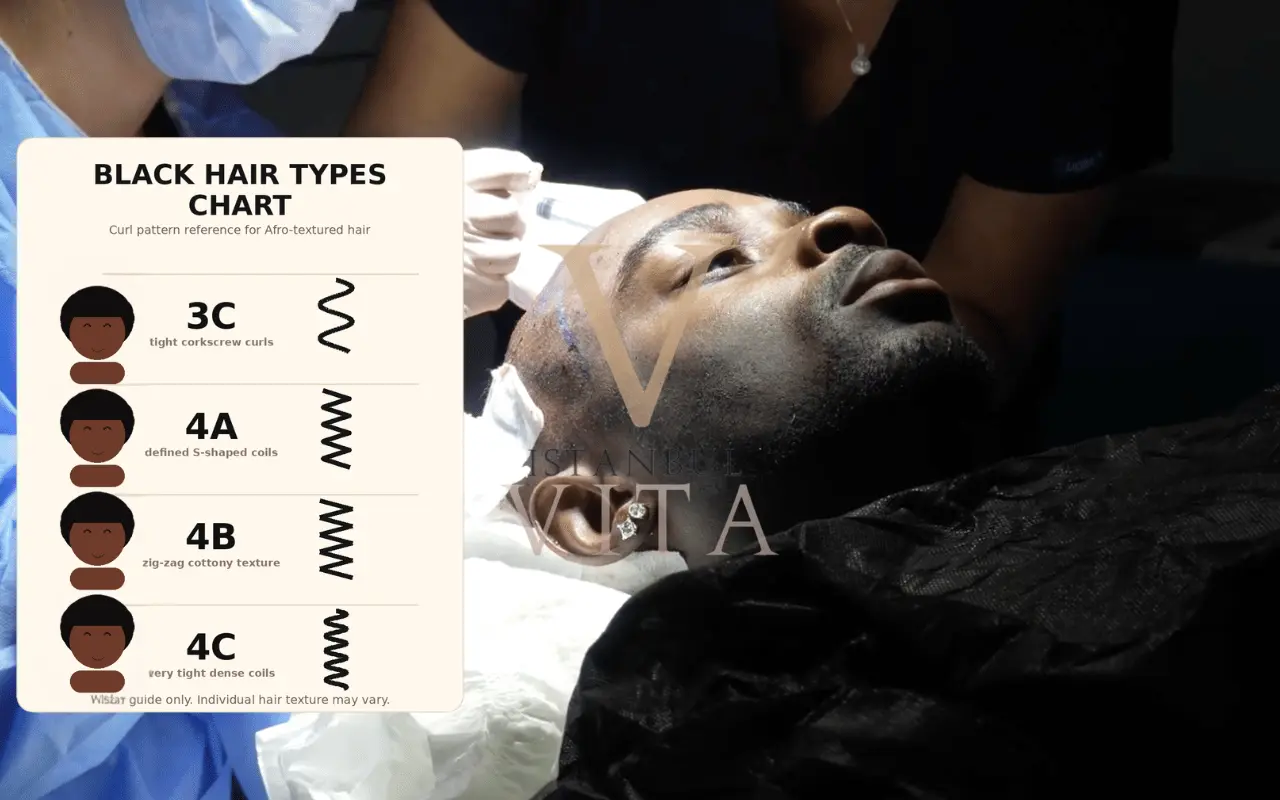
Type 4 hair sits at the tightest end of the curl pattern chart, and it is not one uniform texture. The difference between 4A, 4B, and 4C changes how a surgeon approaches extraction, density, and hairline design.
- 4A hair has a visible S-shaped curl pattern that clumps together and holds definition fairly well.
- 4B hair has a sharper, more zigzag or Z-shaped pattern with less defined curls than 4A.
- 4C hair is the tightest of the three, often shows little visible curl definition, and shrinks noticeably compared to its actual strand length.
Many people also have a mix some 4A alongside patches of 4B, or a blend of 3C and 4A near the hairline. This matters for a type 4 hair transplant because the donor area itself may contain more than one curl pattern, and the surgeon needs to map that before extraction begins.
Why Curl Pattern Changes the Transplant Approach
The tighter the curl pattern, the more the follicle curves under the skin. A 4C follicle can bend at an angle that a standard punch tool was never designed to follow. That single detail is why black hair transplant planning cannot be a copy-paste of a straight-hair protocol.
Why Type 4 Hair Transplant Planning Is Different From Straight or Wavy Hair
Straight and wavy follicles run in a fairly predictable line beneath the scalp. Type 4 follicles do not. They curve, sometimes sharply, before reaching the surface and that single anatomical fact changes almost every stage of the procedure.
Curved Follicles and Extraction Challenges
During extraction, a punch that follows a straight path can transect a curved follicle, damaging it before it is even removed. This is one of the most common causes of poor graft survival in afro hair transplant cases handled by teams without specific experience in coily hair.
According to the American Academy of Dermatology, hair transplantation moves hair-bearing skin, or in the case of follicular unit transplants individual follicles, from one part of the head to another, and success depends heavily on how carefully those follicles are handled during removal and placement. For curved type 4 follicles, that careful handling is not optional it is the entire difference between a natural result and a disappointing one.
Donor Area Assessment for Coily Hair
A proper donor area analysis for type 4 hair looks beyond graft count. It evaluates curl pattern zone by zone, since density and curvature can vary across the same scalp. This is exactly where microscopic donor mapping the kind used in more advanced clinical protocols becomes valuable rather than optional.
4A, 4B, 4C Hair Transplant: Planning Differences at a Glance
Here is how planning typically shifts across the three type 4 subtypes:
| Factor | 4A Hair | 4B Hair | 4C Hair |
| Curl pattern | Defined S-curl | Zigzag, less defined | Minimal visible curl, high shrinkage |
| Follicle curve under skin | Moderate | Moderate to sharp | Often the sharpest curve |
| Extraction difficulty | Moderate | Higher | Highest — needs angle-matched extraction |
| Density perception after healing | Good, curl adds visual volume | Good, curl helps coverage | Very good — coiling gives strong visual density even with fewer grafts |
| Planning priority | Hairline softness | Angle consistency | Curved-follicle extraction precision |
This table is a general guide, not a diagnosis. Every scalp has its own mix of curl zones, and a proper consultation always looks at the patient's actual donor area rather than assuming a fixed pattern based on hair type alone.
What to Expect After a 4C Hair Transplant?
4C hair transplants well when the extraction and implantation angles respect the natural curl direction. In fact, tightly coiled hair often creates the illusion of denser coverage than straight hair, because each strand curls and overlaps rather than lying flat.
This is good news for patients worried about needing an unrealistic number of grafts. A well-planned type 4 hair transplant can look fuller with a lower graft count than the same area would need in straight hair, simply because of how coily strands behave once they grow in.
Type 4 Hair Transplant Before and After: What Changes
Before-and-after comparisons for 4A, 4B, and 4C patients typically show three consistent changes: a softer, natural hairline that follows facial structure rather than a straight geometric line, visibly denser coverage as curl volume fills in, and a texture that blends with the patient's existing hair rather than looking noticeably different.
Photos are useful for setting expectations, but they should be read as general guidance. Donor quality, healing response, and how closely the surgeon followed the natural curl pattern all affect the final look.
Type 4 Hair Transplant Recovery Timeline
Recovery for type 4 hair transplant patients follows a similar overall timeline to other hair types, with a few texture-specific details worth knowing in advance.
| Timeframe | What to Expect |
| Days 1–7 | Scabbing forms over transplanted grafts; scalp sensitivity is normal |
| Days 7–14 | Scabs shed; gentle washing begins as advised by the clinic |
| Weeks 3–6 | Shock loss may occur — this is temporary and expected |
| Months 3–4 | New growth begins to appear |
| Months 6–12 | Curl pattern re-establishes and density becomes visible |
Healing Differences for Tightly Coiled Hair
Because coiled hair holds moisture and oils differently than straight hair, aftercare instructions often include specific guidance on how and when to wash, and how to avoid tight styles like braids or buns during the early healing weeks. Patients are usually advised to avoid tight hairstyles, heavy product buildup, and unnecessary friction on the scalp until the grafts have fully settled.
Have Questions? Let's Chat on WhatsApp!
Get instant answers 24/7. Receive your doctor-led hair analysis within 1 day, plus pricing and booking support.
Start WhatsApp ChatFactors That Affect Type 4 Hair Transplant Cost in Turkey
Cost is one of the first things patients research, and it is a fair question but for type 4 hair transplant turkey procedures, price should never be judged in isolation from the surgeon's experience with coily hair.
| Cost Factor | Why It Matters for Type 4 Hair |
| Technique used | Sapphire-based tools designed for curved follicles reduce tissue trauma |
| Surgeon experience with afro hair | Directly affects graft survival and hairline naturalness |
| Donor mapping detail | Microscopic zone-by-zone planning takes more consultation time |
| Package inclusions | Aftercare products, accommodation, and follow-up support vary by clinic |
Generally, hair transplant packages in Turkey remain more accessible than equivalent procedures in the US, UK, or much of Europe, largely because they bundle consultation, the procedure itself, and aftercare into one price. But for type 4 hair specifically, the lowest quote is rarely the best long-term value if the clinic lacks documented experience with curly or coily cases.
Choosing the Right Clinic for a Type 4 Hair Transplant
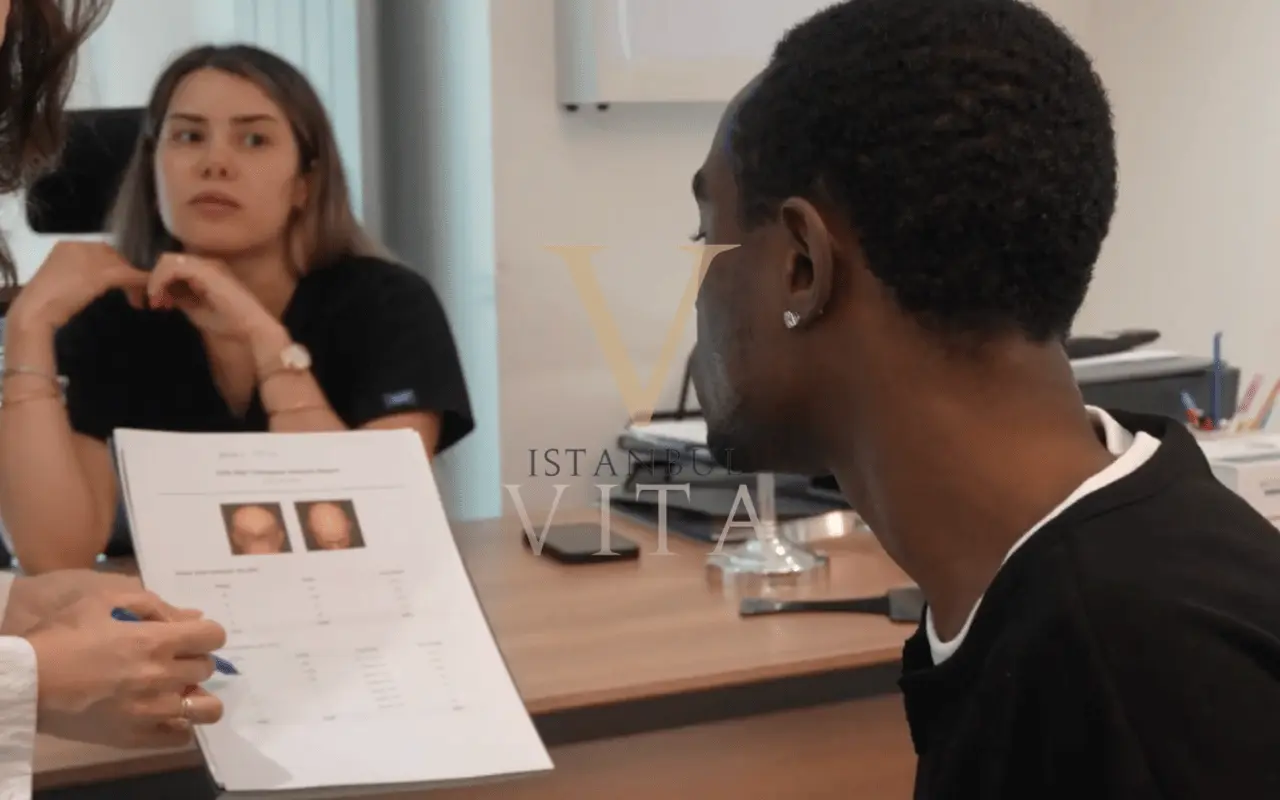
If you have read this far, you already know that type 4 hair transplant success depends on donor mapping precision, curve-aware extraction, and a hairline designed around your actual curl pattern not a generic template.
This is where Istanbul Vita Clinic's approach tends to stand out for afro-textured and coily hair cases. The clinic's doctor-led planning model means a physician evaluates curl pattern, donor strength, and hair caliber before the procedure begins, rather than leaving that assessment to non-medical staff. Doctors such as Dr. Mustafa Ayhan Balcı and Dr. Harun Eymen Alakaya specifically work with afro-textured hair, which matters given how much curved-follicle extraction differs from straight-hair cases.
Istanbul Vita's Vita Technique® uses microscopic donor zone analysis dividing the donor area into distinct sections and matching graft type to the recipient zone+ alongside Sapphire FUE and DHI options suited to different density goals. The clinic also keeps a boutique model, limiting itself to a small number of procedures per day, which allows more consultation time per patient. It is licensed by the Republic of Türkiye Ministry of Health and holds an International Health Tourism Authorization Certificate, and its multilingual coordinators support international patients through the full treatment journey.
None of this replaces your own research. But if you are comparing options for a type 4 hair transplant, it is worth asking any clinic you consider the same three questions: who evaluates the donor area, what technique is used for curved follicles, and how many afro or coily hair cases the surgical team has actually completed.
Frequently Asked Questions
Is type 4 hair suitable for hair transplant?
Yes. Type 4 hair, including 4A, 4B, and 4C, can be transplanted successfully when the surgeon accounts for the curved follicle structure during extraction and implantation.
Can you get a hair transplant with 4C hair?
Yes. 4C hair often transplants well because its tight coil creates strong visual density, though it requires more precise, angle-matched extraction than looser curl patterns.
Which type 4 hair is best for hair transplant?
None is inherently "better" 4A, 4B, and 4C all transplant successfully with the right technique. The difference lies in how much curve the surgeon must account for during extraction, not in the outcome potential.
How long is recovery for a type 4 hair transplant?
Initial scabbing typically resolves within 7–14 days, with new growth appearing around months 3–4 and fuller density visible between months 6–12.
Does 4C hair transplant differently than straight hair?
Yes. The follicle curves more sharply beneath the skin, which changes extraction angle, punch selection, and hairline design compared to straight or wavy hair.
 conversation


