
 Türkçe
  English
  Italiano
  Français
  Español
  русский
  Deutsch
  Română

Table of Contents
What is DHI Hair Transplantation?
The method of hair transplantation called DHI (Direct Hair Implantation) is a modern and innovative procedure designed specifically for hair loss sufferers. During the procedure, the hair follicles are carefully removed from the donor site with the help of special techniques and instruments, and then implanted directly into the recipient site without channel creation. Being minimally invasive in its nature, DHI transplantation ensures painless execution of the procedure and quick healing.
If you want to see how the method is planned as a full treatment — graft ranges, session length, what the package covers and how patients looked afterwards — our DHI hair transplant in Istanbul page sets it out case by case.
Thanks to DHI hair transplantation, excellent cosmetic results are possible to achieve. First of all, this happens due to the ability of the procedure to keep the natural hair growth angle. Due to the fact that each individual hair follicle is transplanted while preserving the natural angle of hair growth, the appearance of the hair becomes denser and more homogeneous.
Moreover, the aim of the DHI procedure is to maximize the graft viability through reducing the duration of the transplantation process during which hair follicles remain outside the body. This can contribute to increasing the number of living cells after transplantation and will help in acquiring better and long-lasting outcomes. Another important benefit is that there is no need to shave before this procedure, which is good for those who don’t want to interrupt their social life.
Material Used in DHI Hair Transplantation
Thanks to DHI hair transplantation, hair follicles are transferred to the area to be transplanted without waiting. The special tool used in this technique is called the Choi pen.
What is CHOI Pen?
The Choi pen is designed to precisely place hair follicles in the recipient area. The Choi pen does not open channels in the scalp during the procedure, instead, it allows the collected grafts to be transplanted simultaneously to the bald area. This technique is less invasive during the operation and reduces the recovery time.

What are the Features That Set CHOI Pen Apart from Other Instruments?
Choi pen is an advanced pen designed specifically for implantation and acts as the basis of the DHI hair transplantation method and ensures increased accuracy in performing the transplant operation. Unlike other hair transplant methods, creating channels in the target area prior to implanting is not required when employing Choi pen. Thus, the hair transplant process becomes more exact and easier since hair follicles can be implanted immediately into the targeted area.
Different from conventional methods, Choi pen doesn't require any extra incisions on the scalp. As a result of the fact that the process of creation of channels and implantation of hair follicles is combined, tissue damage is minimalized, and the process of recovery can be more accelerated than when using other methods. Furthermore, the process of bleeding and scabbing can be prevented from occurring excessively.
One of the key characteristics that makes the Choi pen stand out compared to other hair transplant instruments is its capability to allow a finer control over the angle, direction, and depth at which the graft can be placed. Its tip has been specifically developed to enable hair follicles to be planted in accordance with their natural direction of hair growth. This greatly helps in achieving a natural and aesthetically pleasing outcome in the creation of the hairline.
Moreover, the fact that hair follicles do not remain outside the body for a long period of time due to the use of the Choi pen also increases graft survivability. Thus, Choi pens have proven to help in attaining denser outcomes and thus have helped in making DHI hair transplantation different from other methods of hair transplant.
Differences Between DHI and Other Hair Transplant Methods
The three most commonly contrasted types of hair transplants are DHI, Sapphire FUE, and conventional FUE methods. There are distinct differences between the three regarding how the hair follicles are extracted and implanted, and these differences have direct implications for the healing process as well as the end result.
Sapphire FUE vs. DHI Hair Transplant
In Sapphire Fue hair transplantation, the channels are opened with sapphire-tipped blades and then the transplantation process is performed. The difference here is that in the DHI technique, the hair follicles are placed in the recipient area without waiting, while in Sapphire FUE, the hair follicles are waited for a while and the hair transplantation process is performed in the following process. At the same time, while an unshaved operation is performed in DHI hair transplantation, an unshaved operation is not performed in Sapphire FUE. Although the process is technically different, both procedures leave a minimally invasive effect, and natural results are obtained. Besides the differences, the biggest advantage is the use of both DHI and sapphire FUE techniques within the Combined hair transplantation technique.
FUE vs. DHI Hair Transplant
There are important differences between the FUE (Follicular Unit Extraction) and DHI (Direct Hair Transplantation) techniques. As we mentioned above, in DHI hair transplantation, no channels are opened and a more natural appearance is obtained, while in the FUE technique, hair follicles are taken one by one and placed in the opened channels and the hair follicles are kept for a while before this.
As with Sapphire FUE, it is not possible to perform a shave-free procedure in the FUE technique, but DHI hair transplantation provides great comfort for patients in this regard.
Advantages and Disadvantages of DHI Hair Transplantation
Advantages
More Natural Look and Precise Placement
DHI hair transplant is one of the latest procedures in hair transplantation and allows for achieving better aesthetics results than other procedures using a specially designed Choi pen. Due to the individual hair follicle implantation procedure, the direction, depth, and even angle of the hair follicle implantation can be managed. The hair will grow according to the hair growth pattern and give an aesthetically pleasing look, particularly in the hairline. Also, due to the accurate hair follicle implantation, the existing hair can be protected and density achieved.
Minimal Invasiveness and Shorter Recovery Period
DHI hair transplantation is performed with a minimally invasive approach. With this approach, hair transplantation procedures are performed more painlessly. At the same time, the risk of swelling will be reduced. In this way, the healing rate will be completed in a shorter time.
Permanent and Long-Term Results
Thanks to the DHI hair transplantation technique, long-term permanent results are achieved. For a permanent and long-lasting procedure, the operation should be performed under the supervision of a specialist doctor.
No Shave Procedure
The biggest advantage of the DHI hair transplantation method is that there is no shaving during the procedure. It has become an indispensable technique for female patients.
Disadvantages
Hygiene Conditions
After DHI hair transplantation, patients usually experience a rapid recovery, but this is not the case for some patients and this process can last for 1-2 weeks. During this phase, the transplanted hair follicles should be protected from external factors and proper care should be performed. Although it is a situation that requires patience and attention from patients, it is an important element in achieving the desired results.
Why Choose Istanbul Vita Clinic for DHI Hair Transplant?
Selection of the suitable clinic for the DHI hair transplant is considered among the crucial factors that could result in natural, permanent, and satisfactory outcomes. Our clinic uses cutting-edge technology and a team of skilled specialists and doctors who provide excellent performance during the whole procedure from the pre-operative hair analysis to the development of individual programs taking into consideration patients' specific cases and hair loss pattern.
Safety and aesthetics are our top priorities which include proper hygienic conditions and application of up-to-date techniques including Choi Pen technique. These contribute to minimally invasive surgery that leads to painless and rapid recovery with the help of natural density and appearance of hair. Besides, the clinic's program involves advanced planning techniques to establish perfect graft allocation and distribution.
Apart from performing surgery, we also offer you assistance before and after operation through follow-ups. It is very important that we aim not only at doing the hair transplant successfully but also making sure that you will be satisfied in the future. Being one of the most experienced clinics in DHI hair transplantation, we make it a priority to use innovative technologies.
DHI Hair Transplant Prices

DHI hair transplantation prices may vary depending on the quality of the clinic, its location, and the technology used. Apart from this, the specialist doctor and his team and the technique to be applied are also known as the determining factors for DHI hair transplantation prices. For a detailed overview of the Turkey hair transplant cost and related pricing factors, you can visit our comprehensive cost guide.
Hair transplantation is not a procedure to be taken lightly. The quality of the clinic in terms of hygiene is also a very important factor. As mentioned above, there is more than one effective factor for DHI hair transplantation prices.
Turkey DHI Hair Transplantation Cost Comparison
Turkey DHI hair transplant cost may vary depending on many factors. When compared to other countries, considering our success in health tourism day by day, the quality of the technology used, and the experience of the doctor, Turkey DHI hair transplant prices offer reasonable prices compared to other countries.
In recent years, hair transplant clinics have opened all over the country, especially in Istanbul, creating a competitive environment. Accordingly, Turkey DHI hair transplant prices also vary.
Istanbul Vita DHI Hair Transplant Prices
Like Turkey DHI hair transplant prices, Istanbul Vita DHI hair transplant prices also vary depending on many factors. When compared to other clinics, factors such as the hygienic environment and location of the team have been effective for DHI hair transplant cost.
In addition to the ongoing competition, the experience of the specialist doctor and his team working in the clinic has caused many patients to smile after the surgery. Patient satisfaction is an important criterion for the quality of the clinic. Istanbul Vita DHI hair transplantation prices vary according to the features we have listed above.
At the same time, if you want to have detailed information about pre-operative, post-operative, and washing procedures at Istanbul Vita, you can take a look at our articles.
| Country / Clinic | Average Price |
|---|---|
| USA | 15000 $ |
| Spain | 6200 € |
| Germany | 8800 € |
| France | 8000 € |
| Switzerland | 8000 € |
| Romania | 4200 € |
| Russia | 4000 $ |
| Italy | 5000 € |
| UK | 6000 € |
| Turkey | 2000 – 4000 € |
| Istanbul Vita Clinic | 3200 € |
How is DHI Hair Transplantation Performed?
Consulting and Planning

The DHI hair transplantation surgery process begins with a consultation. After the consultation with the specialist doctor, the plan schedule is determined by the doctor. After the planning is made according to the hair analysis, the preparation process begins.
In addition to the natural and effective results offered by the DHI technique, the Vita Technique can also be used to determine the number of grafts more precisely through personalized microscopic planning. This approach provides a more detailed and scientific perspective in hair transplant planning.
Have Questions? Let's Chat on WhatsApp!
Get instant answers 24/7. Receive your doctor-led hair analysis within 1 day, plus pricing and booking support.
Start WhatsApp ChatPreparation Process
In the preparation phase before the DHI hair transplantation operation, the patient's suitability for treatment is measured and preparations are started. At this stage, the donor area and the recipient area are prepared. The preparation phase is very important for the DHI hair transplantation operation to be performed healthily.
Implantation process
Removal of Hair Follicles
During the DHI hair transplantation implant phase, grafts are carefully taken from the donor area. A special Choi pen is used when collecting hair follicles.
Hair Follicle Transplantation
In DHI hair transplantation, the collected hair follicles are directly transplanted to the recipient area.
Before & After Results of DHI Hair Transplantation
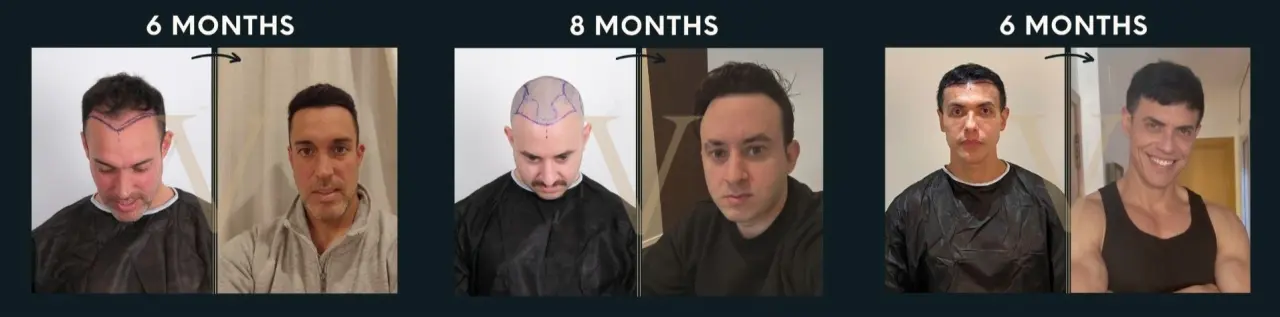
The results obtained from DHI hair transplants may differ according to patient hair structure, number of grafts, and individual healing process. The photographs presented below provide examples of the results actually obtained via DHI technology. The images represent examples of the hairline creation, density increase, and other aesthetic results after DHI hair transplant procedure.
Who Can Get a DHI Hair Transplant?
DHI hair transplant is an effective way of hair transplant that is appropriate for both men and women suffering from hair loss or hair thinning. More specifically, people having genetic hair loss, local baldness, receding hairline, or insufficient hair density may use the DHI hair transplant procedure. Those having enough and good hair follicles in the donor region can be considered proper candidates for the DHI hair transplant procedure following the diagnosis of a doctor.
This procedure is particularly favored by those wanting to acquire natural-looking results with the preservation of hair that already exists. The possibility of performing the DHI hair transplant without any shaving or little shaving allows people who want to get back to their professional and social life soon enough. This makes DHI hair transplant highly popular among people who want to preserve their appearance to the maximum extent during the procedure.
The application of DHI hair transplantation can also be efficient in Afro Hair Transplant. But, there are some specific requirements when working with Afro-textured hair because of the naturally curved shape of hair follicles. It is important to transplant the hair carefully and make sure that the curl pattern will be preserved during surgery. By choosing the right technique and planning everything correctly, DHI hair transplant can help get a natural hairline, preserve the curl pattern, and give a dense hair line.
Because of individual features of each patient in terms of hair type, hair loss degree, and other aspects, it is essential to consider the possibility of using DHI hair transplant individually. The decision on whether the transplant would be suitable for you or not can only be made after a thorough hair analysis and medical examination.
Clinic Selection Criteria
When choosing a clinic for DHI hair transplantation, the facilities of the clinic should be evaluated. The level of hygiene standards should be taken into consideration. If you want to achieve successful results, you should both research the technological infrastructure of the clinics and not ignore the hygiene conditions.
Patient Reviews and References
Emma, 36, England
I had been losing my hair since I was young. I was undecided about whether to have a hair transplant or not because people who have a hair transplant shave their hair and I didn't feel ready for that. Last year I learned that there was a procedure that could be done without shaving, and I was really happy. I immediately researched the DHI hair transplant and decided to have the surgery. Almost a year has passed, you should see my hair, it is so thick and healthy! I am really happy.
Frequently Asked Questions About DHI Hair Transplantation
What is DHI Hair Transplantation? How is it done?
It means direct hair transplantation. DHI hair transplantation method is performed by transferring the hair taken from the donor area to the recipient area. No incision is made on the scalp, the transplantation is done using a special pen.
What factors affect the price of DHI hair transplantation?
First, the hair structure is analyzed. The procedure to be performed is determined as a result of the analysis. The number of grafts to be added to the recipient area is the determining factor. The expertise of the clinic and doctor where the hair transplantation will be performed affects the DHI price.
Can the DHI Hair method be applied to all patients?
It can be applied to patients of all ages, regardless of gender. Hair taken from the donor area is added to the recipient area. People who experience regional hair loss or patients who want a shave-free procedure can benefit from this hair transplant method.
When can I get the look I want?
You can achieve the desired look 10-12 months after the hair transplant operation. Your hair will be thicker and more voluminous. Hair loss will occur in the first months. It is a natural part of the process after the operation. Do not worry.
Will there be any scars after the surgery?
Since a special fine-tipped pen is used during the surgery, the scar will be minimal. Since no channel is opened, the risk of scarring is lower and the scar will disappear over time. The fine-tipped pen will minimize tissue damage.
 conversation


