
 English
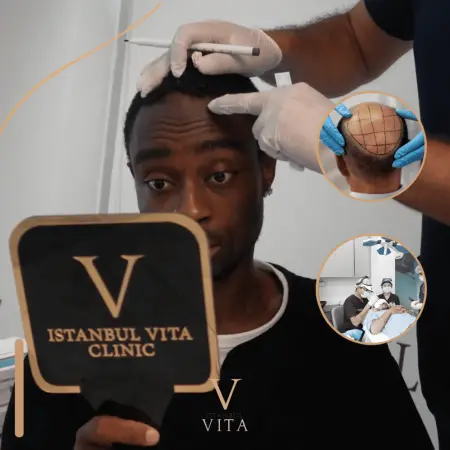
Table of Contents
After all, you've likely gone through thousands of these "before" and "after" pictures. Some look incredible. Others don't. But that's the true question behind any search for a hair transplant surgery in Turkey; not if the hair transplant surgery is effective, but if the outcome will resemble your natural hair.
The fact is that achieving a natural hair transplant requires
- where the hairline starts
- how the grafts get spread out
- how much donor hair gets held back for later
All of it shapes what you'll see in the mirror a year from now.
Turkey has become one of the world's leading destinations for hair transplantation, and for good reasons:
- experienced surgeons
- modern clinics
- affordable prices
Nevertheless, that is not all there is to choosing where to go. It is really Turkey hair transplant planning process that determines whether your hair will still look natural after ten or twenty years from now.
Why Planning Matters
There are many people who would take weeks deciding between FUE, DHI, and Sapphire FUE, as if that alone determined their outcome. But even if two men had the same procedure done, they might end up looking completely different after it.
A good transplant isn't just about relocating follicles from one part of the scalp to another. It's about making the result blend in with the hair you already have, while leaving enough donor hair in reserve in case you need it down the road.
Before touching a single graft, an experienced surgeon is really asking:
- How far has the hair loss already progressed?
- How likely is it to keep going over the next ten years?
- How many grafts can be taken out safely?
- What hairline will still make sense as this person gets older?
- How should the grafts actually be spread out for the most believable density?
The operation itself lasts for a few hours, but the choices you make ahead of time are the ones you will live with for decades.
Understanding Your Hair Loss Before Surgery
One of the most common mistakes patients make is fixating on the bald spots they can see right now.
Male pattern baldness doesn't usually stop where it started. Some men lose ground mainly around the temples; others see the crown thin out, or notice diffuse thinning spread across the whole scalp. And hair loss rarely just stops the moment you've had surgery.
That's exactly why a good surgeon looks at where your hair loss stands today and where it's probably headed. Although giving a 28-year-old such a low hairline would be wonderful right now, there comes a point when this low hairline will look bizarre due to the thinning hair all around it.
Estimating Hair Loss with the Norwood Scale
The Norwood Scale is the most commonly used system for measuring male pattern baldness. It's not just about labeling how much hair you've lost. It helps surgeons work out roughly how many grafts you'll need and whether you might be looking at more than one procedure down the line.
| Norwood Stage | Typical Hair Loss | Estimated Grafts* |
|---|---|---|
| 1–2 | Mild temple recession | 500–1,500 |
| 3–4 | Receding hairline with moderate thinning | 1,500–3,000 |
| 5–6 | Extensive hair loss across the top | 3,000–5,000+ |
| 7 | Advanced baldness with limited donor availability | Often requires staged planning |
*Actual graft requirements vary depending on donor density, hair characteristics, and treatment goals.
Think of the Norwood Scale as a starting point, not the whole answer. Two men at the exact same stage can need completely different treatment plans, simply because their donor hair quality isn't the same.
The Six Factors That Determine a Natural Result
Getting a natural look isn't just about which surgical technique gets used. Before surgery even begins, a good surgeon is weighing several things at once.
1. Future Hair Loss
A hair transplant should be solving tomorrow's problem too, not just today's. If the plan only accounts for your current hairline, you could end up with visible gaps later as the surrounding hair keeps thinning. Thinking ahead protects both how it looks and your options down the line.
2. Donor Capacity
The donor area only has so many permanent follicles to give. Take too many out in the first procedure, and you risk visible thinning at the back of the head. Also, fewer options if you ever want a second round. Holding back donor reserves is one of the most underrated parts of the whole plan.
3. Hairline Design
A natural hairline is never perfectly straight. A good surgeon builds in small irregularities. Single hairs along the very front, gradually filling in behind them. That's how hair actually grows. A too-clean edge is what gives away a transplant.
4. Graft Distribution
Not every part of the scalp needs the same density. Most of what people actually notice comes from the front third of the scalp. The crown and mid-scalp usually call for a different approach entirely. Placing grafts strategically tends to look fuller than just cramming in the maximum number everywhere.
5. Hair Angle and Direction
Even healthy grafts can look off if they go in at the wrong angle. Hair doesn't grow straight up. It angles forward, sideways, and shifts direction around the temples and crown. Getting that right takes careful channel work and precise placement. It's one of those details people notice without ever quite knowing why something looks so natural.
6. Facial Proportions
No two faces are the same. Hairline location depends on forehead height, temple shape, symmetry, and natural hair growth. Imitation of another hairline is rarely successful since something that might suit one person's face might look wrong on another's.
Why More Grafts Don't Always Mean Better Results
The misconception among most patients is that the more transplants that a patient gets, the better the end result will be. More often than not, expert surgeons advise fewer transplants than what the patient wishes.
Over extraction of the follicles can make the donor area thin, making future surgeries impossible and create an artificial density that does not fit in with the rest of the scalp. It was never about transplanting as many follicles as one could.
It's to get the most natural look while keeping your future options open. Where the grafts go usually matters more than how many there are.
Designing a Hairline That Ages Naturally
A natural hairline isn't about placing it as low as possible. It's about creating a design that looks balanced today and continues to look natural as you get older.
When planning your hairline, experienced surgeons consider:
- Age: The ideal hairline changes with age. This will enable you to have a more natural look even when you experience hair loss in the future.
- Facial proportions: There are factors such as height of the forehead, shape of the temples, and the symmetry of your face that will determine the right hairline to design.
- Future hair loss: The design should allow for possible hair loss progression without looking unnatural.
- Natural irregularities: Real hairlines aren't perfectly straight or symmetrical. Small variations help create a softer, more realistic appearance.
The goal isn't to give every patient the same hairline. It's to create one that fits their face, hair characteristics, and long-term hair loss pattern.
Protecting Your Donor Area
Your donor area is one of the most valuable things you have going into this. Unlike the recipient area, once donor follicles are gone, they're gone. Every extraction should be treated as part of a long-term plan, not a one-and-done decision.
During the consultation, a surgeon should be looking at:
- Donor density
- Hair thickness
- Hair texture
- Scalp flexibility
- Long-term donor reserve
The idea is to get great coverage now while still leaving enough in reserve in case you ever need more work done later. A lot of the best long-term results aren't the ones where the most grafts were harvested. They're the ones where the donor area was managed carefully from day one.
FUE, DHI or Sapphire FUE: Which Creates the Most Natural Result?
There is one question that arises time after time: which method results in more natural hair transplant – FUE, DHI, or Sapphire FUE?
Each technique cannot be considered superior to the others on its own. The thing is that all the three methods transplant healthy hair follicles from the donor area to the place where there are bald patches. What is different is the way the follicles are taken out and placed in.
| Technique | How It Works | Best For |
|---|---|---|
| FUE | Individual follicles are extracted and implanted into pre-made channels. | Most patients and larger treatment areas. |
| Sapphire FUE | Similar to FUE, but recipient channels are created using sapphire blades. | Patients seeking precise channel creation and potentially faster healing. |
| DHI | Follicles are implanted using a specialized implanter pen without creating all recipient channels beforehand. | Hairline refinement and smaller areas requiring precise angle control. |
Instead of asking which technique is "best," it's more useful to ask how that technique gets applied to your specific case. Some surgeons even mix methods depending on the area; more precision at the hairline, more efficient distribution across larger sections. The technique itself is just a tool. What actually decides how natural it looks is the planning and experience behind it.
What Happens on the Day of Surgery?
Every clinic runs things slightly differently, but most hair transplants follow roughly the same sequence.
- Your hairline gets reviewed and finalized with the surgeon.
- The donor area is prepped and numbed with local anesthesia.
- Individual follicular units are carefully extracted.
- Recipient sites are opened according to the planned hairline and natural hair direction.
- Grafts go in with attention to angle, density, and spacing.
- You get your aftercare instructions before heading back to the hotel.
Depending on how many grafts are involved, surgery typically runs four to eight hours. You're awake the whole time, and most patients describe it less as painful and more as a long, slightly tedious day.
Hair Transplant Recovery Timeline
Recovery happens gradually, and knowing what to expect helps avoid unnecessary panic in the first few months.
| Time After Surgery | What You Can Expect |
|---|---|
| Days 1–3 | Mild swelling, redness, and tenderness. |
| Week 1–2 | Small scabs form and naturally begin to fall away. |
| Weeks 2–6 | Temporary shedding ("shock loss") of transplanted hairs. |
| Months 3–4 | New hair begins growing, often thin at first. |
| Months 6–8 | Noticeably improved density and coverage. |
| Around 12 Months | The final result is typically visible. |
Another major misunderstanding is the expectation of instant results. It is a time-consuming process, and patience does play an important role in achieving the end result.
How Much Does a Hair Transplant Cost in Turkey?
Why do foreigners choose Turkey for medical care? They are attracted by the presence of qualified staff and low costs compared to those of the UK, Europe, or America.
That said, price should never be the deciding factor on its own. This is something that you will live with for many years, so experience, planning, and medical supervision become way more important than the offer of the least expensive deal.
| Country | Average Cost |
|---|---|
| USA | $10,000 – $25,000 |
| UK | $10,000 – $15,000 |
| Europe | €6,000 – €10,000 |
| Turkey | $2,500 – $5,000 |
| Istanbul Vita | Starting from $3,200 |
Have Questions? Let's Chat on WhatsApp!
Get instant answers 24/7. Receive your doctor-led hair analysis within 1 day, plus pricing and booking support.
Start WhatsApp ChatHow to Choose the Right Hair Transplant Clinic in Turkey
Turkey has numerous clinics which are extremely experienced; however, there is a great difference in terms of the quality of their services. It would be worthwhile to ask the following questions before making your final decision:
- Who does the actual job? Is it the surgeon or the technicians?
- Does the clinic build an individual plan, or just push the highest graft count they can sell?
- Can they show you 12-month results, not just early recovery photos?
- Is the clinic licensed by the Turkish Ministry of Health?
- Does the consultation actually cover future hair loss and donor preservation, or just today's hairline?
If a clinic is willing to spend real time talking through your long-term hair loss, that usually says more about how they operate than a clinic that jumps straight to a package price.
Why Long-Term Planning Makes the Difference
The best hair transplants tend to go unnoticed, simply because they look like hair that was always there. That kind of result comes from a long list of small decisions made before and during surgery:
- how the hairline is drawn
- how grafts are distributed
- how carefully the donor area is protected
- how much thought goes into future hair loss
A successful hair transplant isn't measured by how many grafts are transplanted. It's measured by whether the result still looks balanced and natural years later.
Istanbul Vita: Personalized Planning
Not all patients lose their hair in the exact same way; therefore, in Istanbul Vita, we start with an individual patient diagnosis instead of suggesting a fixed number of grafts.
When making the treatment plan for each individual patient, our doctors first analyze several aspects, such as:
- Your current stage of hair loss
- Donor area quality and graft capacity
- Hair thickness, texture, and growth direction
- Facial proportions and hairline design
- The likelihood of future hair loss
- Your expectations and long-term goals
Based on this evaluation, a personalized treatment plan is developed to determine the most appropriate technique, graft distribution, and hairline design for your individual case.
Instead of seeking to maximize grafts planted, our goal is to create a natural-looking outcome right from the start that will stay natural-looking for years to come.
Frequently Asked Questions
How many grafts do most men need?
It depends on how advanced the hair loss is and how much coverage they want. The exact number really only comes from evaluating your donor area in person.
Will my hair transplant still look natural in 10 years?
It can, as long as future hair loss was factored into the plan from the start. A conservative hairline and careful donor management go a long way toward keeping things looking natural over time.
Is one hair transplant usually enough?
For most men, yes. However, patients with more advanced or ongoing hair loss sometimes benefit from a second round later.
What is the biggest mistake people make before booking a clinic?
Being too concentrated on pricing or the grafts figures rather than the plan itself. It's always advisable to choose the clinic that concentrates more on future planning rather than the one providing the cheapest prices.

 conversation


