
 English
  Deutsch
  Română
  Italiano
Table of Contents
Hair thinning and shedding affect countless individuals worldwide. Men and women alike tend to notice these changes at different times throughout their lives. Some daily hair loss is normal, but when hair becomes noticeably thinner or scalp areas start showing, it may indicate that follicles are not working as they should or that the hair growth cycle is disrupted. Understanding the causes is essential to choosing the right treatment and maintaining healthy hair. Many people ask what causes hair loss, how to stop hair loss, and which hair loss treatment options are most effective. The answer really hinges on figuring out the root cause, which could be anything from hormonal shifts and genetic sensitivity to metabolic stress, medical treatments, or even scalp issues. Hair loss should be seen as a symptom rather than a standalone condition, as it stems from a range of biological processes that influence hair follicles.
Understanding the Hair Growth Cycle
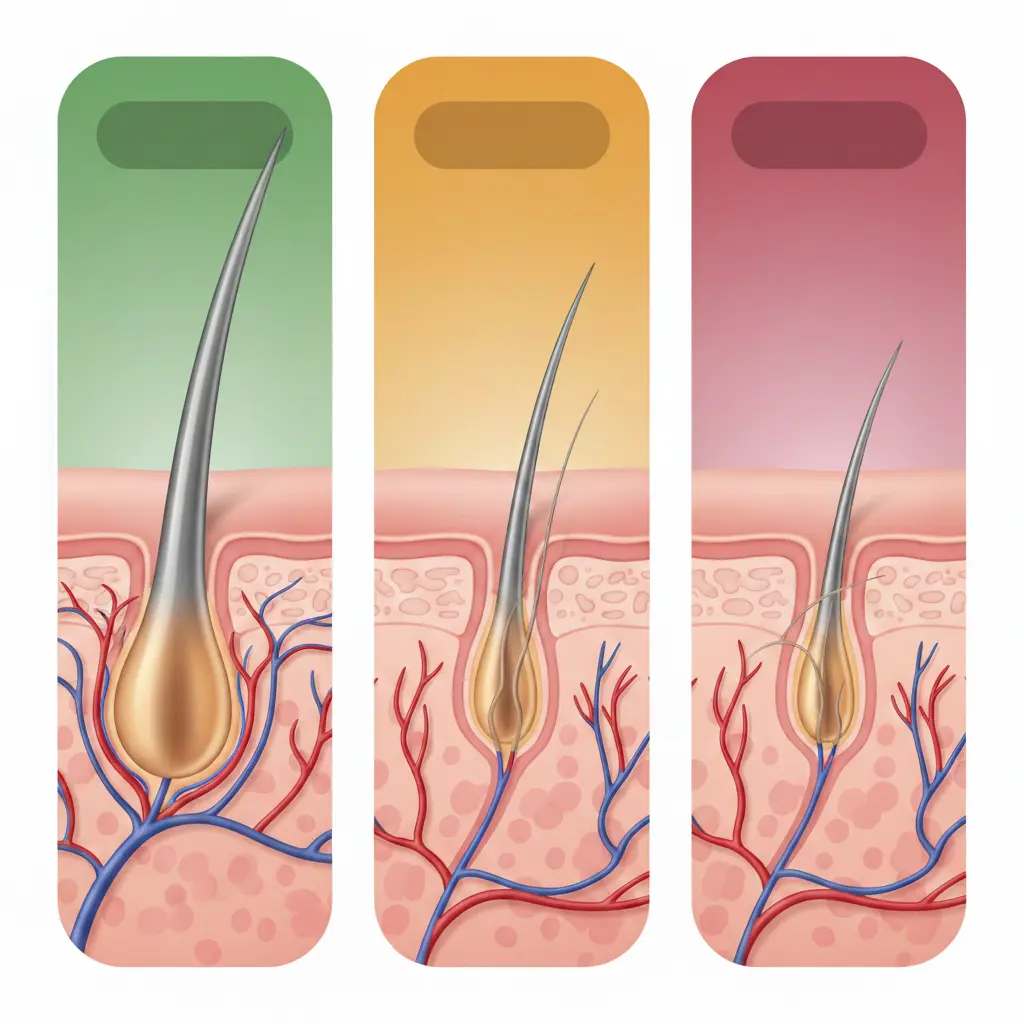
To understand hair loss causes and hair loss treatment effectiveness, it is essential to examine how hair grows, how the follicle functions biologically. Hair growth doesn’t happen all at once; rather, each hair follicle operates on its own continuous biological schedule, which we refer to as the hair regrowth cycle timeline. This cycle keeps hair looking full because while some hairs naturally fall out, others are growing, which helps maintain overall hair density.
Located in the scalp, hair follicles are small but vital structures that are key to the hair growth process. Each one has a hair root, a cluster of cells called the dermal papilla, blood vessels, and stem cells that help hair grow and renew itself. There are several factors that affect hair growth, including hormones, nutrition, blood flow, and how cells communicate with each other. When everything is in harmony, hair tends to grow just as it should. Changes in hormones, stress levels, illness, genetic factors, or specific medications can cause hair follicles to slow their growth or even stop entirely, leading to hair loss.
Anagen Phase (Growth Phase)
In this phase, hair follicles are busily growing, and this process can take anywhere from 2 to 7 years. It's during this time that they generate strong, thick hair fibers. Approximately 85–90% of scalp hair is in the anagen phase at any given time. The duration of this phase determines hair length and density.
Catagen Phase (Transition Phase)
This phase lasts approximately 2–3 weeks. Hair growth stops during this time, and the follicle gradually shrinks as it transitions toward the resting stage.
Telogen Phase (Resting and Shedding Phase)
This phase usually lasts about 3 months. During this period, the hair remains in the follicle without active growth and eventually sheds. At the same time, a new hair begins developing beneath the resting follicle and slowly replaces the old strand as the cycle continues. Hair loss occurs when a large number of follicles prematurely enter the telogen phase. This disruption is responsible for many sudden hair loss causes, including stress, illness, and hair loss due to medication.
What Causes Hair Loss in Men and Women?
To comprehend what triggers hair loss in both men and women, it's essential to evaluate several biological factors that directly impact how hair follicles operate and the dynamics of the hair growth cycle. Hair follicles are incredibly responsive to shifts in hormones, our genetic makeup, metabolic stress, and the balance of nutrients we consume. When the body experiences internal stress, hormonal fluctuations, or reduced nutrient availability, hair follicles may prematurely enter the shedding phase instead of continuing normal growth.
Hair loss can develop gradually, as seen in genetic DHT hair loss, or suddenly, as in telogen effluvium hair loss caused by stress, illness, or rapid weight loss. In some cases, hair loss due to medication, thyroid imbalance, or postpartum hormonal changes can temporarily disrupt follicle activity. For robust hair growth, maintaining a healthy scalp is vital.
The most common hair loss causes include:
- Genetic sensitivity to DHT hair loss
- Hormonal imbalances
- Telogen effluvium hair loss
- Hair loss due to medication
- Hair loss after weight loss
- Nutritional deficiencies
- Thyroid hair loss
- Stress hair loss
- Postpartum hair loss
- Scalp inflammation and dandruff
- Medical treatments such as radiation
Each of these factors affects the hair growth cycle differently.
Does Radiation Cause Hair Loss?
Radiation therapy can damage rapidly dividing cells, including hair follicles. Patients undergoing cancer treatment often ask: Does radiation cause hair loss?
Radiation can cause:
- Temporary hair loss
- Permanent follicle damage depending on dosage
- Hair regrowth may occur after treatment, but medical hair loss treatment may be required.
Androgenetic Alopecia and DHT Hair Loss
Androgenetic alopecia is the most common form of gradual hair loss in both men and women. It happens when hair follicles are naturally sensitive to a hormone called dihydrotestosterone, or DHT. Over time, exposure to DHT gradually weakens the follicles, resulting in finer hair strands and a shorter growth cycle. If it continues, some follicles can stop producing hair entirely.
DHT hair loss causes:
- Progressive thinning
- Shorter growth cycles
- Reduced follicle size
- Permanent follicle damage if untreated
Early hair loss treatment is important to protect follicle function.
Telogen Effluvium Hair Loss: One of the Most Common Medical Causes of Hair Loss
Telogen effluvium hair loss is usually temporary and reversible, resolving naturally once the underlying stress or trigger is addressed. This condition happens when physiological stress, illness, rapid weight loss, or other factors cause hair follicles to enter the telogen phase earlier than normal.
Sudden hair loss can happen, but typically, once you manage the trigger, your hair will return to its normal growth cycle without any issues.
Common triggers include:
- Rapid weight loss
- Illness
- Surgery
- Nutritional deficiencies
- Hormonal changes
- Hair loss due to medication
Does Stress Cause Hair Loss?
Does stress cause hair loss? The answer is yes. Stress hair loss is a well-documented medical condition. Stress affects hair follicles by disrupting hormone balance and increasing cortisol levels. Elevated cortisol forces follicles into the telogen phase prematurely. Stress hair loss is usually reversible once hormonal balance stabilizes.
Does Creatine Cause Hair Loss?
Creatine does not directly damage hair follicles. Concerns about creatine and hair loss have emerged because some studies suggest it may raise DHT levels. If someone has a genetic sensitivity to DHT, they could notice that their androgenetic alopecia develops at a faster rate. In this case, the connection between creatine and hair loss is mainly due to hormonal sensitivity rather than any direct effect on the follicles.
Does Ozempic Cause Hair Loss?
Hair loss associated with Ozempic is mainly caused by rapid weight loss and metabolic changes, rather than the medication directly affecting hair follicles. Shedding usually begins a few weeks after starting treatment, as some hair follicles temporarily enter the resting phase. This can be worrying, but it is generally short-term. Once the body adjusts and weight stabilizes, hair growth typically resumes naturally, so additional hair loss treatment is often unnecessary.
Does Tirzepatide Cause Hair Loss?
Hair shedding linked to Tirzepatide usually happens due to rapid weight loss, changes in metabolism, or stress on the body. The hair follicles themselves are not directly damaged by the medication. The drug doesn’t directly harm the hair follicles. During this time, some hairs may fall out as follicles slow down temporarily. Typically, this thinning will go away on its own, and hair tends to return to its usual thickness once the body gets used to the changes. Maintaining a nutritious diet, taking vitamins that promote hair health, and being gentle with your scalp can really help keep your hair in good shape while it heals.
Postpartum Hair Loss: Hormonal Hair Loss in Women
It's completely normal for new moms to experience hair loss after giving birth, and it usually starts a few weeks to a few months later. The shedding happens because the hormonal shifts that helped your hair grow during pregnancy start to return to what they were before, which pushes the hair follicles into the resting phase.
Most women experience the worst of postpartum hair loss about three to four months after having a baby, and then it slowly starts to decrease over the course of six to twelve months.
Postpartum hair loss treatment typically focuses on:
- Nutritional support
- Hormonal stabilization
- Time for natural recovery
Most women recover within 6–12 months.
Female Hair Loss, PCOS Hair Loss and Hormonal Hair Loss
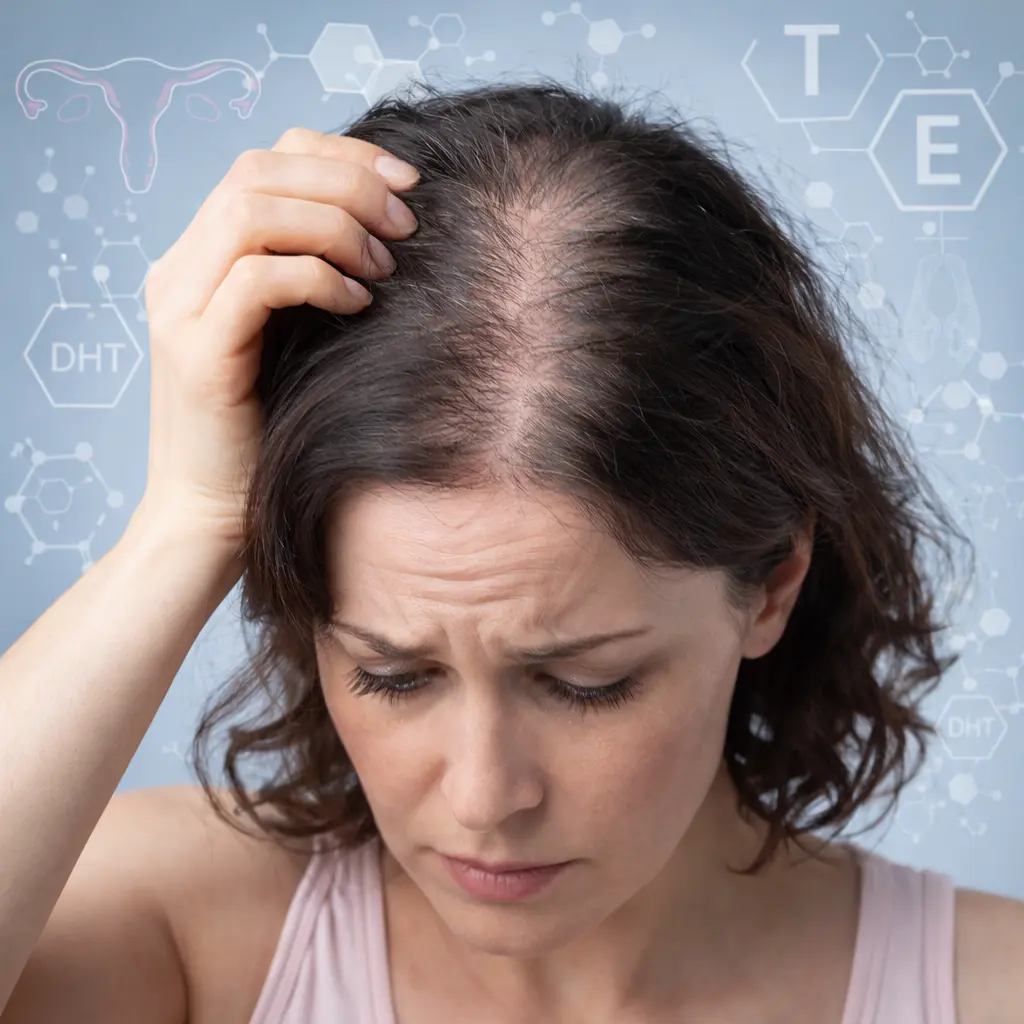
Hair loss in women can result from various hormonal disorders and fluctuations. Conditions such as PCOS hair loss, menopause hair loss, perimenopause hair loss, and thyroid hair loss can significantly impact hair follicle function, leading to thinning and shedding.
When hormones are out of whack, it can really impact hair follicles, messing with the normal hair growth cycle and possibly hastening the shift of follicles into the resting phase. Female pattern hair loss often manifests as diffuse thinning across the scalp, typically starting at the crown and widening over time, rather than forming the distinct receding hairline commonly seen in men.
Vitamin Deficiency Hair Loss
For hair follicles to really flourish, they require the right nutrition. If they miss out on certain vitamins and minerals, it can lead to hair loss. The nutritional deficiencies most frequently linked to hair shedding are:
- Iron deficiency
- Vitamin D deficiency
- Biotin deficiency
- Protein deficiency
- Zinc deficiency

Addressing these deficiencies through diet, supplementation, and targeted vitamins for hair loss can help support follicle health and promote natural hair regrowth.
Does Dandruff Cause Hair Loss?
Dandruff does not directly destroy hair follicles, but it can contribute to scalp inflammation that affects follicle health. Chronic inflammation can really throw a wrench in the stability of hair follicles, leading to increased hair shedding. When it comes to seborrheic dermatitis, hair loss happens because ongoing inflammation on the scalp messes with the hair growth cycle. To ensure your hair stays healthy and to reduce shedding, it's really important to tackle dandruff and take care of your scalp.
Hair Loss Treatment Options: How to Treat Hair Loss Effectively
Understanding how to treat hair loss depends on whether hair follicles are still alive or permanently inactive. Many medical hair loss treatment methods aim to slow hair loss or temporarily strengthen weak follicles. However, when follicles are no longer active, the only permanent and definitive solution is hair transplantation.
Hair Transplant: Permanent Hair Loss Solution

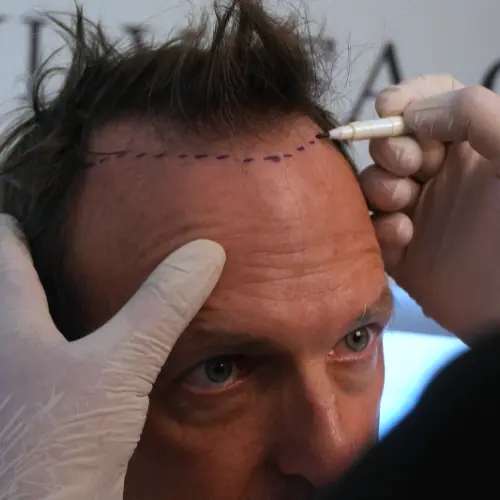
Hair transplantation is the most effective solution for men and women experiencing permanent follicle loss. At İstanbul Vita, the advanced Vita Technique is used to ensure precise extraction and implantation of healthy follicles. With this technique, we can reduce trauma, enhance graft survival rates, and design a hairline that looks completely natural and is specifically tailored to each individual. With Vita Technique, patients receive not only real, growing hair but also a procedure optimized for comfort, efficiency, and natural aesthetic outcomes.
Minoxidil Hair Loss Treatment: One of the Most Effective Hair Loss Treatments
Minoxidil hair loss treatment is one of the most widely used solutions for hair thinning and loss. It works by enhancing blood flow to the hair follicles, prolonging the anagen (growth) phase, and improving nutrient delivery to the scalp. These effects are designed to strengthen your existing hair while also encouraging regrowth over time.
Key benefits of minoxidil hair loss treatment include:
- Increased blood circulation to hair follicles
- Enhanced delivery of essential nutrients
- Prolongation of the follicle growth phase
- Enlargement of follicle size and density
Some individuals may experience initial shedding when starting minoxidil treatment. This temporary hair loss happens when dormant hair follicles wake up and start growing again, and it's actually a normal part of the treatment process. With consistent use, hair density typically improves, making minoxidil a reliable component of hair loss management.
Have Questions? Let's Chat on WhatsApp!
Get instant answers 24/7. Receive your doctor-led hair analysis within 1 day, plus pricing and booking support.
Start WhatsApp ChatFinasteride Hair Loss Treatment: Blocking DHT to Stop Hair Loss
Finasteride for hair loss helps slow down hair thinning by targeting the root hormonal cause. Finasteride for hair loss works by lowering the activity of the enzyme 5-alpha reductase, which normally converts testosterone into dihydrotestosterone (DHT).
Excess DHT contributes to androgenetic alopecia by shrinking hair follicles and shortening their growth cycles, resulting in thinner and weaker hair over time. As a result, hair may become thinner, weaker and less dense, which is a hallmark of androgenetic alopecia.
Key points about finasteride hair loss treatment:
- Reduces scalp DHT levels
- Prevents follicle miniaturization
- Slows or stops progression of androgenetic alopecia
- Supports long-term hair density preservation
Regular use under medical supervision is recommended to achieve optimal results.
Dutasteride Hair Loss Treatment: Advanced DHT Suppression
Dutasteride for hair loss helps by blocking both Type I and Type II 5-alpha reductase enzymes, which turn testosterone into dihydrotestosterone (DHT). By targeting both types, dutasteride hair loss treatment reduces DHT more effectively than finasteride.
This stronger DHT suppression helps prevent further shrinking of hair follicles and can stabilize hair in people dealing with more advanced androgenetic alopecia.
Key points about dutasteride hair loss treatment:
- Blocks both Type 1 and Type 2 5-alpha reductase
- Provides stronger DHT suppression than finasteride
- Effective for advanced hair loss cases
- Helps maintain existing hair and slow progression
Dutasteride is often recommended for patients who do not respond adequately to finasteride or require more aggressive management of progressive hair loss.
PRP Hair Loss Treatment: Regenerative Follicle Stimulation
PRP for hair loss uses growth components from your own blood to help reactivate hair follicles and support a healthier scalp environment. PRP injections for hair loss promote follicle regeneration, improve hair density, and support the overall strength and thickness of existing hair.
Over time, PRP treatment can effectively minimize hair shedding and provide your follicles with added strength. Many patients and clinicians have observed that PRP is a reliable choice for those looking for non-surgical ways to improve hair growth. Its effects are often even better when combined with other hair loss treatments, helping to enhance overall density, thickness, and the health of existing hair.
Microneedling for Hair Loss: Stimulating Regrowth
Microneedling hair loss treatment works by creating controlled micro-channels in the scalp using very fine needles, which supports natural skin repair and helps reactivate less active hair follicles. This method also improves scalp condition and allows topical treatments, including minoxidil, to penetrate more efficiently. As a result, these treatments can interact more directly with the follicle structure.
Over time, this process may contribute to fuller-looking hair, improved strand thickness, and better overall follicle condition, particularly when used alongside other hair loss treatments.
Ketoconazole Shampoo and Hair Loss Shampoo Options
Ketoconazole shampoo helps tackle hair loss by reducing inflammation on the scalp and inhibiting DHT activity near hair follicles. Nizoral shampoo is well-known for its effectiveness as an anti-hair loss treatment, contributing to a healthier scalp.
With consistent use, this shampoo enhances scalp health, supports follicle performance, and can even amplify the results of other hair loss treatments by decreasing shedding and fostering an ideal environment for hair regrowth.
Best Hair Loss Treatment for Men
Finasteride and dutasteride hair loss treatment:
Reduces DHT levels and prevents follicle miniaturization, targeting the hormonal cause of hair loss.
Minoxidil hair loss treatment:
İmproves blood flow to follicles, prolongs the growth phase, and enhances follicle size.
PRP hair loss treatment:
Uses growth factors from the patient’s blood to stimulate follicle regeneration and improve hair density.
Microneedling hair loss treatment:
Promotes collagen production, activates dormant follicles, and enhances absorption of topical treatments like minoxidil.
These combined approaches target both hormonal factors and follicle health to maximize hair regrowth and reduce further thinning.
Best Hair Loss Treatment for Women
Minoxidil hair loss treatment:
Enhances blood flow to follicles, prolongs the growth phase, and increases follicle size, promoting thicker hair.
PRP hair loss treatment:
Stimulates follicle regeneration and improves hair density using growth factors derived from the patient’s own blood.
Microneedling hair loss treatment:
Activates dormant follicles, boosts collagen production, and improves absorption of topical treatments like minoxidil.
Hair loss shampoo and ketoconazole treatment:
Reduces scalp inflammation, blocks local DHT, and supports overall follicle health.
These treatments work together to restore follicle activity safely and encourage natural hair regrowth.
How to Stop Hair Loss and Regrow Hair
Stopping hair loss and promoting natural hair regrowth requires strategies that address the root causes of shedding and support follicle health.
Using clinically proven hair loss treatments:
Topical minoxidil, PRP therapy, microneedling and DHT-blocking medications help reactivate follicles and stimulate growth.
Correcting nutritional deficiencies:
Ensuring adequate intake of iron, vitamin D, biotin, protein and zinc supports healthy hair cycles.
Managing hormonal imbalances:
Treating conditions like PCOS, thyroid disorders, and menopause-related changes helps stabilize follicle activity.
Improving scalp health:
Anti-inflammatory shampoos, ketoconazole treatments, and gentle scalp care reduce irritation and create an optimal environment for growth.
Reducing stress:
Lifestyle adjustments, relaxation techniques, and proper sleep minimize telogen effluvium hair loss caused by physiological stress.
Early intervention and a combined approach targeting multiple factors typically provide the best results for natural hair regrowth.
Frequently Asked Questions About Hair Loss
What causes hair loss?
Hair loss causes include genetics, hormonal imbalance, vitamin deficiency hair loss, thyroid disorders, stress hair loss, and medications like Ozempic or semaglutide.
Does creatine cause hair loss?
Current scientific evidence does not confirm that creatine causes hair loss directly. Creatine hair loss concerns are related to possible DHT changes, but no proven causal link exists.
Which vitamin deficiency causes hair loss?
Iron deficiency hair loss and vitamin D deficiency hair loss are among the most common causes. Zinc and biotin deficiencies can also contribute.
Does Ozempic cause hair loss?
Ozempic hair loss is usually temporary and related to rapid weight loss rather than direct follicle damage. Hair typically regrows once the body stabilizes.
How to stop hair loss effectively?
The best hair loss treatment depends on the cause. Options include minoxidil hair loss therapy, finasteride hair loss treatment, PRP hair loss therapy, microneedling hair loss treatment, and proper nutritional support.
 conversation


