
 English
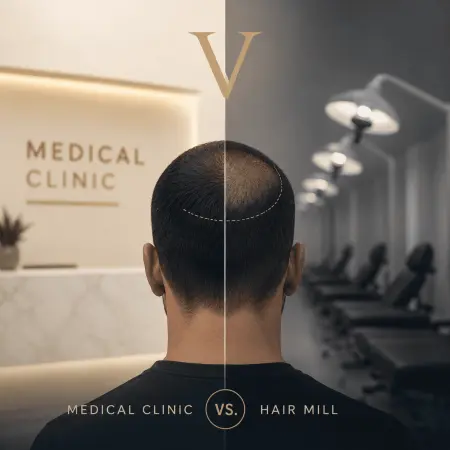
Table of Contents
Istanbul has quietly become the hair transplant capital of the world. Every year, thousands of people fly in for the same reasons, prices that undercut Western clinics by a wide margin, surgeons with serious volume experience, and a medical infrastructure that can actually support it.
But here's the part most people don't find out until after they've booked: not every clinic in this city is playing the same game. Some build their whole model around one patient, one surgeon, one focused procedure. Others are set up to run as many bodies through the door as possible in a single day. In the industry, the second type has a nickname: a hair mill.
From the outside, you'd never know the difference. Same slick website, same discounted package price, same wall of before-and-after photos. The gap only shows up once you're in the chair, or worse, six months later when the results come in.
Price isn't really the thing to worry about. What matters more is:
- who's actually doing the work
- how the donor area is planned
- what the aftercare looks like once you've flown home
Knowing what separates a real clinic from a mill before you book doctor-led hair transplant in Turkey.
What Is a "Hair Mill"?
A hair mill is a clinic model built around volume. The goal is to move as many patients through the schedule as possible. It doesn't tailor each procedure closely to one person. Several patients may be treated around the same time in the same space. Technicians carry out most of the hands-on work while the surgeon oversees things at a higher level. They step in for the key steps rather than handling every part personally.
This model exists partly because of how the regulations are written and partly because it's simply more efficient at scale. In many places, the line between "technician-assisted" work and steps that legally require a doctor isn't always clearly defined or consistently enforced. It's also a matter of economics. Technicians cost less to employ than surgeons. So a clinic built around a larger support team can offer lower prices and treat more patients per day than a clinic running a fully surgeon-led, one-on-one model.

What a Real Medical Clinic Actually Looks Like
A legitimate clinic treats a hair transplant as a professional medical procedure.
A few things tend to be true:
- A licensed surgeon is the one performing or closely supervising the parts that matter most, especially extraction and graft placement, since that's what decides the angle, direction, and density of your future hairline.
- It's one patient at a time. The clinic isn't double-booking operating rooms to squeeze more revenue out of the day.
- The facility itself is a registered hospital or licensed clinic, not a rented office with a vague "medical partner" mentioned somewhere in the terms.
- The consultation is a real one. Bloodwork, scalp analysis, donor assessment, not a two-minute scroll through WhatsApp photos.
- Aftercare is actually structured, with follow-ups booked in and someone specific to contact if something feels off.
Medical Clinic vs. Hair Mill, Side by Side
| Factor | Medical Clinic | Hair Mill |
|---|---|---|
| Who performs the surgery | Licensed surgeon leads extraction & implantation | Technicians handle most or all of it |
| Patients per room, per day | One | Several, at the same time |
| Facility | Registered hospital or clinic | Often a rented space or "partner facility" |
| Consultation | Thorough, sometimes with bloodwork | Quick, sales-driven photo review |
| Pricing | Transparent, tied to graft count and technique | Heavy discounts, bundled packages, upsells |
| Aftercare | Scheduled follow-ups with a named doctor | Minimal, often handled by a call center |
| Marketing | Leans on outcomes and credentials | Leans on price and "all-inclusive" deals |
Have Questions? Let's Chat on WhatsApp!
Get instant answers 24/7. Receive your doctor-led hair analysis within 1 day, plus pricing and booking support.
Start WhatsApp ChatWhy Any of This Actually Matters
Hair transplantation might appear simple; however, it is actually a complex medical process that needs detailed preparation and skillful execution. If some crucial moments are neglected or performed in a routine manner, their negative results can be seen only several months later.
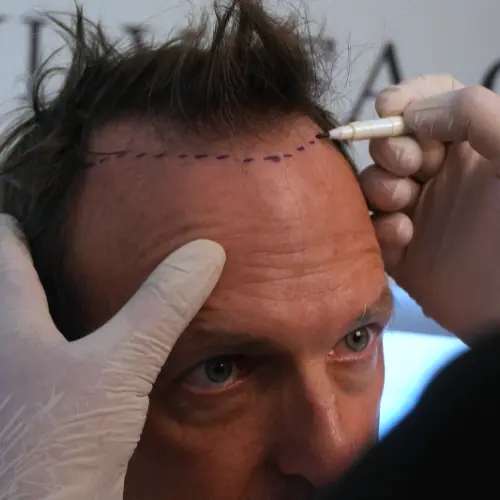
Unnatural hairlines are the most visible one. Getting the angle and density right along the frontal hairline takes real surgical judgment, not just following a template. Making sure that a hairline looks natural involves a lot of planning. The direction of hair growth, its angle, and density, along with the proportions of the face, need to be taken into account.
Then there's graft survival. Grafts are living tissue, and if they're handled roughly, sit out of solution too long, or go in at the wrong angle because someone's rushing to keep pace with the day's schedule, a chunk of them just won't take. You won't know this until months after you've already flown home.
The donor area itself is finite. You don't get it back. A careless extraction technique can scar it or over-harvest it, which permanently limits what's possible if you ever need a second procedure.
And if something does go wrong, there's often nobody to hold accountable. A real clinic has a named surgeon and a medical file. A lot of hair mills operate under shifting brand names or through booking agencies, which makes getting a refund, a correction, or even a straight answer nearly impossible.
How to Actually Check a Clinic Is Legit
Look up the surgeon independently. You should check the followings before the surgery:
- name
- license number
- any board certifications or ISHRS membership
Confirm the facility is a registered hospital or clinic, not just a nice-looking address. Look for longer-term reviews, six and twelve month updates, not just day-one photos fresh off the table, which honestly don't tell you much.
Ask outright whether your surgery will be one-to-one. A clinic confident in its process won't hesitate to say yes. Treat unusually low prices as a question, not a deal, asking what's being cut to hit that number.
Have Questions? Let's Chat on WhatsApp!
Get instant answers 24/7. Receive your doctor-led hair analysis within 1 day, plus pricing and booking support.
Start WhatsApp ChatFrequently Asked Question (FAQ)
Is Istanbul safe for a hair transplant?
Yes. The city has excellent surgeons and accredited hospitals. The risk is picking a hair mill, not the location itself.
How do I spot a hair mill before I travel?
Ask who performs the surgery and whether you'll share the room with other patients. Hair mills tend to dodge both questions.
Are hair mills illegal?
It's a grey area depending on where you look. Technicians doing surgical work that should require a licensed doctor is widely seen as unethical, even where enforcement is weak.
Does a lower price mean lower quality?
Not always, but a price far below the market average is worth questioning before you book.
FUE, DHI, or sapphire FUE: Which one should I ask for?
Depends on your donor density and goals. That's a conversation for a surgeon, not a sales coordinator.
Can a bad transplant be fixed?
Sometimes, with a skilled surgeon doing corrective work. However, it's harder, pricier, and limited by whatever donor hair is left. Better to get it right the first time.
 conversation


