
 English
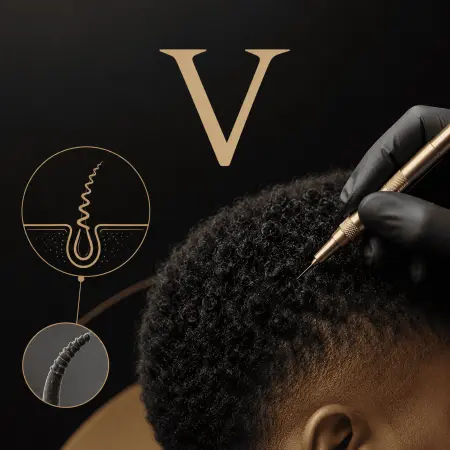
Table of Contents
Is FUE Good for Afro Hair?
Yes, FUE can be suitable for Afro hair, but standardised extraction planning may not suit every curly or coily follicle pattern.
The reason comes down to biology, not skill alone. The follicles here don't just curl above the scalp they curve beneath it as well. That single detail changes how extraction, angle planning, and implantation all need to be approached.
So the real question isn't a simple yes-or-no. It's whether the clinic performing the procedure actually has dedicated experience with tightly coiled follicles — not just a standard protocol applied to every patient regardless of texture. That distinction decides whether you end up with natural-looking density or a disappointing, patchy result. If you're weighing this decision right now, you're not alone it's one of the most common concerns patients raise before booking.
Why Afro Hair Behaves Differently Under the Skin
This texture, often classified as Type 4 using the Andre Walker typing system, has a tightly coiled structure that continues below the skin's surface. It's the part most patients never think about until it's too late.
Curved Follicles and the Hidden Root Structure
In straighter textures, the follicle root usually travels in a fairly predictable, near-straight line. In coily strands, that same follicle can curve, bend, or even spiral before reaching the bulb.
This matters enormously during extraction. If a surgeon uses the same straight-line punch angle used for straighter growth patterns, the curved root gets nicked or severed before it fully exits the donor area.
You might not notice this on the day of surgery. You'll notice it months later, when density in the recipient area looks thinner than expected.
Why Standard FUE Assumptions Don't Always Apply
Most FUE protocols were originally standardized around straighter growth patterns. Punch sizes, extraction angles, and rotation techniques were optimized for follicles that behave in a predictable way.
Tightly curled follicles don't follow that same predictability, and this is exactly where an unadjusted approach can turn a promising candidate into a frustrated patient with a wasted donor area.
If you're researching this type of transplant in Turkey, this is the single most important thing to ask a clinic about before booking: do they have a dedicated technique for coily strands, or do they run every patient through the same standard process?
When Classic FUE Works Well for Afro Hair
Classic FUE can still deliver decent results for looser curl patterns, particularly for those whose texture leans closer to wavy than tightly coiled. But it's worth understanding its real limitations before comparing it to more specialized approaches.
In Classic FUE, follicles are removed using 0.9–1.0 mm punches, which may lead to larger wounds and a longer recovery period. Channel openings created by steel blades measuring 1.0–1.2 mm generally allow a density of around 35–40 grafts per square centimeter, with recovery typically taking 10–14 days.
Ideal Candidate Profile
You're a reasonable candidate for a more standard FUE approach if your curl falls in the looser type 3C to milder type 4A range, your donor area is healthy and dense, and your expectations are realistic rather than aiming for the highest possible graft density.
If any of those factors are missing especially donor density a technique built specifically for tightly coiled follicles usually produces safer, more predictable outcomes.
When FUE Needs Adjustment for Afro-Textured Hair
Tighter curl patterns, particularly deeper type 4B and 4C textures, almost always need an adjusted FUE approach. This isn't a matter of preference; it's a matter of graft survival.
What Changes When FUE Is Adjusted for Afro Hair
An adjusted approach for this texture typically involves a slower, more deliberate extraction pace, real-time correction of the punch angle to follow each follicle's curve, and smaller punch sizes to reduce tissue trauma around tightly coiled roots.
Istanbul Vita built its Vita Technique® with exactly this kind of precision in mind, and applies it as the Afro Technique® for curly and tightly coiled cases specifically using 0.6–0.7 mm sapphire punches for extraction and 0.6–0.8 mm sapphire tips for channel opening, with angle orientation planned around each patient's curl direction and follicle anatomy.
Punch Size, Extraction Angle, and Transection Rate
Transection rate the percentage of follicles damaged during extraction is the number that separates a good outcome from a poor one in curly and coily cases. Standard FUE applied without adjustment can push transection rates noticeably higher than on straighter textures, and curl pattern has been highlighted as a meaningful variable in extraction planning by organizations such as the International Society of Hair Restoration Surgery.
Reducing punch diameter and matching the extraction angle to the follicle's natural curve are the two adjustments most consistently linked to lower transection and better graft survival in these cases. This is also why doctor-led planning matters so much for black hair transplant planning a technician working alone, without a physician mapping curl direction beforehand, is more likely to miss these details.
FUE vs DHI vs Afro Technique®: Which Approach Wins?
At Istanbul Vita, Classic FUE and DHI are both used alongside the Afro Technique®, built on the clinic's Vita Technique® foundation but applied specifically for coily and tightly curled textures to help preserve the natural follicle while planning around each patient's unique growth pattern.
| Feature | Classic FUE | DHI | Afro Technique® |
|---|---|---|---|
| Punch size (graft extraction) | 0.9–1.0 mm — wider cuts, more scarring risk, longer healing | 0.8–0.9 mm — improved, but donor thinning risk remains in dense extractions | 0.6–0.7 mm (sapphire) — smaller cut for less tissue trauma, faster healing, denser results |
| Channel opening & angle planning | Steel slits, 1.0–1.2 mm — this width limits density to around 35–40 grafts/cm² | Implanter pen — opens and places grafts simultaneously, though direction control is more limited | 0.6–0.8 mm (sapphire) — specialized angle orientation for curly patterns, respecting natural curl direction |
| Density & naturalness | 35–40 grafts/cm² — some risk of a sparse look | 40–45 grafts/cm² — denser, though frontal hairline naturalness is more limited | 80–100 grafts/cm² — density planning paired with curl-pattern preservation and hairline design |
| Healing time | 10–14 days — longer scabbing due to wider channels | 7–10 days — faster scabbing, more donor trauma | 5–7 days — smaller sapphire channels support quicker healing |
For patients specifically comparing FUE vs DHI for coily strands, the Afro Technique® tends to stand out because it was designed around curl pattern and follicle anatomy from the beginning, rather than adapted from a method built for straighter textures.
Why Angle Control and Curl Pattern Matter
Angle control isn't a small technical detail here it's often the single factor that decides whether results look natural or noticeably placed. Since these follicles curve beneath the skin as well as above it, every stage of the procedure needs to account for that hidden structure.
Curl pattern, graft angle, follicle shape, scalp characteristics, and donor management strategy all influence the final outcome. A team experienced with wavy, curly, coiled, and tightly textured growth can build a treatment plan that respects the patient's natural structure while still aiming for strong density and a balanced hairline.
This attention matters most at two points: during extraction, where the curved follicle path has to be tracked carefully to protect graft quality, and during implantation, where matching the natural flow and angle of the original growth pattern is what makes a result look authentic rather than simply inserted.
Recovery, Density, and Realistic Results
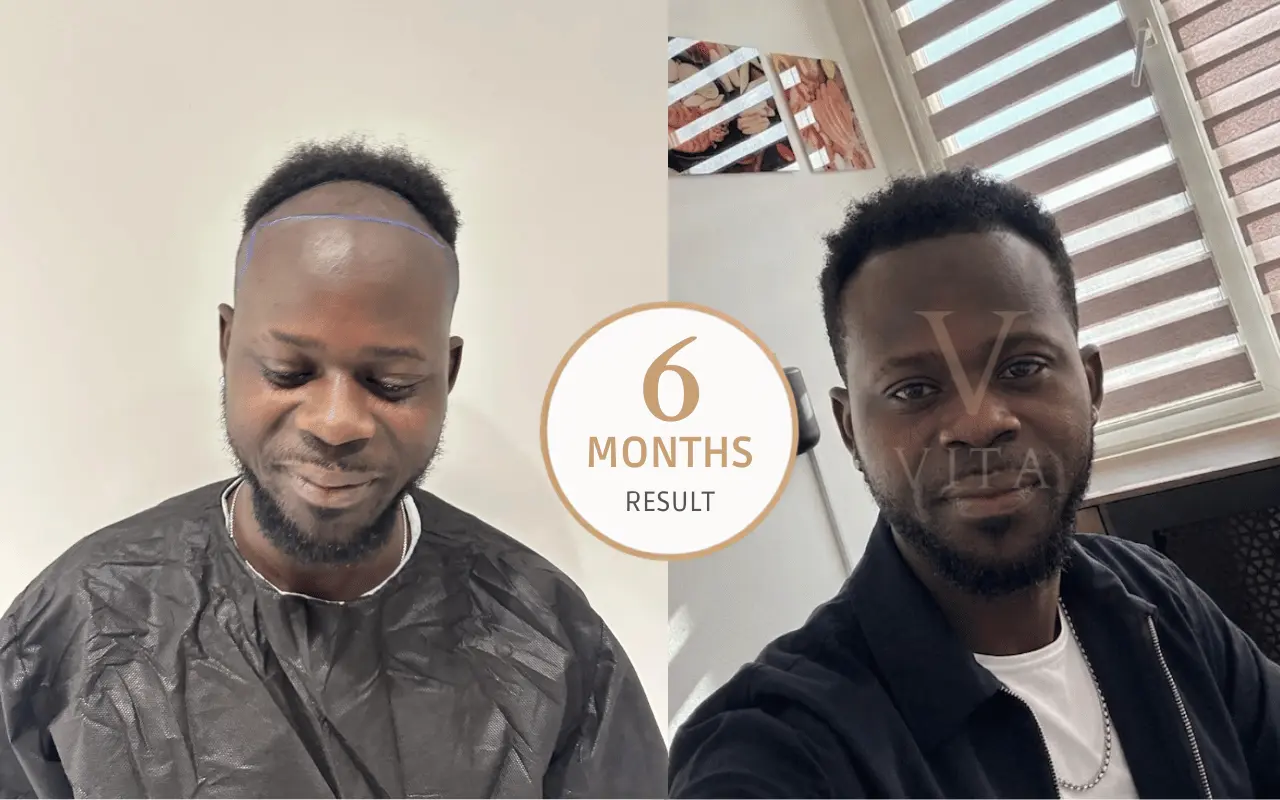
Recovery after this type of FUE procedure generally follows a predictable timeline, though the technique used and the supporting care around it can meaningfully affect both comfort and final density.
| Stage | What to Expect |
|---|---|
| Initial healing | 5–14 days, depending on technique used |
| Visible shedding phase | 2–4 weeks (normal and expected) |
| New growth begins | 3–4 months |
| Final density assessment | 12–18 months |
Results tend to look most natural when the implantation angle mirrors the patient's original growth direction, rather than a uniform angle applied across the whole recipient area. Supporting steps such as pre-operative blood work and EKG screening, graft preservation methods, and a structured post-operative care kit can also play a role in how well grafts settle and survive over the following months.
How to Choose the Right Clinic for an Afro Hair FUE Procedure
The technique name on a clinic's website matters far less than what actually happens during your consultation. A clinic that performs real microscopic donor analysis, rather than a quick visual check, is signaling that it takes curl-pattern planning seriously.
Why Doctor-Led Planning and Microscopic Donor Analysis Matter
Doctor-led planning means the physician not solely a technician is involved in evaluating your donor area, curl type, and hair caliber before extraction begins. For this hair type specifically, this step is what prevents a rushed, one-size-fits-all approach.
At Istanbul Vita, microscopic donor analysis is used to divide the donor area into D1–D4 zones, allowing each region to be assessed according to its graft characteristics, while the recipient area is mapped into F1–F7 zones to determine where single- or multi-hair grafts are most appropriate. Dr. Mustafa Ayhan Balcı and Dr. Harun Eymen Alakaya specialize in afro hair transplantation, while Dr. Özge Miray Gültekin focuses on afro hair procedures and natural hairline design. Channel opening is performed by the doctors themselves, an important consideration when working with curved follicles that require precise angle control. For patients researching curly and coiled hair transplant in Turkey, this level of doctor-led planning and personalized assessment can be just as important as the technique itself. Istanbul Vita follows a boutique model, limiting the number of daily procedures to allow more time for consultation and individualized treatment planning. If you're still comparing clinics, our Afro Hair Transplant Turkey Guide explains what to look for during a consultation, how donor areas should be evaluated, and which questions can help you make a more informed decision.
Frequently Asked Questions
Can afro hair be transplanted with FUE?
Yes this texture can be transplanted successfully with FUE when the extraction angle and punch size are adjusted to match the follicle's natural curve beneath the skin.
What is the best FUE technique for afro hair?
There isn't one universal answer, but dedicated approaches like the Afro Technique® using smaller sapphire punches and doctor-led angle correction tend to produce more consistent density and lower trauma than unadjusted classic FUE.
Why is standard FUE sometimes riskier for afro hair?
Because standard protocols assume a straighter follicle path. Applied to coily strands without adjustment, this can raise transection rates and reduce graft survival.
How long does FUE afro hair recovery take?
Most patients see initial healing within 5 to 14 days depending on the technique used, with new growth typically becoming visible around the three to four month mark.
Have Questions? Let's Chat on WhatsApp!
Get instant answers 24/7. Receive your doctor-led hair analysis within 1 day, plus pricing and booking support.
Start WhatsApp ChatIs Sapphire FUE better than classic FUE for afro hair?
Sapphire-based approaches with smaller punch sizes can reduce tissue trauma and support higher density, which tends to benefit tightly coiled follicles — though the surgeon's dedicated experience with this specific texture still matters more than the tool itself.
 conversation


