
 English
Table of Contents
Many people booking an afro hair transplant find out too late that their donor area was extracted at the wrong angle. The result isn't just a slower recovery it's patchy density, visible scarring, and grafts that never grow back. This mistake is almost always avoidable, but only if you understand why curved follicles behave so differently from straight ones before you sit in the surgical chair.
What Causes Curved Follicles in Afro Hair Transplant?
Curved follicles in afro hair transplant happen because the hair shaft itself grows in a spiral, not a straight line. This spiral shape isn't limited to what you see above the scalp it continues underneath the skin, often bending at unpredictable angles inside the dermis.
This is the single biggest reason afro and coily hair transplants require a different surgical approach than straight or wavy hair. A technique built for straight follicles simply wasn't designed to follow a curve.
| Hair Type | Follicle Shape Under the Scalp | Extraction Difficulty | Extraction Planning |
| Straight Hair | Straight | Low | Standard extraction angle is usually sufficient |
| Wavy Hair | Slightly curved | Moderate | Minor angle adjustments may be needed |
| Curly Hair | Curved | High | Careful angle control helps reduce follicle damage |
| Coily (Type 4) Hair | Highly curved | Highest | Precise, angle-matched extraction is essential |
The Anatomy of Curly and Coiled Hair Follicles
Under a microscope, an afro or type 4 hair strand has an elliptical, almost flat cross-section. Straight hair, by comparison, is closer to a perfect circle.
That elliptical shape is what forces the hair to grow in a curl rather than a straight line and it's also why the follicle beneath the skin twists as it grows toward the surface.
Why the Curve Extends Beneath the Scalp
In afro-textured hair, the follicle doesn't just curl above the skin it can bend, loop, or even nearly double back on itself below the surface. Surgeons sometimes describe this as extracting "around a corner you can't see."
This is exactly why afro hair transplant technique differs so much from standard FUE. Extracting blindly, at a fixed angle, is one of the fastest ways to damage a graft before it's even out of the skin.
What Is Type 4 Afro Hair, and Why Does It Matter for Extraction?
Afro-textured hair falls under Type 4 in the Andre Walker Hair Typing System, and it isn't limited to any single ethnic background it appears across many hair origins, ranging from loosely defined curls to tight, Z-shaped coils. A mixture of types, such as 3C and 4A, is also common.
Understanding which sub-type a patient has directly affects how extraction should be approached, since curl tightness changes how sharply the follicle bends beneath the skin.
Type 4A, 4B, and 4C: What's the Difference?
| Hair Type | Curl Pattern | Extraction Consideration |
| Type 4A | S-shaped curls, clump together, elastic | Moderate curve depth, easier to trace visually |
| Type 4B | Sits between 4A and 4C, sharp zigzag or Z-shaped pattern, less defined curl | Steeper internal bend, higher angle-adjustment need |
| Type 4C | Thickest of the four types, high shrinkage, no defined curl | Requires the most precise, slow extraction technique |
Why Extraction Angle Matters in Afro Hair Transplant
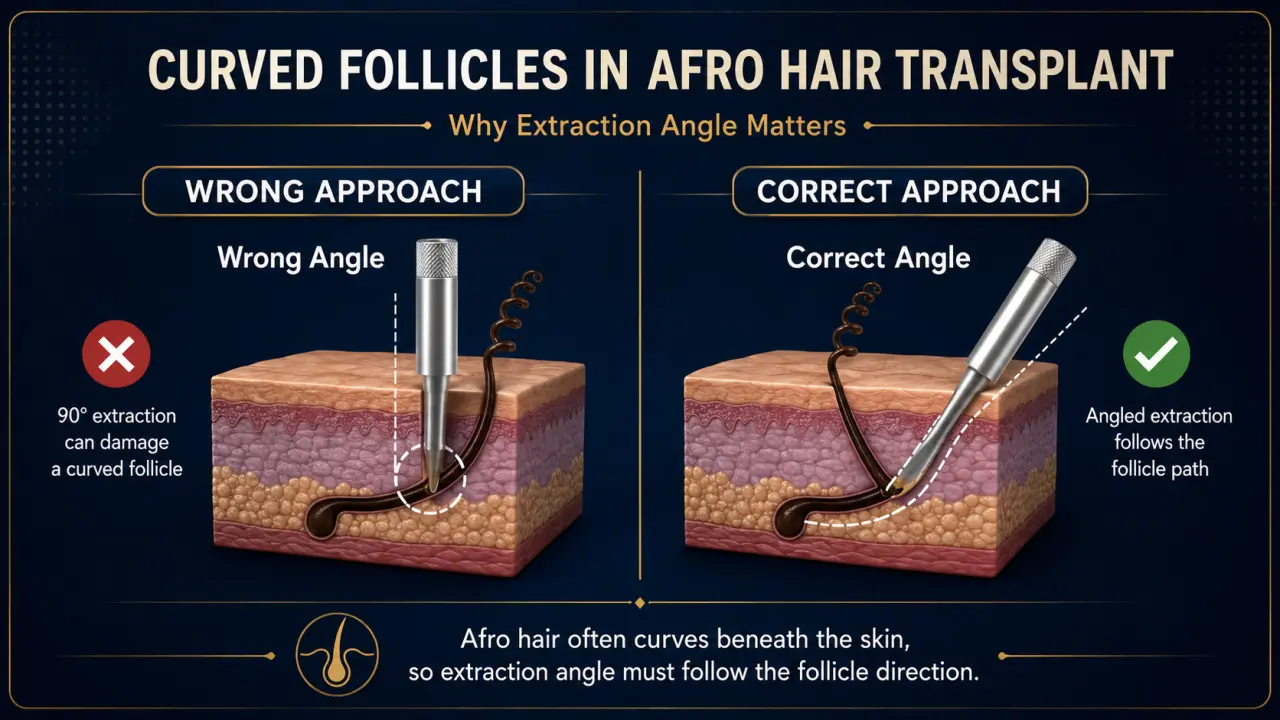
Extraction angle matters because it determines whether the punch follows the natural curve of the follicle or cuts across it. When the angle is wrong, the follicle gets sheared, not extracted and a sheared follicle rarely survives transplantation.
This is the core reason why extraction angle matters in afro hair transplant more than in almost any other hair type.
How the Wrong Angle Increases Transection Rate
Transection means the follicle is partially or fully cut during extraction. In afro hair transplant, transection rate rises sharply when the surgeon uses the same angle and depth approach they'd use on straight hair.
Clinical experience across hair restoration practices consistently shows that transection rates can climb well above 20–30% when curved follicles are extracted without adjusting for their internal curve, compared to single-digit rates achieved by teams specifically trained in afro and coily hair extraction. The International Society of Hair Restoration Surgery (ISHRS) has repeatedly highlighted this as one of the most technically demanding aspects of hair transplantation.
Classic FUE vs. DHI vs. Afro Technique®: How Extraction Angle Compares
Not every technique handles curved follicles the same way. At Istanbul Vita Clinic, Classic FUE and DHI are both used alongside Afro Technique® — a method developed specifically for afro, curly, and tightly coiled hair to help preserve the natural follicle while planning around the patient's hair type.
| Feature | Classic FUE | DHI | Afro Technique® |
| Punch Size (Extraction) | 0.9–1.0 mm — wider cuts, increased scarring risk, longer healing | 0.8–0.9 mm — better control, but donor thinning risk in dense extractions | 0.6–0.7 mm sapphire — smaller cut, less tissue trauma, denser transplant |
| Channel Opening | Steel slits, 1.0–1.2 mm, limits density to roughly 35–40 grafts/cm² | Implanter pen — opens and implants at once, but direction and angle control is restricted | 0.6–0.8 mm sapphire — specialized angle orientation respecting natural curl direction |
| Typical Density | 35–40 grafts/cm² — sparse appearance risk | 40–45 grafts/cm² — dense, but front hairline naturalness limited | 80–100 grafts/cm² — curl pattern preservation and ethnic hairline design |
| Healing Time | 10–14 days — scabbing lasts longer due to wide channels | 7–10 days — faster scabbing, but more donor area trauma | 5–7 days — sapphire channels and tiny punches provide the quickest healing |
This is why the best technique for afro hair transplant usually isn't Classic FUE or DHI applied without modification. Istanbul Vita's Afro Technique® is built to respect the natural texture of afro hair instead of forcing it into a standard straight-hair transplant model.
What Punch Size Works Best for Curved Follicles?
A smaller, sharper punch typically 0.6–0.7 mm works best for curved follicles because it allows finer control over depth and direction. Larger, blunter punches tend to force a straight path through tissue that isn't straight.
This is why afro hair transplant punch size is one of the first things worth asking a clinic about before booking.
How Do Punch Size and Extraction Depth Affect Graft Survival?
Punch size alone isn't the full story depth matters just as much. Going too deep, too fast, increases the odds of clipping the follicle where it bends beneath the skin.
Surgeons experienced in curly hair follicles transplant procedures typically extract more slowly, adjusting angle in small increments as they follow the graft down.
How Curved Follicles Affect Graft Survival, Density, and Keloid Risk
Curved follicles affect graft survival because any nick or shear at the root reduces the graft's ability to survive relocation. A damaged graft may still be implanted, but it's far less likely to grow.
Density perception is different, too. Because curly and coily strands naturally clump and add volume, correctly transplanted grafts can create the illusion of denser hair than the same graft count would on straight hair.
Should Keloid Risk Be a Concern?
Keloid formation is uncommon in afro hair transplant, but patients with a personal history of raised or unusual scarring should mention it during consultation. Skin type, prior wound-healing experience, and overall medical history all factor into a realistic risk assessment before the procedure.
Why Doctor-Led Extraction Reduces Risk
Doctor-led extraction reduces risk because it's the doctor, not a technician working on volume, who adjusts angle in real time as the follicle curves beneath the skin. This kind of hands-on judgment is difficult to standardize into a fixed protocol.
At Istanbul Vita Clinic, Dr. Mustafa Ayhan Balcı and Dr. Harun Eymen Alakaya are specialists in afro procedures and take part directly in both planning and treatment. Afro hair transplant planning begins with the patient's real curl pattern, donor area strength, and long-term density goals not just moving grafts from one area to another, but protecting the natural character of the hair.
For afro hair transplant in Turkey, this level of individual planning is often what separates a natural-looking result from an uneven one.
How to Choose the Right Clinic for Afro Hair Transplant in Turkey
Choosing the right clinic for afro hair transplant in Turkey comes down to how much control the doctor has over extraction and implantation not just which technique name is advertised.
A thorough afro hair transplant Turkey guide should always start with this question, because technique names alone don't guarantee angle-aware, curve-specific handling.
Questions to Ask Before Booking Your Procedure
- Does the doctor personally perform channel opening, or is this fully delegated to technicians?
- What punch size is used specifically for curved and coily follicles?
- Is donor area analysis done under microscope before extraction begins?
- How many procedures does the clinic perform per day and does that allow enough time per patient?
These questions matter more for afro-textured hair than for almost any other hair type, simply because there's less room for error.
If you're still comparing options, thinking through black hair transplant planning in detail including donor strength, curl type, and hairline design tends to matter more than the marketing name of any single technique. Istanbul Vita Clinic has built its afro hair transplant approach around its Afro Technique®, with doctors evaluating donor zones, curl pattern, and long-term aesthetic goals before deciding on punch size or implantation angle. Treatment plans are tailored to the complexity of each case rather than following a one-size-fits-all approach. Pricing is based on case complexity rather than graft count. The clinic also follows a MAX2 model, limiting each doctor to a maximum of two procedures per day. For patients researching curly and coiled hair transplant in Turkey, that level of doctor involvement and detailed planning is worth considering not as a sales pitch, but as a practical way to help protect their long-term results.
Frequently Asked Questions
Does afro hair have curved follicles?
Yes. Afro and coily hair follicles curve both above and beneath the scalp, unlike the mostly straight follicle path seen in straight or wavy hair types.
Can curved follicles be transplanted successfully?
Yes, when extraction angle and punch size are adjusted specifically for the curve. Success rates drop mainly when clinics apply straight-hair techniques without modification.
Why is afro hair transplant different from other transplants?
It's different because the follicle's internal path is unpredictable, requiring smaller punches, slower extraction, and more hands-on angle adjustment throughout the procedure.
What punch size is used for afro hair transplant?
Most experienced surgeons use smaller sapphire punches around 0.6–0.7 mm, rather than the larger 0.9–1.0 mm steel punches common in standard FUE.
How does extraction angle affect graft survival?
An angle that doesn't follow the follicle's natural curve increases the chance of transection, which lowers the odds that the graft will survive and grow after implantation.
Have Questions? Let's Chat on WhatsApp!
Get instant answers 24/7. Receive your doctor-led hair analysis within 1 day, plus pricing and booking support.
Start WhatsApp Chat
 conversation


