
 English

Table of Contents
About a few weeks post hair transplant using afro hair, a patient will experience the shedding of these newly planted hairs. This situation may be frustrating especially to the patient who has already spent a lot of money and energy on the transplant. In fact, it happens in many cases that this phase creates more concern in the patient than the procedure itself. This is because patients tend to think that the transplant is not done properly, the grafts are dead or they are falling off due to other reasons. The thing you need to know about shock loss of hair is its mechanism, time frame and the differences between shock loss and graft failure.
Why Does Shock Loss Happen After Afro Hair Transplant?
Shock loss occurs since the trauma of the procedure induces hair follicles to go into their resting phase prematurely, which is referred to as Telogen or Anagen Effluvium. It can be equated to a plant losing some of its leaves after it has been transplanted into a new container. The plant has not been injured during the transplant but is under a lot of pressure as it adjusts, just as a hair transplant physician would describe shock loss.
Afro hair adds an extra layer of complexity. The follicle itself curves beneath the skin in a C-shape, instead of growing straight down like Caucasian or Asian hair typically does. That curve makes extraction harder and slightly raises the risk of follicle transection, which is part of why graft survival in Afro-textured hair sits around 80% to 90%, compared with 85% to 95% in straighter hair types, based on data compiled by hair transplant graft survival researchers.
This is not a flaw in your hair. It's a structural reality that an experienced surgeon plans around, usually by harvesting 10% to 15% more grafts than the final target to account for the extra handling Afro-textured follicles require.
A few other factors influence how much shock loss you'll see:
- Graft volume. Larger sessions tend to correlate with more noticeable shedding.
- Surgical technique. FUE on curved follicles takes longer, often six to eight hours, because of the careful angle assessment involved.
- Individual healing response. Some scalps simply react to surgical trauma more than others.
- Donor area handling. Over-harvesting from a single zone increases localized stress and shedding risk.
Afro Hair Transplant Shock Loss Timeline: Week by Week
Most shock loss follows a predictable pattern that starts around week two and resolves by month three or four. Here's what that generally looks like:
| Timeframe | What's Happening | Should You Worry? |
|---|---|---|
| Days 1-14 | Healing, scabbing, minimal shedding | No, this is post-op recovery |
| Weeks 2-4 | Transplanted hair shafts begin shedding | No, this is the shock loss phase starting |
| Months 2-3 | Shedding peaks, scalp may look patchy or sparse | No, this is the "ugly duckling" stage |
| Months 3-5 | New hair growth starts emerging from follicles | No, this is recovery beginning |
| Months 6-9 | Density visibly improves, texture normalizes | No, normal progress |
| Months 10-12 | Full, mature results for Afro-textured hair | No, this is the expected final timeline |
| Beyond month 4 with no new growth | Recipient area stays bald with no stubble | Possibly, worth a clinic check |
This timeline is in agreement with the time frame known as the recovery window in surgical telogen effluvium in dermatological studies, wherein most cases show complete regrowth after about ten months of the onset of the condition, according to published NIH research.
Shock Loss vs Graft Failure After Afro Hair Transplant: How to Tell the Difference
The biggest fear patients have isn't shock loss itself, it's not knowing whether what they're seeing is shock loss or a failed graft. The two look similar on the surface but behave very differently over time.
| Sign | Shock Loss | Graft Failure |
|---|---|---|
| Timing | Starts weeks 2-4, peaks months 2-3 | Visible immediately or grafts never "take" |
| Scalp appearance | Tiny dot scabs, mild redness, then smooth skin | Crusting, infection signs, or grafts visibly dislodged |
| Hair shaft vs follicle | Shaft sheds, follicle stays under skin | Follicle itself doesn't survive |
| Regrowth pattern | New fine hair appears by months 3-5 | No new growth from that specific graft, ever |
| Pain or inflammation | Minimal, resolves with healing | Often paired with prolonged swelling, pus, or pain |
| Distribution | Often diffuse across the recipient or donor area | Often clustered, follows poor implantation pattern |
| Resolves on its own | Yes, within months | No, the graft is gone permanently |
If you're past month five with zero new growth in a specific patch, that's the point to flag it with your surgeon rather than assume it will fix itself. A clinic that offers real follow-up support, not just a one-time consultation, makes this distinction far less stressful, because you can send photos and get a doctor's read on it instead of guessing from a forum thread.
How Long Does Shock Loss Last After Afro Hair Transplant, and What Does Recovery Look Like?
For most patients, the active shedding phase lasts roughly four to eight weeks, with visible regrowth beginning by month three to five and full maturity by month ten to twelve. Afro-textured hair tends to sit at the longer end of that window because of slower growth cycling and the additional healing time curved follicles need.
Recovery isn't just about waiting it out. A few things genuinely speed it along:
- Finasteride, when appropriate for the patient, is the most commonly prescribed medication among hair restoration physicians, used in over 70% of cases according to the ISHRS 2025 Practice Census, and can shorten the shedding window when started early.
- Topical minoxidil, prescribed in roughly half of cases per the same census data, supports blood flow to follicles during the resting phase.
- Avoiding tight hats, heavy product, and excessive scratching during the first few months reduces additional mechanical stress on healing follicles.
- Sticking to the aftercare schedule your clinic gives you, rather than improvising based on what worked for someone else's hair type.
This is where hair loss treatment plans matter more than people expect. Shock loss recovery isn't just biology working on its own timeline, it's also about whether your post-op support actually answers your questions when you're three months in and unsure if what you're seeing is normal.
Can Shock Loss Be Prevented After an Afro Hair Transplant?
Shock loss can't be eliminated entirely, but its severity and duration can be reduced through surgical planning, technique, and aftercare. The biggest lever isn't a product you apply, it's who's holding the punch tool during extraction.
Here's what actually moves the needle:
Microscopic donor analysis before surgery. Mapping follicle angle, curl direction, and density under magnification before the first incision reduces unnecessary transection, which directly reduces graft trauma and shock loss severity.
Conservative extraction per session. Surgeons who avoid over-harvesting any single zone of the donor area limit localized inflammatory stress, which is one of the documented contributors to more severe shedding.
Realistic graft planning. Padding the harvest by 10-15% to account for Afro hair's curved follicle structure, instead of cutting corners to hit a lower price, means fewer grafts are pushed past their tolerance.
Low-volume, focused sessions. Clinics performing a high number of procedures per day, per surgeon, are statistically more likely to see fatigue-related transection increase, which is exactly what fuels the kind of botched results behind a rising number of revision cases, up to 6.9% of all procedures in 2024 according to ISHRS data.
Early medical support. Starting finasteride or minoxidil at the right point in the timeline, under a doctor's guidance, rather than self-prescribing.
None of this guarantees zero shedding. What it does is help keep shock loss within the normal, temporary range rather than allowing it to develop into the kind of prolonged shedding that causes unnecessary concern during recovery.
This is also why treatment planning matters before the procedure even begins. At Istanbul Vita, factors such as donor density, follicle characteristics, and graft distribution are evaluated before surgery to help support healthy healing and realistic long-term results.
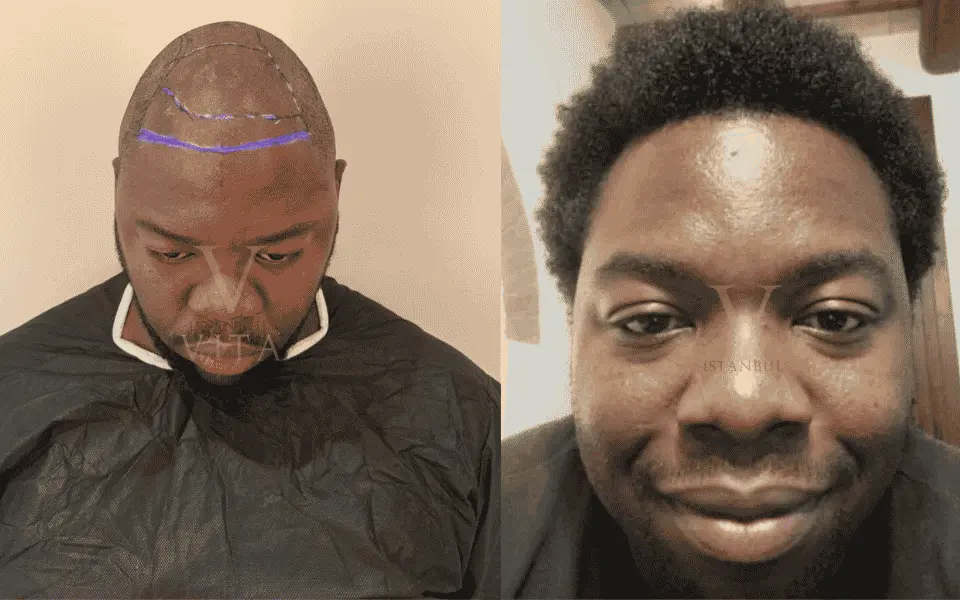
What Afro Hair Transplant Before and After Photos Really Show About Shock Loss
It is true that before and after photos will be of great use while assessing the afro hair transplant recovery results; however, it should be noted that taking photos at different stages of growth may lead to a totally different appearance of the photos. Thus, a photo taken during the first few months of the process may differ significantly from the one taken at the last stage due to the effect of shock loss and other recovery features.
That is why it is much better to see the monthly changes in terms of shedding and regrowth as well as hair density. This is especially relevant when it comes to the assessment of afro hair transplant before and after photos as such factors as curling, hair density, and healing period may affect the results.
Modern Afro Hair Transplant Techniques and Recovery
Today's afro hair transplants are planned very differently from older hair restoration procedures. Because afro-textured follicles naturally curve beneath the skin, both extraction and graft placement require a more specialized approach. Techniques such as Sapphire FUE and DHI can be used as part of the treatment process, while donor area evaluation and graft planning play an equally important role in achieving natural-looking results.
At Istanbul Vita, afro hair transplant procedures are supported by microscopic donor analysis and the clinic's Afro Technique®, which was developed specifically for curly and afro-textured hair. Treatment planning is carried out under doctor supervision, with careful attention to follicle characteristics, graft distribution, and natural hairline design. Hair Transplant Surgeon Özge Miray Gültekin, who has more than 12 years of experience in hair restoration and surgical planning, is among the specialists experienced in afro hair transplantation and patient-specific treatment planning. If you would like to learn more about afro hair transplant options or recovery expectations, you can contact the Istanbul Vita team through the contact page.
Frequently Asked Questions
Is shock loss after Afro hair transplant a sign the surgery failed?
No, shock loss is a normal shedding response and does not mean the follicles underneath have died.
When does shock loss start after Afro hair transplant?
Shedding typically begins between weeks two and four after the procedure.
How long does shock loss last after Afro hair transplant?
Active shedding usually resolves within four to eight weeks, with new growth appearing by months three to five.
Can shock loss affect hair that wasn't transplanted?
Yes, native hair near the recipient or donor area can temporarily thin due to surgical trauma, then recover within several months.
Does Afro-textured hair experience more shock loss than straight hair?
Afro hair can show slightly more shedding due to its curved follicle structure, but recovery follows the same general pattern.
Have Questions? Let's Chat on WhatsApp!
Get instant answers 24/7. Receive your doctor-led hair analysis within 1 day, plus pricing and booking support.
Start WhatsApp ChatHow do I know if it's shock loss or graft failure?
If new fine hair hasn't appeared by month five in a specific patch, ask your surgeon to evaluate it rather than assuming either way.
Will my hair transplant before and after results look bad during shock loss?
Yes, the months two to four window often looks worse before it looks better, which is expected and temporary.
 conversation


