
 English

Table of Contents
Five minutes in! That's about how long it takes before someone at your first hair transplant consultation starts throwing out words like "graft density" or "donor zone," like you're supposed to just know. You don't. Nobody really does at first.
This hair transplant consultation guide exists because of that exact gap: what clinics assume you already know versus what you're actually walking in with.
Maybe you're brand new to this, still deciding if hair implants make sense. Or maybe you've already sat through a few consultations and somehow you're still confused.
Either way, real answers, no pressure to book on the spot, no jargon you'll be googling later wondering what you just agreed to.

Hair Transplant Consultation Guide: Is Hair Implants or Restoration Right for You?
Understanding Androgenetic Alopecia Consultation (Pattern Baldness)
Almost everyone who books a consultation has the same underlying cause is genetics. Androgenetic alopecia, pattern baldness, basically follows a script that's frustratingly predictable. Temples recede. The crown thins. The area becomes progressively wider each year, and the change is subtle enough that you do not even realize what is happening until someone tells you.
The reason is DHT, which is created from testosterone and causes the hair follicles to get smaller until they eventually become too small to produce usable hair. This is where your position on that continuum comes into play.
Can Hair Implants Treat Alopecia Areata and Other Hair Loss Types?
Here's where things get more complicated. Alopecia areata isn't genetic. It's autoimmune, and it shows up as sudden patches rather than the slow thinning of pattern baldness.
Can hair implants help? Sometimes, but only once the condition has calmed down and stopped being active.
Transplant into an area that's still inflamed and you're wasting grafts on tissue that might reject them anyway. A proper diagnosis has to come before any talk of surgery.
Determining the Ideal Age and Timing for Hair Replacement
There's no magic number for when to get hair replacement done. But there's definitely a wrong time, and that's too soon. Surgeons tend to hold off until the loss pattern has settled, because operating on a scalp that's still actively losing hair around the transplanted area can leave you with mismatched density five years down the line. Patience pays off here more than people expect.
What to Expect During a Comprehensive Hair Transplant Consultation
A real hair transplant consultation shouldn't feel like a fifteen-minute upsell. It should feel like an actual medical evaluation.
Critical Questions to Ask Your Hair Transplant Specialist
Bring a list. Seriously.
Ask who's actually performing the surgery, a doctor, or mostly technicians?
Ask which technique fits your specific hair type and why that one over another.It would be wise to request the viewing of before and after pictures of actual patients that have hair just like yours and ask the number of grafts possible to be accommodated by your donor site.
If the clinic answers these questions without batting an eyelid, chances are you are dealing with a good clinic.
Evaluating Donor Hair Density and Graft Requirements
Everything depends on the donor zone that strips at the back and sides of your scalp that's genetically resistant to balding.
Surgeons measure density there per square centimeter to figure out how many grafts can come out safely without leaving the donor area visibly thin.
Older extraction methods top out around 35–40 grafts per cm². Never, finer techniques using sapphire blades can push that toward 80–100 grafts per cm² in the right candidates. That gap matters a lot if you're hoping to cover significant ground in one session.
Designing a Natural Hairline: The Key to Invisible Results
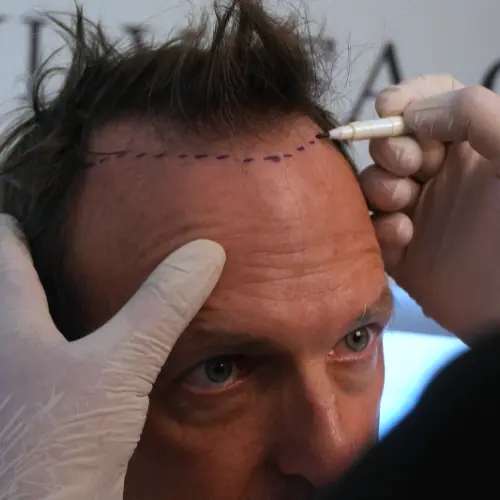
An obviously "transplanted" hairline almost always comes down to bad planning, not bad surgery. The trick is restraint at the front single, fine grafts along the hairline, with denser multi-follicle grafts saved for the crown and mid-scalp where nature does the same thing anyway.
Some clinics take this further. Istanbul Vita in Turkey, for instance, maps the donor and recipient sites into distinct zones before touching a single follicle, matching graft type to region so the growth direction actually looks like it grew there.
Maximizing Your Free Hair Transplant Consultation
A free hair transplant consultation sounds like a no-brainer, and it can be — if you go in knowing how to use it.
How to Find a High-Quality Hair Transplant Free Consultation
Good ones share a few traits. A doctor is involved somewhere in the process, not just a coordinator reading off a script. You're shown actual patient results, not a curated highlight reel. And the clinic doesn't dodge questions about certification.
Check independent review sites before you book not just testimonials sitting on the clinic's own homepage, which tend to tell only one side of the story.
Virtual vs. In-Person Hair Restoration Assessments: Pros and Cons
Virtual consultations are great for narrowing down a shortlist, especially if you're considering options abroad. A photo and a video call can rule clinics out fast. However, scalp elasticity, hair diameter, donor density – those are things a screen cannot do justice to.
Most people opt for both methods; virtually first as a filter then in person to confirm."
Red Flags to Watch for: Distinguishing Medical Advice from Sales Pitches
Watch out for pressure to book on the spot. Watch out for guaranteed graft counts handed out before anyone's even examined your scalp.
And watch out for consultations where no doctor appears at any point in the conversation. Real medical advice sounds careful, it talks about limits and realistic timelines, not just impressive before-and-after math.
Modern Hair Restoration and Hair Replacement Technologies
Technique shapes everything that follows: recovery time, final density, even how natural the result looks a year later.
Here is a hair transplant consultation guide for FUE and DHI techniques.
FUE vs. DHI Hair Transplant: Which Technique Suits You Best?
Classic FUE extracts follicles using punches around 0.9–1.0 mm, then opens recipient channels separately before implantation. It generally allows 35–40 grafts per cm², with recovery running 10–14 days.
DHI flips part of that process, an implanter pen opens the channel and places the graft in a single motion, often with slightly finer 0.8–0.9 mm punches.
Density can edge up to 40–45 grafts per cm², recovery shortens to roughly 7–10 days, though some patients notice more donor site tension with this approach.
Both remain solid options among modern hair transplants, and which one wins really depends on your density goals more than anything else.
Sapphire FUE: Advancements in Healing Times and Graft Survival
Sapphire blades cut cleaner than steel, smoother edges, less trauma to surrounding tissue, faster healing. Some methods take this further still.
Istanbul Vita's patented Vita Technique®, for one, uses 0.6–0.7 mm sapphire punches and reports densities up to 80–100 grafts per cm² in suitable cases, paired with tighter angle control for a result that's harder to spot as surgical.
No-Shave Hair Transplants and Specialized Hair Restoration for Women
Long Hair FUE, along with certain DHI applications, lets patients skip the full head shave entirely, a real consideration if you can't disappear for two weeks.
Female hair restoration deserves its own mention too, since it rarely follows male-pattern protocols. Diffuse thinning, different hairline shapes, different donor planning, women's cases need a tailored approach, not a copy-paste of standard male procedures.
Location Strategy: Local Clinics vs. Medical Tourism
Where you actually get the procedure done changes more than just the price tag.
"Hair Restoration Near Me": The Benefits of Local Continuity of Care
Typing hair restoration near me into a search bar has obvious appeal. Easier follow-ups. Faster suture removal if it's needed. The same doctor checking on you at every stage without flight logistics getting in the way.
Hair Transplants in the US: Choosing Clinics in Denver and Beyond
Patients researching hair transplants in cities like Denver often find genuinely skilled local surgeons. It's usually just at a higher cost, generally because of the cost of staffing and administration in American hospitals.
To some, having an ongoing relationship with one surgeon at home is worth the additional expense. To others, it is not.
Hair Transplant Consultation Turkey: Why Turkey is the Global Hub for Hair Restoration
There's a reason hair transplant consultation Turkey searches keep climbing.
The country has quietly become the world's busiest hub for this exact procedure, pairing experienced surgical teams with prices a fraction of what Western clinics charge.
Istanbul Vita Hair Transplant Clinic is a fair example of what that actually looks like on the ground, over 15 years in the field, a boutique model that caps things at just 1–3 international patients a day, and 40–60 minutes of real doctor consultation time per patient, not a rushed five-minute chat.
Opening of channels is done by the doctors personally rather than leaving it for the technicians to do; patient care is conducted in 13 different languages with the help of native speakers.
This clinic has got authorization from the Ministry of Health in Turkey as well as the International Health Tourism Authorization Certificate, and won the title of Best Hair Transplant Clinic in Europe for 2023. No matter which clinic one chooses while going abroad, this can be used as a benchmark.
Timeline Management: Pre-Consultation to Post-Op Recovery
The consultation is just the starting line. What happens after matters just as much.
Preparing for Your Procedure After a Successful Consultation
After agreeing upon a plan with your surgeon, preparation involves only simple blood tests and even an EKG test in some cases just to verify that you’re in a condition to have this surgery done on you. It’s always advised by doctors that patients stop taking blood thinners, stop drinking and smoking.
The First 12 Months: Navigating the Recovery and Shock Loss Phases
Around weeks two to four, a lot of patients panic when transplanted hairs, and sometimes nearby native ones, start shedding. This is shock loss, and it's completely normal, even if nobody warned you it would happen.
Regrowth typically kicks in around month three or four. Final texture and density usually don't settle in fully until close to the twelve-month mark, so patience really is the name of the game here.
Long-Term Maintenance: Extending Your Results with PRP and Medical Therapy
Transplanted follicles are permanent in most cases, but the native hair around them isn't automatically protected just because you had surgery. PRP, mesotherapy, and medicines such as finasteride and minoxidil may be applied post-surgery in order to prevent further hair loss and ensure that the remaining hair remains firmly rooted for quite some time to come after the surgery heals.
Have Questions? Let's Chat on WhatsApp!
Get instant answers 24/7. Receive your doctor-led hair analysis within 1 day, plus pricing and booking support.
Start WhatsApp ChatFrequently Asked Questions (FAQ) About Hair Transplantation
Is a hair transplant permanent?
For most patients, yes. Donor-zone follicles are naturally resistant to the hormone behind pattern baldness, so once they're settled into their new spot, they generally keep growing for the rest of your life.
How much does a reputable hair transplant consultation cost?
A lot of solid clinics don't charge for the initial evaluation at all, the cost comes later, with the procedure itself. As this hair transplant consultation guide keeps circling back to, how a clinic structures its pricing tells you more than the number alone.
Istanbul Vita, for example, prices its all-inclusive packages between $2,300 and $4,600 based on technique and procedure length, not graft count, which removes a lot of the guesswork.
How many grafts will I need for my hair restoration?
It all depends on the stage of hair loss and what the donor site is capable of giving. Usually, a person receives between 1,500 and 3,000 grafts. In more severe situations, where there is a need for more extensive coverage, one might receive even up to 6,000.
What is the success rate of hair implants for advanced alopecia?
The survival rate with an experienced team will be more than 90% generally. However, the exact figure depends on various factors like the donor’s health, type of surgery, and compliance with post-op instructions.
Why do patients travel to Turkey or cities like Denver for hair transplants?
Mostly it comes down to cost, concentrated surgical expertise, and packages that bundle the consultation, the procedure, and aftercare into one straightforward price. Whether you choose to fly somewhere or stay close to home, that's the real point of this hair transplant consultation guide, giving you enough clarity to weigh both paths and pick the one that actually fits your situation, not just the cheapest headline number.
 conversation


