
 English

Table of Contents
Afro hair transplants require a different surgical approach because curved follicles are easier to damage during extraction.
However, choosing the right hair transplant clinic is important no matter which procedure you choose. In the case of afro hair transplants, choosing the right clinic becomes even more important because afro hair follicles have their own characteristics. Unlike straight hair follicles, they naturally curve beneath the skin.
For this reason, a standard FUE method may not always be enough, as the final result largely depends on a detailed donor area analysis and the right extraction technique. The surgeon should also have experience working with curved follicles. Otherwise, graft quality may be affected.
Understanding the specific characteristics of a FUE afro hair transplant will help you make a more informed decision before booking your procedure. The following guide explains what to expect and what to look for when choosing a clinic.
What Is an FUE Afro Hair Transplant?
An FUE Afro Hair Transplant is a follicular unit extraction procedure adapted specifically for tightly coiled, curved follicles using curved or non-rotary punches, slower controlled speeds, and angle-matched implantation instead of the tools built for straight hair.
Standard FUE already works the same basic way for everyone. A surgeon removes individual follicular units one at a time, then implants them where hair is thinning. No strip of scalp is removed, so there's no long linear scar just tiny puncture marks that heal within days.
The difference with afro hair starts beneath the surface. A curl pattern you can see on top of the scalp is one thing. The way that same follicle bends underneath the skin, sometimes in a tight C-shape, is another problem entirely, and it's the part most generic FUE guides skip.
A surgeon who hasn't trained specifically on this anatomy is essentially extracting blind. That's where things go wrong.
Why Afro-Textured Hair Needs a Different FUE Technique
The FUE procedure has to be specially adapted for Afro-textured hair since the follicle is curved underneath and the straight rotary punch passes through that curve rather than along it - this is known as transection.
A landmark case series published in PMC, a database run by the U.S. National Library of Medicine, tested this directly. Researchers compared standard sharp rotary punches, dull rotary punches, and a curved non-rotary punch on patients with tightly curled afro-textured hair.
The standard sharp punches failed outright or produced unacceptably high damage in most patients. The curved, non-rotary punch consistently kept transection under 5%.
Here's what that gap actually looks like in practice:
| Extraction Method | Typical Transection Rate | What It Means for You |
| Standard sharp rotary punch (built for straight hair) | 30–80% | Up to 8 in 10 grafts destroyed before they're even implanted |
| Dull rotary punch | 15–30% | Better, but still high graft loss in tightly coiled hair |
| Curved non-rotary / skin-responsive punch | Under 5–10% | Most grafts survive extraction intact |
This is the single biggest reason a generic clinic and a specialist clinic can quote wildly different results for the exact same patient. The tool and the surgeon's hands-on experience with that tool decides how much of your own hair you actually keep.
There's a silver lining, though. Once an afro-textured graft is successfully transplanted, its coil shape covers more scalp surface per follicle than straight hair does. Surgeons sometimes call this "visual density" fewer grafts can still look fuller, which partly offsets the lower donor count most people of African descent have to begin with.
Is FUE Hair Transplantation Suitable for All Afro Hair Types?
If you have stable donor density at the back or sides of your scalp, if your hair loss has plateaued rather than rapidly progressing, and if you don't have an active scalp condition like folliculitis or acne keloidalis nuchae, you are likely a good candidate.
Just having curly hair never disqualifies someone. More important is the donor count, as the average person of African descent carries approximately 55,000 to 65,000 usable donor follicles, while in Caucasian patients this number can reach up to 100,000. This smaller donor bank explains why each graft salvaged during extraction is more valuable and why a clinic's cutting rate is far more important for afro hair than for straight hair.
Another common form of hair loss that is prevalent in areas such as the hairline and temples, which results from wearing braids or wigs tightly for a number of years, may be another common cause for afro-textured people opting for FUE. Such conditions usually need a gentler hairline creation and taking into consideration the extent to which the hair around can take tension; this is something that should be considered beforehand.
FUE vs. FUT for Black Hair Transplant: Which Is the Better Choice?
Generally speaking, FUE is the better option for afro-hair transplant patients since it doesn’t create a long linear scar typical of FUT. For people with dark skin, which tends to form visible scars when subjected to large incisions, the absence of such a scar makes FUE more appealing.
FUT is the process whereby a strip of skin is removed from the donor area and then split into grafts. While it is suitable in some cases, it leaves one continuous scar that is easily visible if the patient keeps his or her hair cut short. In contrast, FUE removes follicular units one at a time creating tiny dotted scars distributed throughout the donor area.
In afro hair transplants, however, selecting the right technique isn’t all there is to it. The success of such a procedure largely depends on the fact that afro hair follicles grow in curves, which implies donor site assessment, use of the right equipment and surgical skill.
| Factor | FUE | FUT (Strip) |
| Donor harvesting | Individual follicular units | Strip of scalp tissue |
| Donor scar | Small dot scars | One linear scar |
| Suitability for afro hair | Commonly preferred | Used in selected cases |
| Donor area healing | Usually faster | Usually takes longer |
| Future donor management | Greater flexibility | More limited after strip removal |
If you have had a history of scar formation and especially keloids in yourself or any member of your family, do let your consultant know about it as this can affect your treatment plan.
Every treatment at Istanbul Vita is made depending on the special features of the patient; not with a standard treatment program for everyone. Before the operation, the donor area and the hair are assessed together with expectations from the long term results.
How Much Does an FUE Hair Transplant Cost in 2026?
An FUE hair transplant for afro hair transplant costs between $3,000 and $6,500 in Turkey for a full session, compared to $10,000 to $28,000 for the same graft count in the United States or United Kingdom.
The gap comes down to cost-per-graft, not corner-cutting on quality. Clinics in the U.S. and U.K. average $5 to $10 per graft. Established Turkish clinics average roughly $1 to $1.80 per graft, largely because of lower facility and labor overhead, not lower-grade equipment.
| Region | Avg. Cost Per Graft | Cost for 3,500 Grafts |
| United States | $5.44 | $15,750 – $28,000 |
| United Kingdom | $5.00 – $10.00 | Roughly £4,820 average total |
| Turkey | $1.07 – $1.80 | $3,745 – $6,300 |
| Istanbul Vita Clinic | Doesn't Change by Grafts | $1,900 – $3,200 |
There are two important factors to consider, however, before getting carried away by the figure on offer. Firstly, afro-textured hair requires a more careful extraction method due to its curly nature, hence it is important to confirm whether the quote you received takes this into account when offering a very cheap price. Secondly, be sure about what is actually covered in the quotation. An ideal one should cover surgery costs, accommodation, transportation, medications, and consultations, amongst other things.
How to Choose a Clinic for Afro Hair Transplant in Turkey
The right clinic for an afro hair transplant in Turkey will run a microscopic donor analysis before quoting a price, use curl-specific extraction tools, and let you meet the operating doctor not just a sales coordinator before you commit.
Turkey performs an estimated 1.1 to 1.5 million hair transplant procedures a year, according to Turkish Ministry of Health tourism data, which means the market ranges from internationally accredited hospitals to high-volume clinics processing dozens of patients a day. For afro-textured hair specifically, volume is not the advantage you want. Precision is.
A short checklist before you book:
- Doctor-led planning. The surgeon who designs your hairline should be the same person reviewing your donor density, not a separate sales team.
- Microscopic donor analysis. Your curl angle and donor density should be assessed under magnification before a price is even discussed.
- Curl-specific technique. Ask directly whether they use Sapphire FUE or DHI tools adapted for coiled follicles, and how they manage transection risk for your specific curl type.
- Licensing. Confirm the clinic is licensed by the Turkish Ministry of Health and holds an International Health Tourism Authorization Certificate — this isn't paperwork trivia, it's what separates a regulated medical facility from an unlicensed operator.
- Caseload per day. Clinics running a boutique model with one to three procedures a day generally give each case more surgical attention than high-volume operations.
- Aftercare and language support. You'll need clear instructions during healing multilingual support matters if you're traveling from abroad.
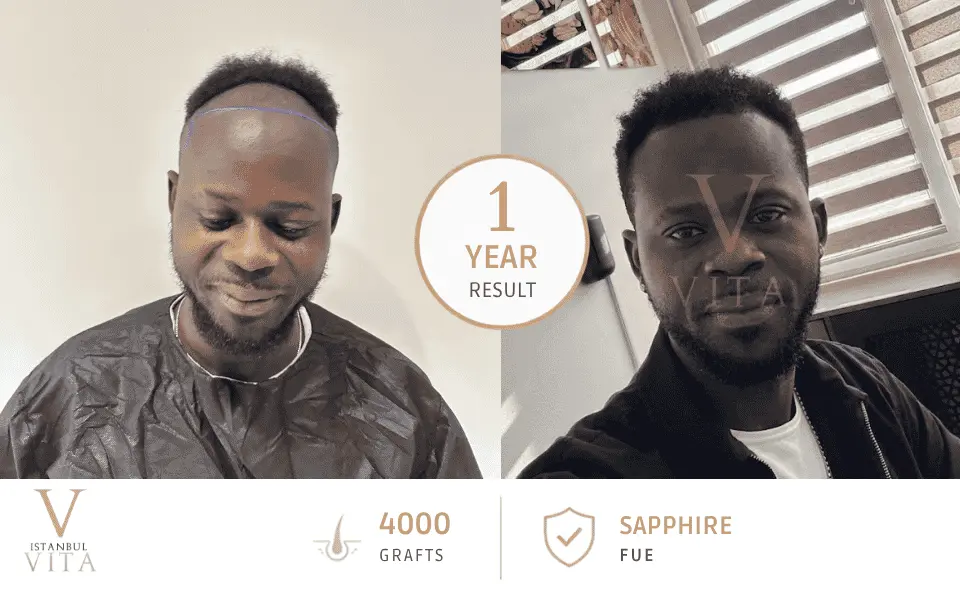
FUE Afro Hair Transplant Before and After at Istanbul Vita
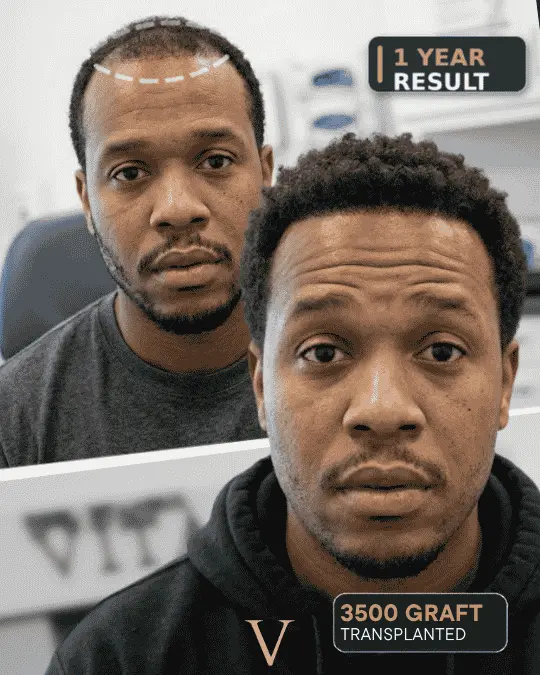
Before and after photos are one of the most reliable ways to evaluate an FUE afro hair transplant clinic. Instead of focusing only on how much hair was restored, look closely at whether the natural curl pattern has been preserved, the hairline suits the patient's facial features, the donor area has healed evenly, and the overall density looks balanced.
At Istanbul Vita, every FUE afro hair transplant is planned around the individual characteristics of the patient. Treatment planning is carried out under doctor supervision and supported by microscopic donor analysis before the procedure begins. Depending on the patient's needs, Sapphire FUE is used to extract and implant grafts with precision, while DHI may be preferred in selected areas where additional density or refined placement is required. Vita Technique® supports this process by helping the surgical team evaluate the donor area, classify grafts, and plan their distribution according to the natural characteristics of afro-textured hair. For tightly curled hair, Afro Technique® is applied to accommodate the curved structure of afro follicles and support natural-looking results.
The before-and-after cases shared by Istanbul Vita represent real patient experiences rather than standardized outcomes. They show how careful FUE planning, personalized graft placement, and techniques adapted to afro-textured hair can help achieve natural hairlines, balanced density, and healthy donor area healing.
If you'd like to discuss your case, you can contact the Istanbul Vita team through our contact page for a personalized consultation.
Have Questions? Let's Chat on WhatsApp!
Get instant answers 24/7. Receive your doctor-led hair analysis within 1 day, plus pricing and booking support.
Start WhatsApp ChatFrequently Asked Questions
How Long Do You Have to Wait After an FUE Afro Hair Transplant Before Getting a Haircut?
The clinics usually advise you to wait at least three to four weeks after your transplant before using clippers on the transplanted site. Your doctor will let you know how long you should wait, depending on the process of recovery.
Can You Wear a Durag After an FUE Afro Hair Transplant?
No. Any activity that puts pressure and friction on your transplanted hair should be avoided until your doctor says that your scalp has fully recovered.
Will an FUE Afro Hair Transplant Affect Your Natural Curly Hair?
No. The transplanted hair keeps the same genetic properties as the hair from the donor area. Therefore, it keeps growing in the same curl pattern as your natural hair.
Can You Have Another FUE Afro Hair Transplant in the Future?
Yes, if you have healthy grafts in your donor area. It depends on whether another hair transplant is appropriate for you.
 conversation


