
 English
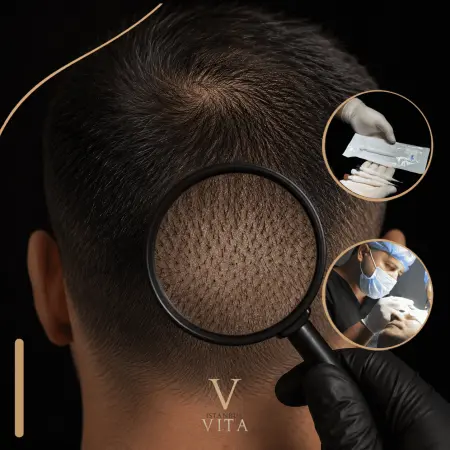
Table of Contents
What if a donor area isn't as strong as it appears? Thick hair at the back of the head is often taken as reassurance, as though the question ends there. In most cases, it doesn't. Donor area analysis before hair transplant exists precisely because appearance alone reveals very little about what lies beneath the surface.
A quick glance at the back of the scalp is never sufficient for a proper evaluation. Real donor assessment examines:
- density
- follicle thickness
- how follicles are grouped
- how the area is likely to hold up over the next twenty or thirty years
This step is among the first covered in proper hair transplant planning, and it remains the part of the process least understood by patients.
Hair loss patterns tend to be well known and easy to describe. What's far less known is that the donor area follows its own, entirely separate trajectory. One that can't be read from a mirror.
What Is Donor Area Analysis Before a Hair Transplant?
It is the process of examining the back and sides of the scalp, the zone that is genetically resistant to balding, to determine how many follicles can be extracted without weakening it over the long term.
It is not a hair count. It is the process that goes as follow:
- density per square centimeter is measured
- individual hair shaft thickness is assessed
- follicle grouping is documented
- the scalp's likely aging pattern is factored in
Two individuals can present the same hair color and the same visible volume at the back of the head, and still be found to have very different donor capacities once examined closely.
For this reason, donor evaluation is treated as its own distinct step, separate from hairline design or recipient area planning. The question it answers is narrow: how much can this specific donor area provide, safely, over a lifetime?

Does a Thick-Looking Donor Area Always Mean Good Hair Transplant Candidacy?
No.
Even though the donor site may be very dense, it can still produce poor quality grafts if:
- the hairs are thin
- miniaturization is beginning
- there is lack of elasticity in the scalp
However, an ordinary donor area can provide healthy grafts if evaluated well.
The difference between a visual impression and an actual donor density analysis comes down to this: one reflects what is seen, the other reflects what is measured.
How Do Doctors Actually Measure Donor Capacity?
No single number captures this. A handful of measurements are considered together.
How Many Hairs Grow From Each Follicle?
Density alone says little without knowing the follicular unit composition: how many hairs emerge from each individual unit. Two donor areas can have a similar graft count but produce different results. The one with more 3-hair and 4-hair grafts often creates better density and fuller coverage.
How Thick Are the Individual Hair Shafts?
Thicker strands simply provide more visual coverage per graft. Miniaturization, the gradual thinning caused by hormonal sensitivity, is checked closely, since a donor zone showing early signs of it may not remain reliable a decade later.
Why Is Scalp Elasticity Checked?
Elasticity affects how comfortably grafts are extracted and how well the area heals afterward. Donor stability, separately, concerns whether that zone will continue resisting hair loss for decades, not merely for a few favorable years.
Can a High Density Number Still Be Misleading?
Consider a donor area measured at 90 follicular units per square centimeter. That figure might suggest an almost unlimited supply. It often isn't.
A dense donor area does not always mean a large supply of usable grafts. If many grafts contain only one hair or show signs of early thinning, the number of safe grafts may be lower than it appears. For this reason, donor evaluation requires more than just measuring density. When too much is taken from a donor area that looks strong on paper, visible thinning can appear later, a risk any careful surgical plan is designed to avoid.
| Traditional Donor Evaluation | Microscopic Donor Analysis |
|---|---|
| Visual estimate of hair thickness | Measured follicular density per cm² |
| General impression — "good hair" or "limited hair" | Zone-by-zone mapping of the donor area |
| No distinction between hair types | Classification by follicular unit composition |
| Graft number estimated by eye | Graft estimation based on measurable data |
| Little insight into future hair loss | Assessment of long-term donor stability |
How Does Microscopic Donor Mapping Work?
In the case of microscopic donor harvesting, the donor site is broken down into several smaller segments that are looked at separately. In other words, microscopic donor mapping determines those areas of the donor site where density is greatest, the shafts are widest, and the donor site safely ends.
The result is more accurate graft budgeting. Extraction is prioritized in the strongest zones, while weaker areas are left untouched and reserved for later. This approach also reduces the risk of a patchy, uneven appearance at the back of the head — a common outcome when harvesting isn't planned with this level of detail.
Have Questions? Let's Chat on WhatsApp!
Get instant answers 24/7. Receive your doctor-led hair analysis within 1 day, plus pricing and booking support.
Start WhatsApp ChatWill There Be Enough Donor Hair for a Second Transplant Later?
Hair loss rarely stops after a single procedure. For many patients, particularly younger ones, further thinning is likely in the years ahead — which is exactly why donor preservation is considered just as important as the first surgery itself.
A donor area that has been managed carefully, rather than harvested to its limit, keeps future options available. If a second procedure becomes necessary, a preserved reserve makes it possible. An overharvested one typically does not.
This is also why donor planning cannot be based solely on immediate goals. Age, the likely progression of hair loss, and the state of the donor area decades from now all have to be factored into the plan.
| Factor | What Is Assessed |
|---|---|
| Density | How much coverage the area can realistically provide |
| Miniaturization | Early signs the donor zone could weaken over time |
| Hair shaft diameter | How much visual coverage each graft can deliver |
| Scalp elasticity | Comfort during extraction and quality of healing |
| Safe donor zone | The boundaries where extraction won't cause visible thinning |
| Previous surgery | How much donor reserve remains for future sessions |
| Future hair loss | How much capacity should remain untouched for later |
At Istanbul Vita, donor area analysis is not treated as a formality before surgery — it is built into doctor-led planning from the first consultation onward. Each case is evaluated individually, with attention given to density, follicle composition, and how the area is expected to age. For those trying to understand their own donor capacity before making a decision, a donor density guide or a one-on-one hair transplant planning consultation tends to offer far more clarity than graft numbers found online.
Frequently Asked Question (FAQ)
How is donor area analysis different from a regular hair transplant consultation?
Donor area analysis focuses specifically on the back and sides of the scalp: density, follicle type, and long-term capacity.
Can donor density change over time?
Yes. It can decline gradually due to aging, hormonal factors, or prior overharvesting.
Does a higher graft count always mean a stronger donor area?
Not always. A high number can reflect a large proportion of thin, single-hair follicles rather than genuine density.
Does donor area analysis matter if hair loss is still at an early stage?
Arguably, it matters more. Planning around future loss and protecting donor reserve tends to be most effective before extensive harvesting has already taken place.
 conversation


