
 English
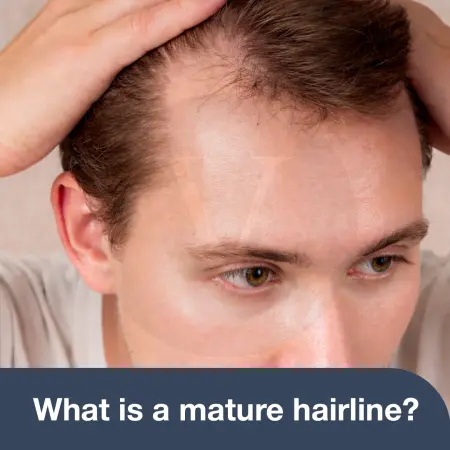
Table of Contents
Short answer: A mature hairline is the natural, even rise of the hairline that most men go through between their late teens and late twenties. It settles slightly higher on the forehead and then stops; unlike male pattern hair loss, it does not keep receding or thin the crown.
The occurrence of a new hairline can cause great stress in many people, especially because of the fear of balding. However, one should be aware of the fact that not every small change on the forehead means hair loss. The most frequent and at the same time misinterpreted phenomenon is a mature hairline. As the name suggests, it is associated with the natural process of maturing.
Understanding the concept of a mature hairline, the difference between a mature hairline and a receding hairline, as well as the difference between a mature hairline and male pattern baldness, is essential in order to take proper action concerning hair care and hair loss treatment. Thus, the following guide is aimed at helping the audience of Istanbul Vita understand the concept of mature hairlines of both men and women.
What Is a Mature Hairline?
A mature hairline is defined as the gradual shift of the hairline in the direction of retreat. Such changes occur in young adults, usually after puberty. Namely, the distance between the youthful and mature hairline amounts to about 0.5 to 1.5 cm.
Key Characteristics of a Mature Hairline
-
There may be a slight recession in the temple region.
-
The hairline has a well-defined edge.
-
Post-hairline, there is a uniform hair density.
-
The hairline tends to form a small M shape or V shape.
-
This kind of hairline rarely worsens over time every year.
Note: Having a mature hairline does not imply that you are losing your hair. This is where you move from adolescence to adulthood in terms of scalp physiology.
What Does a Mature Hairline Look Like?
A lot of folks wonder what a mature hairline actually looks like, especially when they compare old photos to how they look now.
Visual Features
- Shape: Soft M or V, not a straight juvenile line
- Height: Roughly one finger-width above the highest forehead wrinkle when eyebrows are raised
- Density: Even thickness with no visible scalp
- Edges: Sharp and tidy, not frayed or wispy
Mature Hairline vs Receding Hairline (Visual Comparison)
| Feature | Mature Hairline | Receding Hairline |
|---|---|---|
| Recession depth | ≤ 1.5 cm | Progresses beyond 2 cm |
| Temple shape | Gentle angle | Deep V or U shape |
| Density behind line | Stable | Gradually thinning |
| Crown involvement | None | Often present |
| Progression speed | Stops | Continuous |
This comparison is often searched as mature hairline vs receding, and the distinction largely comes down to stability over time.
Mature Hairline Men: When and Why It Happens
In males, the maturity of the hairline normally occurs between the ages of 18 and 25, though it is not uncommon for maturity to occur slightly earlier or slightly later than this.
Why Men Experience Hairline Maturation
1. Hormonal Influence
There are a lot of changes in hormones during puberty and the beginning of adulthood, which might affect the hairline. One of the hormones, which play an important role in this matter, is dihydrotestosterone (DHT), which is the result of testosterone production. As androgen increases, especially in teenage years, hair follicles on the forehead and temples become somewhat sensitive to DHT. Due to such sensitivity, there is a slight shortening of the hair cycle, resulting in a progressive and natural shifting of the adolescent hairline towards the mature one. Usually, this procedure takes place gradually and slowly, causing no rapid loss of hair. Mature hairline is a part of a regular male development stage and does not necessarily lead to baldness.
2. Skull and Forehead Development
Hairline formation is not solely dependent on hair follicles because any alteration in the face or skull structure also affects hairline formation. The skull bones and forehead region still undergo development during puberty and young adulthood. The subtle alteration in the shape of the forehead, scalp tissue distribution, or facial proportions can give an illusion of either high or recessed hairline despite good hair density and absence of hair loss. Therefore, one can observe changes in the hairline without experiencing hair thinning. The correlation between facial development and hairline formation is another example of natural anatomical development affecting appearance.
3. Genetics
Genetics is another critical factor that plays a role in the development of the hairline, determining not only the time but also the extent of changes during a lifetime. Personal genetic traits received from relatives can have an impact on the appearance of the mature hairline and its prominence. Ethnicity could be another reason for differences in the formation of hairlines. For instance, males from Mediterranean and Middle Eastern ethnic groups tend to form their mature hairlines early, yet retaining their hair density for quite a long period of time. Genetic tendency affects hair follicle sensitivity and hair growth cycle. However, the maturation process of hairline due to genetic predisposition does not imply hair loss.
Biology Behind a Mature Hairline
Understanding the biology helps explain why a mature hairline differs from balding.
| Biological Factor | Effect | Outcome |
|---|---|---|
| DHT | Shortens anagen phase locally | Minor permanent shift |
| Collagen remodeling | Adjusts scalp elasticity | Stable hairline |
| Follicle size | Slight miniaturization only | Density preserved |
| Hormone stabilization | Ends active change | Plateau effect |
Unlike male pattern baldness, follicles do not continue shrinking.
Mature Hairline vs Balding: Key Differences
One of the most important comparisons is mature hairline vs balding.
Male Pattern Baldness vs Mature Hairline
| Criterion | Mature Hairline | Male Pattern Baldness |
|---|---|---|
| Cause | Natural maturation | Genetic DHT sensitivity |
| Progression | Stops | Continues for years |
| Crown Thinning | No | Common |
| Hair Diameter | Uniform | Progressively thinner |
| Family History | Optional | Strong correlation |
This distinction is often described as male pattern baldness vs mature hairline, and understanding it can prevent unnecessary anxiety or overtreatment.
Receding Hairline vs Mature Hairline: How to Tell the Difference
The debate around receding hairline vs mature hairline usually comes down to observation over time.
Step-by-Step Self-Assessment
- Frown and measure from the deepest wrinkle to the hairline
- Take pictures every six months
- Measure hair density 2 centimeters behind the hairline
- Watch for symmetry—imbalance may be a sign of alopecia
- Note hair shedding patterns
If the hairline continues moving beyond 2 cm or thinning appears, it may no longer be maturation.
Mature Hairline Haircuts: What Works Best?
A mature hairline does not limit hairstyle options. In fact, many cuts look more natural with a mature hairline.
Recommended Haircuts
- Textured crop
- Side-part with volume
- Medium-length layered styles
- Short back and sides with natural front
Styles to Avoid
- Very tight slick-backs
- Aggressive fades exposing temples
- Overly straight artificial hairlines
Choosing the right mature hairline haircuts enhances balance and avoids drawing attention to the temples.
What Causes a Hairline to Mature?
The formation of a mature hairline is not an instantaneous process but rather a combination of both biological and environmental influences, instead of just being influenced by any one factor. With this knowledge, it becomes apparent that this process is considered to be a natural part of growing up.
1. Aging and Skin Changes
As we progress from being adolescents to adults, there are changes that take place in our skin and connective tissues. The rate at which our bodies produce collagen and elastin decreases; therefore, there will be minor changes in the elasticity of our scalp. This may lead to a slight change in position of the hair follicles, especially those found on the frontal part of the scalp.
2. Hormonal Shifts
Peak androgen activity is characteristic of late puberty to early adulthood. DHT, one of the androgens along with testosterone, causes a slight decrease in the anagen stage in a mature hairline. The recession process is temporary until the hormones are stabilized, whereas it is permanent in the case of androgenic alopecia.
3. Genetics
How soon your hairline reaches maturity, as well as the extent to which this transition becomes noticeable, is mostly a result of genetics. The hair follicle's sensitivity, the form of your hairline, and the structure of your scalp are all factors that determine whether or not you develop your hairline at an early or late stage in life, as well as whether or not the process will be very apparent. Remember that genetics that influence hairline development are distinct from genetics associated with male pattern baldness.
4. Stress or Illness
The occurrence of telogen effluvium may be triggered by such factors as stress, surgery, infection, or general health problems. When such hair loss takes place at the front hairline area, it may further emphasize the problem of recession. The good news is that in the majority of cases, hair density regains its normal levels once the triggering factor is removed.
5. Hairstyling Habits
Wearing tight hairstyles like ponytails, braids, and man buns, or brushing your hair very harshly, can cause you to lose hair from your hairline. This is not actually hair loss due to aging or genetics; however, if it continues for long periods of time, it may start to look like a receding hairline.
6. Lifestyle Factors
Your daily habits could also affect the health of your scalp. For instance, smoking can interfere with circulation and oxygen supply to your hair follicles while crash dieting may lead to lack of vital nutrients such as proteins, iron, and zinc. In addition, lack of adequate rest and poor stress management may affect hair growth patterns, causing any changes in hairline to become more pronounced.
When Does a Mature Hairline Stop?
A matured hairline remains unchanged for many years. But, in case your hairline begins to show signs of alteration after reaching 30 years of age, it can be because of:
- Aging
- Androgenetic alopecia
- Different health problems
In such a situation, you should see a dermatologist.
Maintaining a Healthy Mature Hairline
Though it is impossible to undo the process of maturation, there are ways to help maintain scalp health for the future.
Advice for Daily Scalp Care
-
Healthy balanced diet high in protein, iron, zinc, vitamin D
-
Gentle hair treatment; no excessive heat
-
Scalp washing twice to three times per week with gentle shampoo
-
Stress management by sleeping and exercising
-
No tight hairstyles
When to Seek Professional Advice
Look for symptoms that include:
-
Hairline that is slowly receding
-
Topping thinning of hair
-
More hair loss on a daily basis
-
Baldness running in your family history
Early detection of these symptoms will allow you to take steps that are not as extreme as others that you may have to eventually undergo if you fail to notice them.
Final Thoughts
Mature hairline is not a cause for concern since it is a natural process in life. By distinguishing between the two, one is able to make well-informed decisions concerning their health and appearance. At IstanbulVita, we understand that knowledge is key in everything that one does; hence, the first thing to do is to learn the natural changes.
Frequently Asked Questions About Mature Hairline
What Is a Mature Hairline?
A mature hairline is just a normal part of growing up, usually kicking in after puberty and often seen in early adulthood. During this time, the hairline tends to rise a little—about 0.5 to 1.5 cm—compared to where it was in your younger years, and then it finds its new, permanent spot. This change is all thanks to normal hormonal activity and the development of the scalp, not due to any illness or permanent hair loss. Once established, a mature hairline tends to stay consistent for many years.
What Does a Mature Hairline Look Like?
Mature hairlines are smooth and evenly distributed, with no signs of thinning. They usually have a soft M or V shape, particularly at the temple region. The hair that grows behind the hairline will be thick, and no scalp will be visible through the hair. In contrast to balding hairlines, where the edges are blurred, the edges are defined, and no weak or miniaturized hair will grow around the hairline.
Does a Mature Hairline Mean Balding?
A mature hairline is not an indication that your hair is about to fall out. It is just a stage in hairline growth and should not be confused with male pattern baldness. When someone is going bald, hair thins and recedes gradually, affecting both the hairline and crown. A mature hairline is fixed, and its position changes little after reaching maturity. In fact, most men can have a mature hairline for years without their hair falling off.
What Is a Mature Hairline vs Receding Hairline?
As far as hairlines are concerned, the most important distinguishing characteristic between the mature hairline and the receding hairline lies in their formation. The mature hairline undergoes a minor change before it gets established, whereas the receding hairline just keeps on receding as time passes. When you have a receding hairline, then you would notice that the corners at your temples become more prominent, there is a decrease in the thickness of the hair behind your hairline, and even the balding starts to occur at the top of your head.
Have Questions? Let's Chat on WhatsApp!
Get instant answers 24/7. Receive your doctor-led hair analysis within 1 day, plus pricing and booking support.
Start WhatsApp Chat
 conversation


