
 English
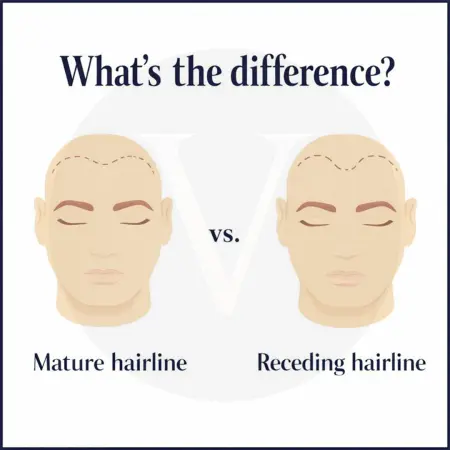
Table of Contents
Short answer: A mature hairline rises slightly and evenly across the forehead, usually between the late teens and late twenties, and then stops. A receding hairline keeps moving back, typically deeper at the temples, and is often accompanied by thinning at the crown. If your hairline is still changing after 6–12 months, pattern hair loss is more likely than maturation.
The hairline is such a vital part of our facial structure. It not only outlines our features but also influences how we’re seen regarding age and overall looks. It makes perfect sense that even small tweaks to your hairline can turn heads. Many individuals start to notice that their hairline isn’t as low, straight, or even as it once was, prompting them to wonder if they’re experiencing hair loss or simply the natural progression of aging.
This is where the confusion starts between a mature hairline and a receding hairline. Although these two terms are often tossed around as if they mean the same thing, they actually refer to very different biological situations. Grasping the distinction between a maturing hairline and a balding one is essential—not just for your peace of mind, but also for making informed choices about prevention, treatment, or long-term planning.
Why Hairlines Change Over Time
Hairlines are not static. Hairlines change as our bodies develop, hormones fluctuate, and our genetic instructions come into play. In our younger years, particularly during childhood and adolescence, most people have a hairline that sits low on the forehead, typically straight or a little rounded. As we move into adulthood, though, you might notice some gentle changes taking place.
In men especially, androgen-sensitive hair follicles around the temples and frontal scalp respond to dihydrotestosterone (DHT). This hormone plays a central role in whether a hairline simply matures or begins receding in a pathological way.
A mature hairline is a sign of adaptation and balance, while a receding hairline indicates that hair follicles are shrinking and hair is gradually being lost. The main difference is found not just in how they look, but also in their growth patterns and how stable they are as time goes on.
Hairline Types and Facial Structure
When looking at the differences between a mature hairline and a receding hairline, it’s crucial to first grasp that there are several types of hairlines. The variations you see come from a combination of genetics, ethnicity, and the one-of-a-kind anatomy of your face.
Common Hairline Types
Some folks are born with a V-shaped hairline, commonly known as a widow's peak, where the middle dips down just a bit. Others might have a more straight or rounded hairline. You might come across hairlines that are a bit uneven yet still manage to look symmetrical, even if they aren't perfectly straight across.
A great hairline isn’t just about being low or perfectly straight. It’s really about finding one that complements your facial features and looks healthy and full. On the other hand, what many folks see as a bad hairline usually comes down to irregular shapes, thinness, or an uneven look that can result from recession or a lack of density. Terms like crooked hairline, messed up hairlines, or bad hairline are pretty subjective and often tied to emotions. Clinically, what matters is follicle health, density, and long-term stability.
What Is a Mature Hairline?
Defining a Mature Hairline
A mature hairline is a natural and expected stage of development, particularly in men. It usually occurs between the late teenage years and the late twenties. During this process, the juvenile hairline shifts slightly upward—typically by 1 to 2 centimeters—and settles into a more adult position.
This process is referred to as hairline maturation, and it doesn't mean you're going bald. A maturing hairline stabilizes after this shift and remains consistent for many years.
What Does a Mature Hairline Look Like?
A mature hairline generally maintains its original shape. If someone had a widows peak, the widows peak remains visible. If the hairline was straight, it remains straight. The temples may appear slightly higher, but the recession is mild and symmetrical.
The density right behind the hairline is still quite strong, and there’s no noticeable thinning happening in the mid-scalp or crown area. This is an important factor to consider when comparing a mature hairline to balding situations.
Is a Mature Hairline a Sign of Balding?
One of the most common misconceptions is that a mature hairline is an early stage of hair loss. In reality, a mature hairline is not a disease process. It is a response to hormonal maturity and ageing.
While both a mature hairline and a receding hairline involve DHT, the follicles in a mature hairline are not genetically predisposed to progressive miniaturization. This is why a mature hairline stabilizes, whereas a receding one continues to worsen. Understanding this distinction is essential when comparing mature hairline vs balding outcomes.
What Is a Receding Hairline?
What Is a Receding Hairline Clinically?
To answer the question what is a receding hairline, we need to look at androgenetic alopecia. One of the first and most noticeable signs of male pattern baldness is a receding hairline. It takes place when the hair follicles at the temples and the front of the scalp start to shrink over time, resulting in thinner, weaker hairs until growth completely stops. Unlike a mature hairline, a receding hairline doesn’t stabilize by itself.
What Does a Receding Hairline Look Like?
When someone inquires about what a receding hairline looks like, the common response usually mentions a clear retreat at the temples, a bit of asymmetry, and a thinning of the hair overall. A classic example of this is the M-shaped hairline, where both temples pull back sharply while the central forelock stays relatively untouched for a while. As time goes on, this pattern tends to move further back and can even blend with thinning at the crown.
Early Signs of Hair Loss
Early signs of hair loss can be pretty subtle, often starting at the hairline, and they can easily go unnoticed. Some of the most common early signs to look out for include a gradual recession at the temples, an uneven hairline, thinning hair at the front, and the development of an M-shaped hairline. These changes are frequently confused with a mature hairline, but unlike normal hairline maturation, early hair loss tends to progress over time. Recognizing these early signs allows for timely evaluation and helps determine whether the change is part of a mature vs receding hairline pattern.
Signs of a Receding Hairline
Spotting the early signs of a receding hairline can really change the game when it comes to treatment options.
Common indicators include:
- Rapid changes over months rather than years
- Increasing asymmetry or uneven hairline
- Thinning hair at the temples
- Formation of an M shaped hairline
- Reduced density behind the frontal line
An early receding hairline may look subtle, but progression is the key factor. If changes continue year after year, it is unlikely to be simple maturation.
Mature Hairline vs Receding Hairline: Key Differences
When evaluating mature vs receding hairline, progression, density, and pattern matter more than height alone.
A mature hairline:
- Shifts a bit before settling down
- Maintains its fullness
- Keeps its original form
A receding hairline:
- Keeps moving back
- Shows signs of thinning and miniaturization
- Often takes on an M shape
This comparison is essential for anyone confused about mature hairline vs receding changes.
| Criteria | Mature Hairline | Receding Hairline |
| Causes | Normal aging process | Male pattern baldness; rarely frontal fibrosing or traction alopecia |
| Hair loss speed | Slow change over several years, then stabilizes | Gradual but faster progression, often noticeable within months |
| Extent of recession | Recedes about 1–1.5 cm from the original position and stops | Recedes beyond 1.5–2 cm and usually continues toward the crown |
| Other scalp symptoms | Mild thinning limited to the frontal hairline and temples | Temple thinning with reduced density behind the hairline and possible crown involvement |
Receding Hairline in Men
A receding hairline men experience is most commonly linked to genetics. If close male relatives have experienced pattern baldness, the risk increases significantly. Genetics aren't the only players in the game when it comes to hair loss; timing and severity can also be swayed by lifestyle choices. Factors like stress, smoking, and your overall health can really impact how quickly hair loss happens. Still, once androgenetic alopecia begins, it does not reverse without intervention.
Women and Hairline Changes
While less common, women can also experience hairline recession. However, the causes are often different. Tight hairstyles, hormonal changes, or autoimmune conditions can affect the frontal hairline. Unlike men, women rarely develop an M shaped hairline. When a female patient presents with a receding hairline, careful diagnosis is essential.
Normal Hairline vs Problematic Hairline
A normal hairline is one that fits facial proportions and shows no signs of active hair loss. It does not need to be low or perfectly straight. A lot of folks tend to criticize their hairlines, thinking they’re “bad” just because they don’t fit the unrealistic ideals we see online. But the truth is, everyone’s hairline is different, and that’s completely normal! By learning about the different types of hairlines, we can better separate cosmetic concerns from actual medical issues.
Can a Mature Hairline Become Receding?
Yes, a mature hairline can later become receding if androgenetic alopecia develops. This is why monitoring changes over time is important. Stability over many years usually indicates maturation. Continuous movement suggests balding. This transition is where confusion around mature hairline vs receding hairline often arises.
Preventing Hairline Recession
While a mature hairline does not need treatment, a receding hairline can often be slowed.
Medical options may include:
- DHT-blocking therapies
- Scalp health optimization
- Lifestyle modifications
Early action is especially effective in cases of early receding hairline.
Hairline Aesthetics and Psychological Impact
Hairline changes affect self-image more than many people realize. A perceived bad hairline can impact confidence, even when hair loss is minimal. Education plays a major role in reducing unnecessary anxiety. At our clinic, we emphasize the importance of objective assessments in our consultations, making sure to avoid decisions that stem from fear.
Hair Transplant as a Permanent Solution
For anyone facing a confirmed balding hairline, hair transplantation can provide a durable solution. Today's advanced methods enable surgeons to design hairlines that appear natural and are in harmony with your facial proportions and age. When it comes to hair transplants, the goal isn’t to craft an unnaturally low or fake hairline, but rather to restore harmony. This is especially vital in cases of mature hairlines compared to balding, where too much correction can end up looking quite unnatural.
A Modern Approach to Hairline Restoration
We’re committed to providing hairline evaluations at our clinic that balance medical accuracy with a strong aesthetic sensibility. Each patient’s hairline type, donor capacity, and the possibility of future hair loss are thoroughly assessed to ensure the best outcomes.
Rather than treating every high forehead as a problem, the goal is to determine whether the hairline is mature, receding, or actively balding—and act accordingly.
Have Questions? Let's Chat on WhatsApp!
Get instant answers 24/7. Receive your doctor-led hair analysis within 1 day, plus pricing and booking support.
Start WhatsApp ChatFinal Thoughts on Mature vs Receding Hairline
Understanding your hairline isn’t just about putting it in a box of good or bad; it’s really about acknowledging what’s normal for your age, genetics, and facial structure. Having a mature hairline doesn’t mean you’ve hit a dead end, and a receding hairline isn’t the end of the world. With the right diagnosis and strategy, you can effectively manage both. If you are uncertain whether you are experiencing natural maturation or the early stages of hair loss, a professional evaluation is the most reliable step forward.
Frequently Asked Questions
Can a hair transplant help me redesign a mature hairline?
Yes. A hair transplant can be used to slightly lower or refine a mature hairline if it feels too high or uneven. The goal is not to create a juvenile hairline, but a natural, age-appropriate design that suits your facial structure.
What is a receding hairline?
A receding hairline is a pretty common sign of genetic hair loss. It happens when the hairline slowly moves back, often starting at the temples. Unlike a mature hairline, this one tends to keep progressing over time if you don’t do anything about it.
What is a mature hairline?
A mature hairline is just a natural part of getting older. Typically, it recedes about 1–2 cm during early adulthood before settling down. Your hair density typically remains strong, so this change doesn’t necessarily mean you’re losing your hair.
What does a receding hairline look like?
A receding hairline typically shows temple recession, thinning at the front, and often forms an M-shaped hairline. The hairline becomes uneven and continues moving backward over time.
Is a widow’s peak a sign of a receding hairline?
No. A widow’s peak is a natural hairline shape. It only suggests hair loss if the surrounding temples are thinning or receding.
 conversation


