
 English
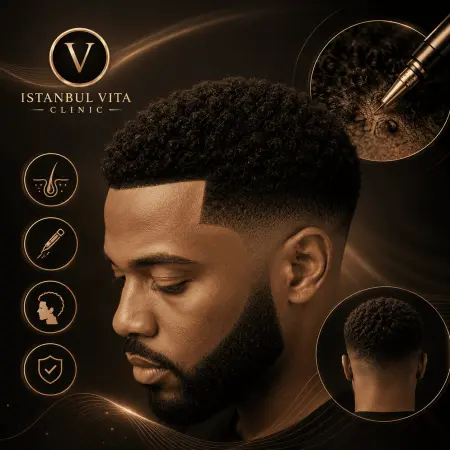
Afro-textured hair grows differently under the scalp compared to straight hair. It requires a unique hair transplant method.
So, if you are researching afro hair transplant, you've probably come across DHI technique more than once.
And what is DHI hair transplant, exactly?
DHI Afro Hair Transplant focuses on angle control. Also, it adapts to the natural curl pattern of afro hair. As a result, completely natural from every angle can be achieved.
If you have curly, coily, or tightly coiled hair, this specialized technique is designed with your hair type in mind from the very first step.
What Is DHI Hair Transplant for Afro-Textured Hair?
Direct Hair Implantation (DHI) is one of the most modern hair transplantation techniques.
In this technique, hair follicles are extracted one by one from the donor area and implanted directly into the recipient zone. Also, a specialized tool, called Choi pen is used for implantation.
Besides, DHI, unlike older methods, skips the step of opening channels before.
The follicle goes straight from extraction to implantation. It shortens the time the graft spends outside the body. So that it can support better survival rates.
That is why DHI hair transplant can be a great technique for afro textured hair.
How DHI Differs From Traditional Techniques
In classic FUE, channels are opened with steel blades before the grafts are implanted.
It usually creates a density window of around 35 to 40 grafts per square centimeter.
However, DHI changes the order of operations. Because the implanter pen creates the channel and places the graft in a single motion. Surgeons gain finer control over the exact angle and direction of each hair.
That is especially important while working with hair that doesn't grow in a straight line beneath the skin.
Is DHI Good for Afro Hair?
It is among the most frequently asked questions by patients and it is understandable.
In short, yes. Afro hair doesn't just have curls outside; even the hair follicle tends to be curved, in a C-shape or in a corkscrew formation.
This implies that the procedure requires following the natural curvature of the hair follicle.
Otherwise, the graft can be damaged before it's even out of the skin.
A well-executed DHI Afro Hair Transplant takes this curvature into account from the very first stage of planning.
Choi pen allows for shaping of hair strands angle easily, it is a great advantage for afro-textured hair. As a result, the direction and curl pattern of new hair will seem exactly the same with your original hair.
Understanding the Unique Structure of Afro Hair Follicles
It is a known fact that Afro hair follicles aren't round. They have an oval or flattened appearance.
This plays an important role in three key areas:
- Hair Curl Pattern: It decides how your hair curls and waves.
- Position of Hair Follicles: It influences the way the follicles sit underneath your scalp.
- Procedure of Removal: It affects how the hair graft is removed from your scalp.
DHI vs FUE for Afro Hair: Which Works Better?
The comparison of DHI vs FUE for afro hair comes up often.
The honest answer is that both can work. However, they're not equally suited to every case.
Classic FUE relies on pre-made channels. It gives less flexibility once the angle is set. DHI, on the other hand, allows the angle to be adjusted graft by graft during implantation.
It is particularly useful for recreating the natural swirl and direction of afro hair growth, especially around the crown and hairline.
That said, DHI is also more time-intensive and requires a larger, well-coordinated medical team. Because extraction and implantation often happen in parallel.
This is one of the reasons the experience level of the clinic's medical staff plays such a big role in the final outcome of any DHI hair transplant procedure.
Who Is a Good Candidate for a DHI Afro Hair Transplant?
In general, DHI hair transplant candidates share several key characteristics below:
- Patients having afro-textured hair, curly hair, coily hair, or tight curls
- Individuals suffering from receding hairline, thinning, or localized hair loss
- Patients having enough hair density in the donor area on the scalp
- Individuals wanting to have a natural hairline similar to the one they already have
- Healthy individuals with realistic expectations regarding the recovery process and outcomes
The Best DHI Technique for Afro Hair at Istanbul Vita
When patients search for the best DHI technique for afro hair, they're usually looking for more than just a method.
They're looking for a team with hands-on experience in afro-specific cases.
At Istanbul Vita Hair Transplant Clinic, this is where the combination of DHI principles and the clinic's own Vita Technique ® becomes relevant.
A DHI Afro Hair Transplant at the clinic isn't treated as a one-size-fits-all procedure. It starts with a detailed donor analysis under microscope, classifying grafts by thickness, curl pattern, and growth direction before any extraction begins.
Combining DHI Precision with the Vita Technique ®
The Vita Technique ® is developed by Hasan Başol, Medical Director and Founder of Istanbul Vita.
It uses sapphire punches as small as 0.6–0.7 mm to open microscopic channels, which can support higher graft density while reducing tissue trauma.
When this precision is combined with DHI's direct implantation approach, the result is a method built to handle the angle sensitivity that afro hair demands.
Doctors Dr. Harun Eymen Alakaya and Dr. Özge Miray Gültekin are directly involved in planning these cases.
This includes frontal hairline design, one of the most technically demanding parts of any afro hair procedure.
Doctor-Led Approach for Curly and Coiled Hair
At Istanbul Vita, doctors personally perform the channel opening stage for every patient. It helps maintain consistency in angle and depth throughout the procedure.
Each patient also receives 40 to 60 minutes of direct doctor consultation. It is enough time to discuss donor strength, expectations, and the specific curl characteristics of the individual's hair before surgery.
Natural Afro Hairline Design With DHI
A hairline that doesn't match the natural curl pattern of the surrounding hair is one of the most common complaints after a poorly planned transplant.
This is why DHI afro hairline design requires more than technical skill. It requires an eye for how curl density should taper and how single grafts should be angled at the very front edge.
Creating a Balanced, Authentic Hairline Shape
A natural afro hairline transplant usually employs single hair grafts at the front hairline. And it increases the number of grafts per follicle towards the middle of the scalp and crown region.
It is the lack of this gradient that causes unnatural hairlines regardless of the number of grafts transplanted.
You're not alone if you've seen transplant results online that look stiff or unnatural around the hairline. In most cases, that's a planning issue rather than a limitation of the technique itself.
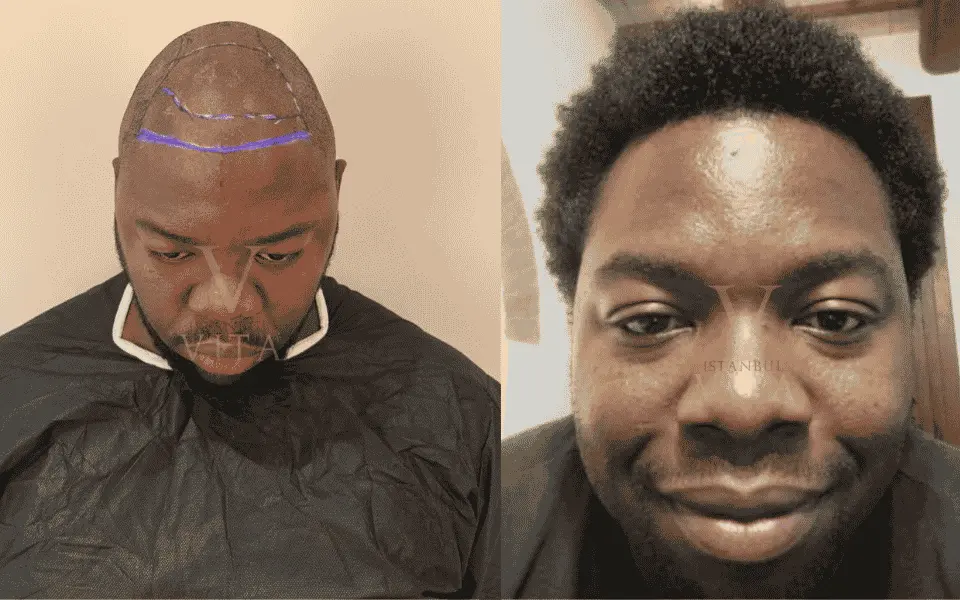
DHI Afro Hair Transplant Before and After
DHI afro hair transplant results can vary based on:
- Donor density
- Curl tightness
- The number of grafts transplanted
However, looking at DHI afro hair transplant before and after results can give a realistic sense of what to expect.
In general, patients with strong donor areas and moderate to large recipient zones tend to see the most visible improvement in both density and hairline definition.
What Realistic Results Look Like Over Time
It's worth setting realistic expectations early.
New growth typically begins around the third or fourth month. Yet, more noticeable thickness appears between months six and nine.
Full results, including final curl pattern and density, are usually visible around the 12-month mark for most DHI Afro Hair Transplant cases.
Afro Hair Transplant Recovery Process
One of the advantages of DHI is a comparatively smoother afro hair transplant recovery. Because the technique avoids the larger wounds associated with older extraction methods.
Swelling and redness are common in the first few days. But most patients are able to return to light daily activities within about a week.
| Timeline | What to Expect |
|---|---|
| Days 1–10 | Mild tenderness and small scabs form around grafts. Scabs usually fall off naturally within 7–10 days. |
| Week 2 | Most redness and irritation begin to fade. |
| Weeks 3–4 | Temporary shedding of transplanted hairs occurs (shock loss). This is completely normal. |
| Months 2–4 | New hair growth starts to appear. |
| Months 6–12 | Hair becomes thicker, fuller, and more noticeable. |
Afro Hair Aftercare: Use gentle washing techniques, avoid tight hats, limit sweating, and follow your clinic's shampoo recommendations to support healthy healing.
DHI Afro Hair Transplant Cost
Naturally, cost is one of the first things people want to understand before committing to treatment.
DHI afro hair transplant cost can change based on
- the clinic
- the technique combination used
- how many medical staff
- surgical days the case requires
At Istanbul Vita, pricing for hair transplant procedures generally ranges between $3,200 and $9,000.
Moreover, the price isn't tied to the number of grafts used. It's based on factors like technique, the number of surgical days, and total procedure time.
What Influences DHI Hair Transplant Turkey Afro Hair Pricing
For patients comparing DHI hair transplant Turkey afro hair options, it helps to know that pricing differences between clinics due to:
- medical team size
- doctor involvement
- technology used
- the level of personalized planning offered
Worth to remember: A clinic that includes in the following offers a more complete service than one priced purely per graft.
- detailed consultation time
- doctor-led channel opening
- aftercare support
in its package is generally offering a more complete service than one priced purely per graft.
Why Choose Istanbul Vita for Afro DHI Hair Transplant
Choosing where to have an afro DHI hair transplant performed is a decision that deserves careful research.
For many international patients, Istanbul Vita Hair Transplant Clinic will be a great choice.
With more than 15 years of experience in hair restoration and a boutique approach limited to just 1 to 3 international patients per day, the clinic prioritizes depth of care over volume.
Frequently Asked Questions
Is DHI good for afro hair?
Yes. When performed by a team experienced in working with curved follicles and afro-specific curl patterns.
DHI for curly hair can offer strong angle control and natural-looking density, particularly around the hairline.
What is the difference between DHI and FUE for afro hair?
FUE uses pre-opened channels, while DHI implants follicles directly using an implanter pen.
It allows more flexibility in adjusting angle and direction for DHI techniques. Also, it is an important factor for afro hair's natural curl pattern.
How much does a DHI Afro Hair Transplant cost?
Cost depends on the clinic, technique, and procedure length rather than graft count alone.
Is DHI suitable for black hair transplant patients?
DHI for black hair transplant cases generally responds well to the technique, provided the medical team has specific experience with the curved follicle structure typical of afro and black hair.
Have Questions? Let's Chat on WhatsApp!
Get instant answers 24/7. Receive your doctor-led hair analysis within 1 day, plus pricing and booking support.
Start WhatsApp ChatHow long does afro hair transplant recovery take?
Initial healing typically takes 7 to 10 days. However, the most visible redness fades within two weeks. Final results usually become clear around the 12-month mark.
Can DHI achieve a natural-looking afro hairline?
Yes, when hairline design uses single grafts at the front edge and gradually increases density toward the crown, mimicking how afro hair naturally grows.

 conversation


