
 English
Table of Contents
After three months following an afro hair transplant procedure, a lot of individuals might start seeing visible growths on the scalp. However, what actually happens is that the scalp remains quite thin, uneven, and may even become worse-looking than before. This can certainly worry an individual who traveled far and paid for the operation.
The good news is that, in most instances, this stage does not indicate failure. Afro or curly hair transplants usually require a longer amount of time to adapt to the new site and develop their first signs of growth. Since the curling pattern forms slowly, the final density will appear later too.
Afro Hair Transplant Results Month by Month: The Quick-Reference Timeline
The short answer: expect a worse-looking scalp before a better one, no visible change for almost three months, and final results only after 12 to 18 months. That gap is normal, not a warning sign.
| Timeframe | What's Happening Beneath the Skin | What You'll Actually See | Should You Worry? |
|---|---|---|---|
| Week 1–2 | Grafts anchoring, new blood supply forming | Swelling around days 2–3, light scabbing, redness | No. Normal recovery process |
| Week 2–4 | Transplanted shafts shed (shock loss) | Scalp looks thinner than day one | No. Expected shedding |
| Month 2–3 | Follicles resting in a dormant phase | Almost no visible change | No. The quiet stage |
| Month 3–4 | New growth phase (anagen) begins | Fine, thin, sometimes straight-looking new hairs | No. Texture isn't final yet |
| Month 4–6 | Shafts lengthen and thicken | Patchy coverage, curl pattern not obvious yet | No. Still early growth |
| Month 6–9 | Curl pattern re-emerges as hair passes 1–2 cm | Visible density jump, texture starts matching native hair | No. This is the turning point |
| Month 9–12 | Follicles maturing, pigment settling | 60–80% of final density visible | No. On schedule |
| Month 12–18 | Full maturation | Final density, natural curl, settled hairline | This is the final result |
This is also the broad hair transplant recovery timeline most reputable surgeons quote afro and curly hair simply needs the extra months at the tail end for the curl pattern to fully reassert itself.
Why Afro and Curly Hair Follow a Different Growth Timeline
Afro-textured follicles don't grow straight down under the scalp they curve, sometimes in a spiral, beneath the surface even when the visible hair looks tightly coiled. That single anatomical detail changes almost every part of the hair transplant recovery process.
A standard FUE punch is built around the geometry of straight hair. Used on curved follicles without modification, it can transect (cut) a far higher percentage of grafts, which is why textured hair demands curved punches, slower extraction, and far more surgical experience.
This is the main reason the hair transplant growth timeline runs longer for textured hair than for straight hair, and why graft survival depends so heavily on the surgeon's specific experience with curl patterns, not just their FUE caseload in general.
| Factor | Straight Hair Transplant | Afro / Curly Hair Transplant |
|---|---|---|
| Follicle shape beneath skin | Mostly straight | Curved, C-shaped, or spiral |
| Transection risk with unmodified tools | Low | Can reach 60–80% without curved punches |
| Typical procedure time | 4–6 hours | 6–8 hours |
| Graft survival (experienced specialist) | 90%+ | 80–90%, up to 90–98% at specialist centers |
| Grafts needed for moderate coverage | Roughly 2,500–3,500 | Roughly 1,500–2,500 (curl gives more visual coverage per graft) |
| Visible final result | Around 12 months | 12–18 months |
| Extra risk factors | Minimal | Higher keloid and hyperpigmentation risk on skin types IV–VI |
That last row matters more than most patients realize. Anyone with darker skin tones should ask directly how the clinic manages keloid risk before booking not after.
Weeks 1 to 12: Understanding Shock Loss After an Afro Hair Transplant
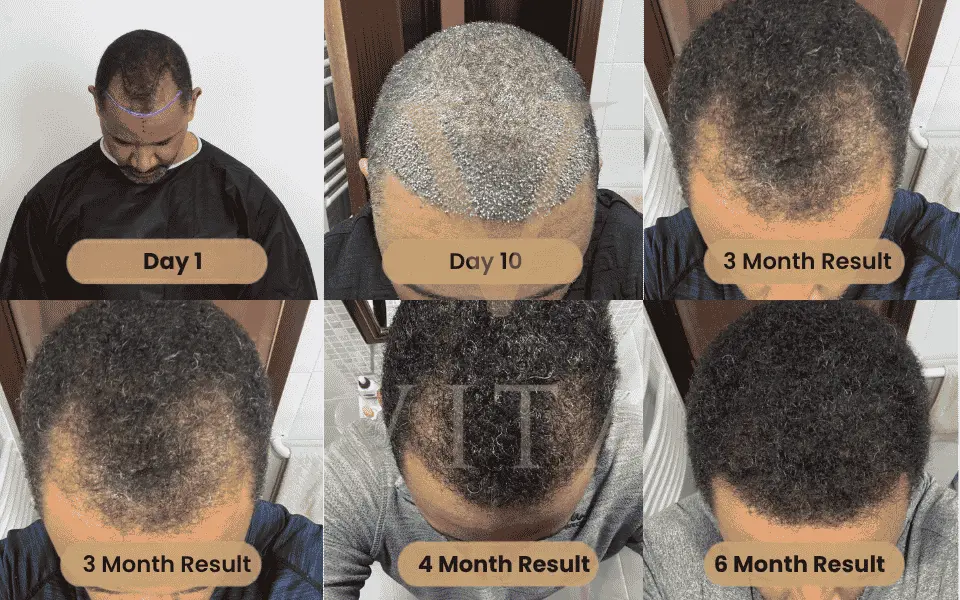
The most stressful stage of the recovery process is often the shock loss phase, which usually occurs between the second and fourth weeks after surgery. During this period, many of the transplanted hairs begin to shed, causing the treated area to look thinner than expected.
For many patients, this can feel alarming. However, in most cases, shedding is a normal part of the hair growth cycle and does not mean the grafts have failed. The follicles remain beneath the skin and continue the recovery process before producing new hair.
This stage is particularly important for patients with afro-textured hair because visible density often takes longer to develop. While some early growth may appear after a few months, noticeable improvement usually becomes easier to see between months four and six, with continued maturation in the months that follow.
One of the most common mistakes during this period is judging the outcome too early or trying unproven products in an attempt to speed up growth. Following your clinic's aftercare instructions and maintaining realistic expectations is usually the best approach while the follicles move through the early stages of recovery.
Months 3 to 12: What Hair Transplant Before and After Afro Hair Photos Really Show
Most "before and after" galleries skip straight from month one to month twelve, which is misleading. The middle months tell the real story of hair growth after hair transplant.
At month 4, new hairs are often thin, sparse, and noticeably straighter than the patient's natural texture. This worries people, but it's not the final texture it's simply too short and too new to show its true curl.
By month 6 to 7, as strands pass roughly 1 to 2 centimeters, the curl pattern typically reasserts itself and density starts climbing fast. This is usually the point where patients stop checking the mirror anxiously every morning.
By month 9 to 12, most patients are looking at 60 to 80 percent of their final density, with the remainder filling in gradually through month 18. A trustworthy clinic will set this expectation before surgery, not after you've already started worrying.
How Long Do Hair Transplant Results Last?
When the procedure is done properly, the results are deemed to be permanent since the grafts are taken from those parts that resist the DHT effect hormone which leads to hair loss. Once transferred, those follicles will keep producing hair during one's lifetime.
It is important to keep in mind that the result of hair transplant is permanent in relation to those follicles only. While the native hair could go on thinning with time, and that is why some people prefer using medications such as finasteride or minoxidil.
In order to have good long-term results of the procedure, it is also essential to have a good treatment plan developed beforehand. At Istanbul Vita, such aspects as donor capacity, hair quality, hair loss patterns in the future are analyzed to develop a sustainable result. In case of most patients, results of afro hair transplant last many years.
Have Questions? Let's Chat on WhatsApp!
Get instant answers 24/7. Receive your doctor-led hair analysis within 1 day, plus pricing and booking support.
Start WhatsApp ChatWhy Hair Transplants in Turkey Lead for Afro and Curly Hair
Turkey performs a high volume of hair transplants every year, which means its leading clinics see far more hair-type diversity than most single-country practices elsewhere including a meaningful share of afro-textured and mixed-heritage patients. That volume is exactly what builds the specific curved-punch experience this hair type needs.
Cost may certainly factor in but it should not be the deciding one. It is possible to go for an afro hair transplant turkey package which appears cheap but lacks use of curved extraction tools or surgeon-directed channel opening.
If you're comparing options for the best afro hair transplant turkey clinic, run through this checklist before you commit to anything:
| What to Check | Why It Matters | Red Flag |
|---|---|---|
| Doctor-led procedure | Channel opening and hairline design need surgical judgment, not just technician hands | "Technicians handle everything" |
| Documented afro/curly hair experience | Curved follicles need specific tools and technique | No before-and-afters of textured hair |
| Microscopic donor analysis | Matches graft thickness and angle to your actual density | Pricing given with no consultation at all |
| Licensing & health tourism certification | Confirms the clinic is legally authorized to treat international patients | No Ministry of Health or health tourism license shown |
| Caseload per day | Surgeons handling many patients daily can't give each one full attention | "Same-day" mass scheduling |
| Ongoing support after surgery | You need answers during the scary shedding phase, not just on surgery day | No support contact after you leave |
This is also where the conversation should move from generic research to a real consultation a clinic that does proper microscopic donor analysis and follows a doctor-led, boutique scheduling model (rather than running several patients through in parallel) is in a far better position to plan grafts correctly for curly or coily hair from day one. Istanbul Vita, for example, builds its planning around exactly this kind of individual donor analysis and natural hairline design rather than a one-size-fits-all template which is the standard worth comparing any clinic against.
A study combining ISHRS census data with search trend analysis found that demand for surgical hair restoration has climbed steadily for two decades, with FUE now the dominant technique worldwide which is exactly why surgeon-specific experience with your hair type, not just the technique name on a brochure, is the detail worth verifying.
How Istanbul Vita Approaches Afro Hair Transplants
At Istanbul Vita, procedures are planned under doctor supervision, while microscopic donor analysis helps determine the most suitable graft placement strategy for each patient. Depending on individual needs, Sapphire FUE, DHI, and Istanbul Vita's Afro Technique® may be incorporated into the procedure.
Get Your Afro Hair Transplant Plan in 30 Minutes. Our medical team will analyze your curl pattern and donor density and recommend a personalized surgical approach.
Frequently Asked Questions
How many grafts does an afro hair transplant typically need?
The number varies from person to person, but afro-textured hair can often create good coverage with fewer grafts than many people expect.
Is FUE safe for 4A–4C hair?
It can be, provided the procedure is performed by a team experienced in working with afro-textured follicles and suitable extraction techniques are used.
When can I get a low haircut after an afro hair transplant?
This depends on your recovery progress, but many patients wait several months before returning to very short hairstyles.
Will the curling pattern remain in the transplanted hair?
Yes, because the transferred hair follicles maintain their natural properties from the donor area.
Is the price of afro hair transplant higher than a regular FUE operation?
It depends on the pricing policy of the clinic and not just on the type of hair.
How permanent are the effects of the transplant procedure for Afro and curly hair?
If done correctly, the effects of the procedure should be permanent.
 conversation


