
 English
Table of Contents
What Is the Right Punch Size for Afro Hair Transplant?
There is no single universally correct punch size for every afro hair transplant case. That might feel unsatisfying if you were hoping for one clean number, but it's the honest answer.
Selecting the right extraction tool depends on several things together: follicular unit width, root curvature beneath the skin, the subcutaneous path it follows, extraction angle, and individual donor anatomy. A tool that works well for one person's curl pattern can transect grafts in another, even when both are described as "curly" or "coily."
This is exactly why black hair transplant planning starts with a donor assessment rather than a fixed protocol. Curved follicles behave differently under a punch than straight ones, and treating them the same way is one of the more common planning mistakes in this field.
Why Follicle Curvature Changes the Punch Size Equation
Straighter follicles generally follow a more predictable path beneath the skin. Curved follicles, common in coily and tightly coiled textures, often bend or spiral below the surface before straightening out. A tool built with a straight path in mind can catch the wall of a curved root and shear it off partway through extraction.
This is the core reason the smallest punch is not automatically the safest choice. A very narrow instrument reduces surface trauma on straight roots, but on a sharply curved root it may not follow the bend far enough to release the graft cleanly. Depth and angle matter just as much as diameter.
How Subcutaneous Curl Affects Extraction Planning
Surgeons who work regularly with textured strands typically map curl behavior before extraction begins. Some grafts curve gently and release with little adjustment; others spiral tightly enough that the angle has to change mid-procedure, graft by graft.
Curved follicular anatomy can increase the technical difficulty of extraction and the risk of transection when the extraction path is not adjusted accordingly, making donor area safety one of the most important factors for successful channel placement and overall treatment planning. This is one reason experience with curly and coily donor areas matters.
Why There Is No Universal Punch Size for Afro Hair
Clinics sometimes advertise a single tool diameter as though it solves afro hair transplant punch size for every case. In practice, the right diameter shifts patient to patient, and even zone to zone within the same donor area. The table below outlines the factors that actually drive that decision.
| Factor | Why It Matters | How It May Affect Sizing Decisions |
| Follicular unit width | Thicker grafts need clearance to exit without being crushed or torn. | Wider units may call for a marginally larger diameter, even in the same patient. |
| Follicle curvature | Sharp bends raise the chance the tool wall meets the root at an angle. | May call for shorter, more controlled depth rather than a smaller diameter alone. |
| Subcutaneous path | Some roots change direction more than once before reaching the bulb. | Often requires graft-by-graft angle adjustment during extraction. |
| Hair splay | Multiple strands can emerge from one unit at slightly different angles. | Influences how the instrument is rotated to avoid catching adjacent strands. |
| Extraction angle | An angle that doesn't track the root's true path raises transection risk. | Angle correction sometimes matters more than diameter itself. |
| Donor density | Tightly packed zones leave less room for error between grafts. | Denser areas may call for a more conservative approach to spacing. |
| Surgeon assessment | Visual and tactile judgment during extraction catches what measurements miss. | Real-time adjustment often separates a clean extraction from a damaged one. |
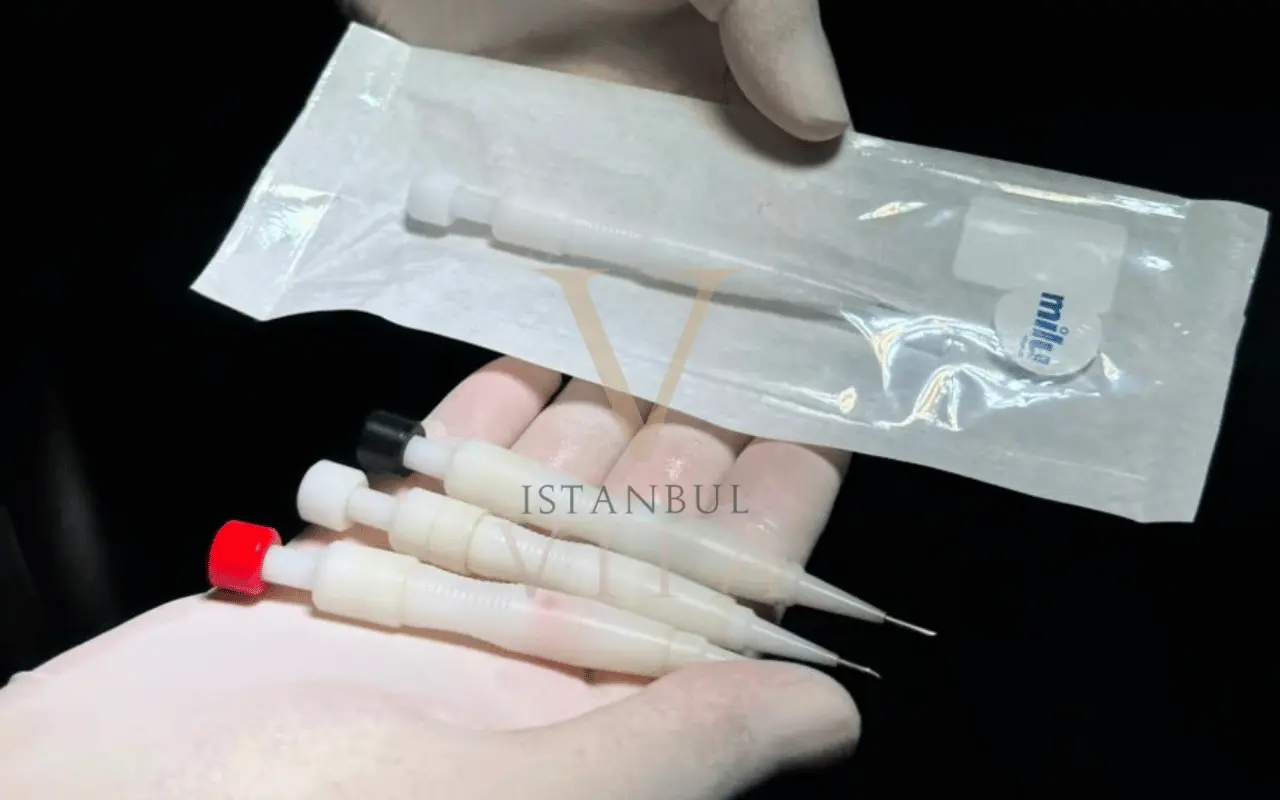
At Istanbul Vita, the Afro Technique® uses a documented 0.6–0.7 mm sapphire tool alongside individualized planning for channel angle, direction, and depth. These parameters are adjusted according to the patient's curl pattern and donor characteristics rather than following a single fixed protocol. In this approach, diameter is considered as one factor within the overall surgical plan, not as a standalone measure of suitability.
What Happens When Punch Size Does Not Match Follicular Anatomy?
When the extraction tool is chosen without accounting for curvature, depth, or path, the results tend to show up in two places: donor area and final density.
A tool too wide for a given root can leave larger scars and slower healing a known drawback of older, one-size approaches. An instrument too narrow for a sharply curved root can shear the graft before it fully releases, damaging the bulb and lowering its odds of surviving implantation. Neither error is about the number itself; both come from a mismatch between the chosen instrument and the anatomy it's used on.
Have Questions? Let's Chat on WhatsApp!
Get instant answers 24/7. Receive your doctor-led hair analysis within 1 day, plus pricing and booking support.
Start WhatsApp ChatSigns of a Poorly Matched Punch Selection
Patients often ask what a mismatched approach looks like in practice: higher-than-expected transection counts, visible thinning in the donor zone despite a moderate graft count, or a final result sparser than the extracted number would suggest. None of these are guaranteed outcomes, but they're worth tracing back to technique.
Why Extraction Angle and Punch Depth Matter as Much as Diameter
Diameter gets most of the attention because it's the easiest number to put in a table. But exraction angle and depth do much of the actual work. If the tool enters at the wrong angle relative to a curved root, even a well-chosen diameter won't prevent damage. Going too deep or too shallow on a bent root can also nick the bulb before the graft releases.
This is part of why experience shows up more clearly in curved-follicle cases than straighter ones a surgeon adjusting angle and depth graft by graft is compensating for something a fixed protocol can't.
What Does Individualized Punch Selection Actually Look Like?
In practice, individualized planning means the team evaluates several things before extraction begins, rather than reaching for a preset number.
| Assessment Factor | What the Surgeon Evaluates | Why It Matters |
| Curl pattern mapping | How tightly the visible curl matches the subcutaneous curve | Predicts how much extraction angle may need to shift across the donor area |
| Donor zone variation | Whether curl and density stay consistent or vary by region | A single fixed setting rarely fits an entire donor zone evenly |
| Graft thickness | Whether units are single, double, or multi-strand | Thicker units may need different clearance than fine, single-strand units |
| Scalp elasticity and skin type | How the skin responds to extraction pressure and depth | Affects healing time and scarring risk independent of curl |
| Prior procedure history | Scar tissue or extraction patterns from earlier procedures | Can change how a root behaves under a new instrument |
None of these factors work in isolation. A surgeon weighing curl pattern against donor density might choose a different approach for the crown than for the nape, even in the same patient. That's the practical meaning of individualized planning: fewer assumptions, more direct evaluation.
FAQ:
Is a smaller punch always better for curly or coily strands?
Not necessarily the right choice depends on curvature and angle, not diameter alone.
Does punch size alone determine how natural the result looks?
No graft survival, implantation angle, and hairline design matter just as much.
Can the same punch size be used across an entire donor area?
Not always, since curl pattern and density can vary from one zone to another.
What questions should I ask a clinic about punch selection?
Ask how curl pattern is assessed and whether a doctor is involved in extraction decisions in real time.
 conversation


