
 English
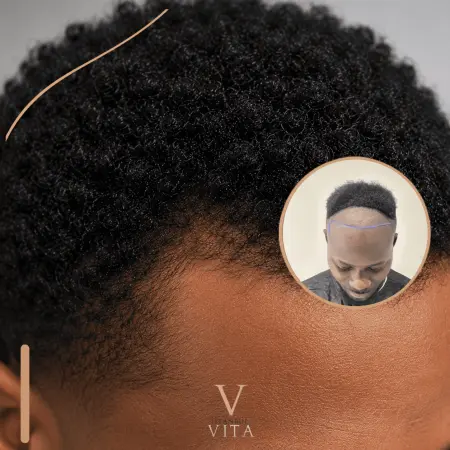
Can a Hair Transplant Fix a Receding Afro Hairline?
Most of the time, yes. A well-planned transplant can restore a receding frontal line in curly, coily, or otherwise textured hair. But the outcome has less to do with how many grafts go in and much more to do with how the case gets read beforehand. Curl pattern, the direction follicles travel under the skin, whether the recession has actually stopped moving, and even the shape of someone's face all factor into what a realistic result looks like.
An Afro hair transplant for receding hairline cases isn't something you can approach the same way you'd approach a straight-hair case. Type 4 strands often curve sharply beneath the surface, and that curve has to be respected twice: once during extraction, and again when everything gets placed back in. Miss that detail and you can end up with a technically fine procedure that still looks flat or strangely angled once it grows out.
For anyone who wants the fuller picture, from consultation through recovery, there's a broader resource worth reading first: this afro hair transplant Turkey guide walks through the entire process before narrowing in on hairline-specific decisions. Here, though, the focus stays narrow. One question: what does it actually mean when the front has visibly moved back?
Why Is My Hairline Receding?
There's rarely one single reason. And two people can show up with frontal lines that look almost identical, yet need entirely different treatment plans.
Androgenetic Hair Loss and Natural Maturation
Androgenetic alopecia, the pattern-based kind, is the most common driver behind frontal and temple recession. It creeps in slowly, usually starting near the temples before working its way toward the crown. For some men that starts in their late teens. For others, not until much later. The pace varies a lot from one person to the next.
Worth separating from all of this: ordinary maturation. Nearly everyone's frontal edge shifts back slightly after adolescence, and that's just development, not loss. Treat a mature line like it's a medical problem, and you risk placing something artificially low that won't age well.
Traction Alopecia and Hairstyle-Related Recession
In some patients, years of tension from certain styles worn tight can wear down growth around the front and temples. Traction alopecia, in other words. It does turn up in textured cases, though not nearly as often as people assume, and it shouldn't be treated as the automatic explanation.
Traction-driven thinning doesn't behave like pattern loss. Catch it early, adjust styling habits, and it can sometimes partially reverse on its own. When a transplant is needed anyway, the surrounding growth and scalp condition need their own separate evaluation.
| Cause of Recession | What It May Look Like | Why It Matters Before Surgery |
| Androgenetic loss | Gradual, often symmetrical thinning at temples and front | Usually progressive; future changes need to be planned for |
| Natural maturation | Slight, stable upward shift after adolescence | Not a medical condition; may not need treatment |
| Traction alopecia | Thinning tied to styling tension, sometimes patchy | Stability and scalp health require separate assessment |
Is It a Mature Hairline or Actual Hair Loss?
Different question entirely. This isn't about why the front moved. It's about whether what you're looking at right now is finished and stable, or still in motion. A mature line settles and stays put for years. Actual loss keeps going, sometimes barely noticeably, and it usually comes with other clues: thinning density just behind the edge, a part that's widening, shedding that feels heavier than it used to.
One way doctors sort this out is symmetry. Maturation tends to pull the whole front back a modest, fairly even amount. Genuine recession is messier, often more pronounced at the temples, sometimes forming that recognizable M-shape where the sides have dropped further back than the center. Family history counts too. Close relatives with early, progressive loss raise the odds that what's happening now is the same process, not a one-time developmental shift.
Getting this right, before any surgical decisions get made, actually matters quite a bit. Mistake a mature line for active loss, and you might end up placing something too low for someone's age and bone structure. Mistake active loss for something stable, and you underestimate how much that area could still change over the next decade.
Can Receding Hair Temple Be Restored?
Yes, generally, and temple recession is one of the more common reasons textured-hair patients book a consultation in the first place. That said, temples are technically trickier than the central front. Skin there tends to run thinner. Blood supply can be more limited in some patients. And the growth angle shifts sharply compared to the rest of the frontal zone.
Restoring a temple point isn't just about filling empty space, either. It has to sit right with the rest of the face. Too sharp, and it can look artificial. Too rounded, and depending on someone's bone structure, it can read as feminized. This is exactly where experience with a wide range of face shapes and textures tends to show, one way or another, in the final result.
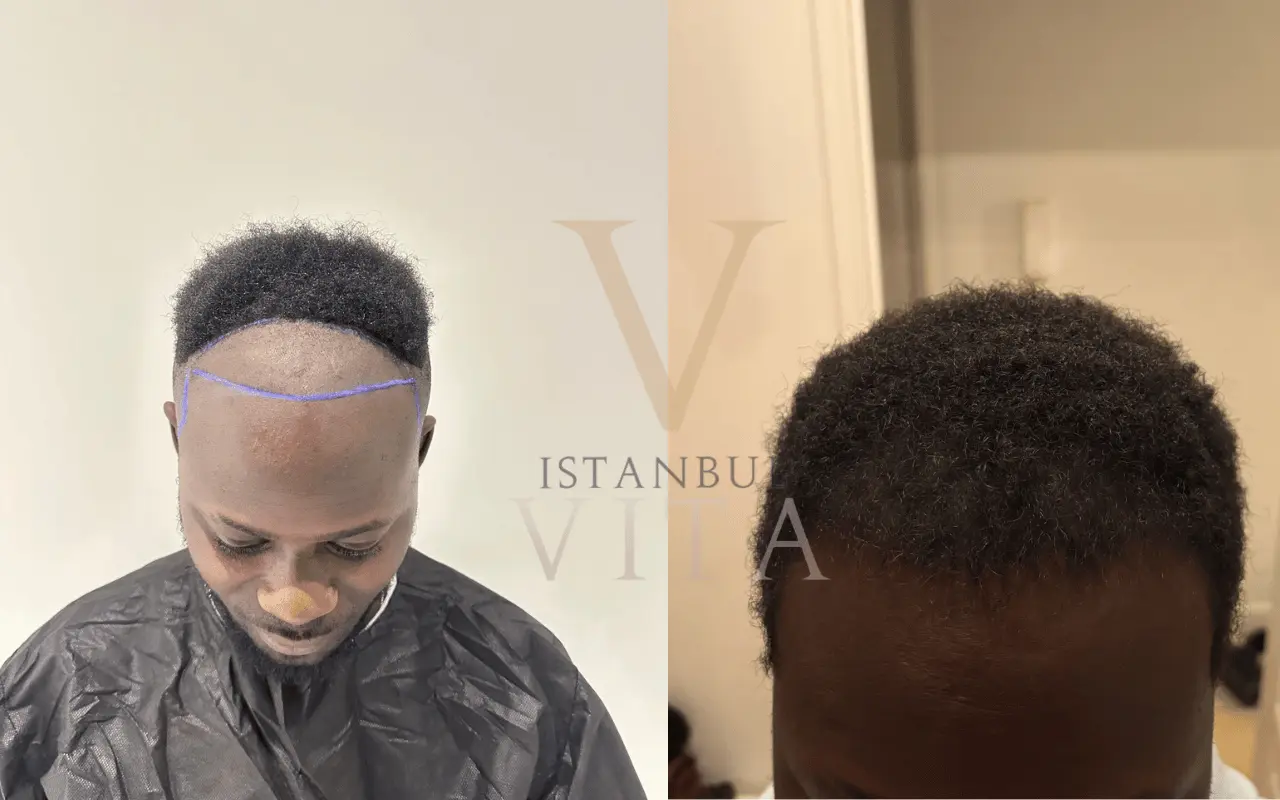
What Makes Afro Hairline Restoration Different?
Textured strands don't just curl above the scalp surface. In a lot of patients, the follicle itself curves underneath, sometimes quite sharply. That one anatomical detail changes several steps of the process.
Curved Follicular Anatomy and Curl Direction
During extraction, a curved follicle is far more likely to get transected if the tools and technique weren't adjusted for that curve. And damaged grafts simply don't grow, so accuracy here has a direct effect on density in the treated area later on. Direction matters just as much. Curly growth doesn't come straight up out of the scalp; it exits at an angle, often with a visible twist that differs from what's happening just below the surface.
Istanbul Vita built its Afro Technique® around exactly this problem, an individualized approach to extraction and placement designed for curved follicular anatomy rather than a straight-hair protocol stretched to fit.
Graft Angle and Single-Graft Placement at the Frontal Edge
Right at the very front, single grafts go in instead of grouped units. That's what creates a soft, gradual transition rather than a hard, obvious edge. In textured cases, each single graft needs to sit at roughly the same angle as the surrounding growth. Get that wrong, and the frontal edge can end up looking stiff, or pointing in a direction that just doesn't match anything around it.
How Is a Natural Afro Hairline Designed?
Good design work starts long before anyone picks up an instrument. Usually it begins with old photos, a look at family patterns, and a physical read on bone structure, density, and how far the recession has actually progressed.
Should Your Original Hairline Be Recreated Exactly?
Not always, and this catches some patients off guard. Restoring every millimeter isn't automatically the goal, especially for younger patients whose recession hasn't fully settled yet. Set something too low, too straight, or too dense for someone's age, and it can look off within a few years, especially if the surrounding growth keeps thinning.
Often, a slightly more mature, individualized frontal design ages better than an attempt to bring back exactly what someone had a decade ago. That's not a universal rule, though. Age, donor supply, and how the recession is expected to behave all shift the calculation differently for each person.
Facial Proportions and Temple Points
Forehead height, temple shape, overall proportion, none of it is optional in this equation. A design that skips over these details, or simply borrows someone else's shape, tends to look out of place on a different face. There's a deeper breakdown of how temple points and facial structure come together in this piece on natural hairline design for afro hair, which goes further into shape planning and how a frontal line ages over time.
| Planning Factor | What It Affects | Why It Matters in Afro-Textured Cases |
| Curl direction | Graft angle and final growth appearance | Wrong angle can leave the front looking flat or off |
| Donor curvature | Extraction safety and graft survival | Curved follicles are more easily damaged if unaccounted for |
| Facial proportion | Overall shape and temple points | Ignoring bone structure produces a disconnected look |
What Happens If Hair Loss Continues After the Transplant?
Transplanted follicles are generally resistant to whatever caused the original recession. What's around them isn't. Native growth behind and alongside the treated zone can keep thinning, particularly in younger patients whose pattern loss hadn't fully stabilized going into surgery.
So future changes get built into the plan from the start rather than treated as an afterthought. Doctors weigh family history, current density behind the front, and age to get a sense of how that area might look ten or twenty years out. Sometimes that means holding the line a little higher than a patient initially wants. Sometimes it means being conservative with donor use so a smaller follow-up procedure stays possible down the road.
How Does Istanbul Vita Plan Receding Afro Hairlines?
At Istanbul Vita, planning starts with microscopic donor analysis, checking curvature, thickness, and growth pattern before extraction even begins. That single step shapes a lot of what comes after, since curl-aware extraction protects follicles that tools calibrated for straighter textures would otherwise damage.
The Afro Technique® pairs that donor analysis with individualized design work, factoring in facial proportions, existing density, and how a patient's recession has actually behaved over time. Doctors stay involved through the planning stages and during channel opening, which keeps angle and direction consistent across the treated area instead of leaving that precision to vary between different hands.
None of this promises an identical outcome for every patient, and it shouldn't be sold that way. Skin, donor supply, and how someone's loss progresses afterward still play a role no matter how careful the planning is. What individualized work actually does is lower the odds of a result that looks disconnected from someone's real face and texture.
Why Does Choosing a Clinic Experienced With Afro Hair Matter?
Not every clinic doing transplants has real experience with tightly coiled or Type 4 textures specifically. Techniques and angles that work fine on straight or wavy strands don't just transfer over to curved anatomy, and a team without that background may miss the details separating a natural result from a stiff one.
Worth asking during a consultation: how curl pattern gets evaluated before extraction, who actually performs channel opening, how temple design gets approached specifically, whether they can show prior results on similar textures. A clinic that treats these as reasonable questions, rather than brushing past them, is usually telling you something.
If you're trying to figure out whether your own recession has stabilized, how much of it realistically needs restoring, and what shape would actually suit your face and curl pattern, a consultation is really the only way to get answers built around your case instead of general averages.
Have Questions? Let's Chat on WhatsApp!
Get instant answers 24/7. Receive your doctor-led hair analysis within 1 day, plus pricing and booking support.
Start WhatsApp ChatFrequently Asked Questions
Can a hair transplant fix a receding Afro hairline?
Usually, yes. It comes down to correctly diagnosing the cause, setting a realistic frontal design, and accounting for curl pattern along with any future changes.
Can receding temples grow back with a transplant?
Temples can be restored, though they demand more precise angle and shape work than the central front, given the thinner skin and sharper directional shifts involved.
How many grafts are needed for a receding hairline?
That depends heavily on how much has receded, donor availability, and the density someone's aiming for, so it's really something worked out during a detailed consultation.
Is an M-shaped pattern suitable for transplantation?
Yes, though the temple points typically need individualized shaping so the final design fits the person's actual face rather than a generic template.
Can traction alopecia around the front be treated with a transplant?
It can, once the area is confirmed stable. Active traction loss sometimes needs styling changes addressed first before surgical restoration makes sense.
Will my results look natural with coily texture?
That largely depends on curl-aware extraction and correct graft angling, which is exactly why experience with textured hair specifically matters here.
Can recession continue after the procedure?
Transplanted follicles generally resist further pattern loss, but native growth nearby can still thin over time, and that's factored into the design from the start.
Is Afro-textured hair harder to work with around the front?
It demands more technical precision because of the curved anatomy beneath the skin, but with the right planning it isn't inherently riskier than other textures.

 conversation


