
 English
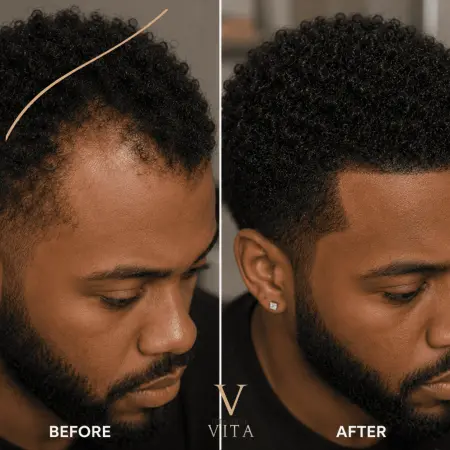
Table of Contents
Can a Hair Transplant Restore Traction Alopecia in Afro Hair?
Years of braids, cornrows, tight ponytails, weaves, extensions. Then one day the edges just aren't there anymore. If that sounds familiar, you're probably past wondering what traction alopecia is. You want to know whether it can actually be fixed.
It depends on what's happening underneath the surface, not on how long the thinning has been visible. Some follicles recover once the pulling stops. Others don't, and that's usually the point where a transplant enters the conversation.
We've covered the broader surgical process in our Afro hair transplant guide, which walks through techniques and planning for curly and coily types more generally. Here, the focus stays narrow: traction alopecia specifically, and what determines whether restoration through surgery makes sense.
You're far from the only one asking this. It's one of the most common reasons Afro-textured patients contact a restoration clinic in the first place.
Active vs. Permanent Traction Alopecia: Why the Difference Matters
When Thinning May Still Recover on Its Own
Recent thinning behaves differently than old thinning. If the change is new, if there's still fine or short regrowth visible, or if the tension has already been reduced, the affected follicles may still be functional. Surgery isn't usually the first move here. Time and reduced pressure are given a chance first.
When the Area Is Considered Stable Enough for Surgery
Long-standing cases look different. No regrowth over an extended stretch. A scalp that appears smooth where something used to grow. At that point, the follicles in question may no longer be producing anything, and this is generally what gets described as permanent traction alopecia.
There's no calendar rule for this. Six months doesn't automatically mean permanent, and two years doesn't guarantee it either. What matters is whether the scalp shows activity, and how the surrounding growth has changed over time. A clinician looks at the tissue, not a timeline.
Can Damaged Edges Recover Without a Hair Transplant?
Sometimes. Catch it early, remove the tension, and regrowth is genuinely possible. No surgery required. That's exactly why permanence needs confirming rather than assuming.
The complicated part: early-stage and long-term thinning can look nearly identical from the outside. A monitoring period, looser styling, a few months of watching how the edge responds, usually comes before anyone discusses grafts seriously. Improvement during that window means surgery probably isn't necessary. No improvement is useful information too, just in the other direction.
Understanding causes and stages of traction alopecia in more general terms helps explain why some cases bounce back and others settle into something permanent. We go into that separately, in more depth, elsewhere on the site.
Can a Hair Transplant Restore Edges Lost From Braids or Tight Hairstyles?
Once the loss is confirmed as stable, yes, in many cases. But restoring an edge isn't like restoring density on the crown. The edge sits in plain view. It has to look like it grew there, not like something added afterward.
Planning carries more weight than the surgery itself in these cases. A graft placement that fills space without matching the original pattern, the curl behavior, the framing of the face, tends to read as artificial even when every graft survives perfectly.
Why Afro-Textured Hair Requires a Different Restoration Approach
Curved Follicular Anatomy Beneath the Skin
Here's something that surprises most patients: what you see on the surface doesn't match what's happening below it. Follicles in Afro-textured types often curve sharply beneath the skin before the visible shaft ever emerges. Straighter types rarely show this same degree of subsurface curvature.
Extraction at the wrong angle risks transection, cutting the graft before it can even be used. This single detail explains most of why experience matters so much in this category of surgery, traction-related or otherwise.
Type 4A, 4B, and 4C Variations in Planning
4A tends to run looser, more defined. 4B and 4C are typically tighter, more coiled, with heavier shrinkage. Extraction angle, expected growth, and how density gets distributed across a rebuilt edge all shift depending on which pattern is involved. A plan built around one doesn't transfer cleanly to another.
How Are Damaged Edges and Temples Rebuilt Naturally?
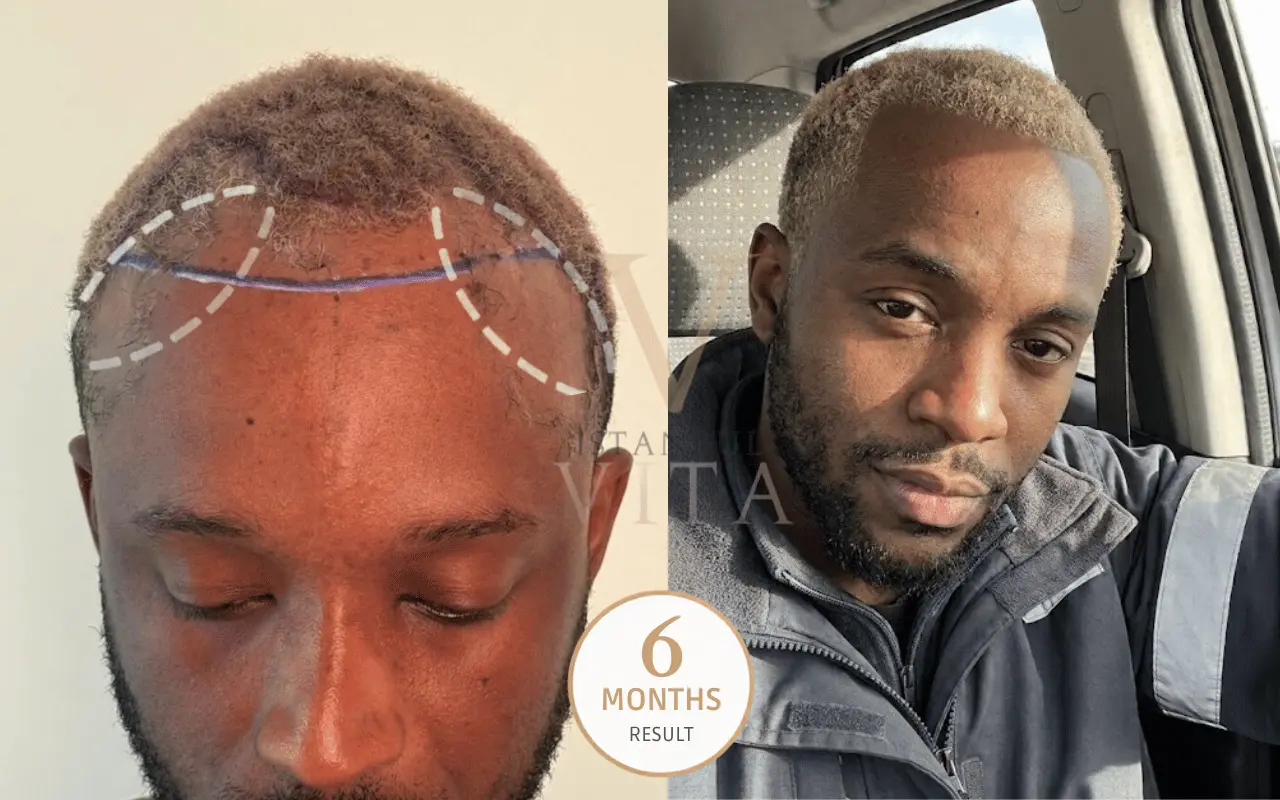
Designing a Hairline That Matches Existing Growth
What remains matters as much as what's missing. Native growth still present, forehead shape, temple angle, whatever can be reconstructed of the original pattern, all feed into the design. Rebuild an edge in isolation, without referencing everything around it, and the result tends to look disconnected from the rest of the head.
Blending Transplanted Grafts With Natural Curl Direction
Direction gets overlooked constantly. Place a graft at the wrong rotation and it grows the wrong way, invisible at first, obvious the moment length comes in. Matching direction, not just type, is often the detail separating a convincing result from one that clearly reads as surgical.
| Stage | What It May Look Like | Why It Matters Before Transplant |
| Active / Potentially Reversible | Recent thinning, some fine regrowth, no visible scarring | Removing tension may still allow natural recovery; surgery is usually premature |
| Stable / Long-Standing | No regrowth over time, smooth or scarred scalp in the affected zone | Follicles are unlikely to recover on their own; transplantation becomes a realistic option |
Have Questions? Let's Chat on WhatsApp!
Get instant answers 24/7. Receive your doctor-led hair analysis within 1 day, plus pricing and booking support.
Start WhatsApp ChatCan Tight Hairstyles Damage Transplanted Hair Again?
Lower-Tension Styling After Recovery
Fair question. Yes. Grafts placed surgically aren't immune to the same repeated pulling that caused the problem originally.
That doesn't mean giving up braids, cornrows, locs, wigs, or sew-ins permanently. It usually means adjusting how much pressure sits right along the root near the restored edge. Looser installs, less pull near the front, time for the area to settle before returning to anything tight. Nobody's asking anyone to abandon styles tied to their identity. Protecting the result once it's there is the point.
How Does Istanbul Vita Approach Afro Traction Alopecia Cases?
Microscopic Donor Analysis and Curl-Aware Extraction
At Istanbul Vita, cases involving traction alopecia in Afro-textured patients start with assessment, not a fixed protocol. The donor region gets examined microscopically for curvature, density, and thickness before extraction begins. This matters more here than in straighter types, given how unpredictable direction can be beneath the surface.
Individualized Planning With the Afro Technique®
That case-by-case approach is the foundation of what Istanbul Vita calls the Afro Technique®, built specifically around curly and tightly coiled anatomy. Curl-aware extraction. Careful reading of the damaged recipient zone. Placement planned around natural direction instead of a template.
Doctors stay involved through the planning stages that require this kind of judgment, particularly density distribution across a restored edge. The Afro Technique® isn't a guarantee that every traction alopecia case qualifies for surgery. It's a framework for individualized evaluation. That's what this category of restoration actually requires.
Frequently Asked Questions
Can traction alopecia be treated with a hair transplant?
In many stable, long-standing cases, yes. It comes down to whether the affected follicles are still active or have permanently stopped producing.
Can a hair transplant restore damaged Afro edges?
Often, provided the loss is confirmed permanent and donor characteristics support a natural design.
How do I know if my traction alopecia is permanent?
Permanence gets assessed by checking for regrowth after tension is removed and examining the scalp for scarring or follicular activity, ideally in person.
Can Black women get a hair transplant for traction alopecia?
Yes. It's one of the more common reasons patients, including many Black women, pursue restoration, and clinics with real experience in coily and curly patterns tend to plan these cases more reliably.
Can tight styles damage transplanted grafts later?
Yes. The same repeated tension that caused the original loss can affect transplanted follicles too, which is why lower-tension styling near the restored area matters afterward.
How long should traction alopecia be stable before considering surgery?
There's no universal number. Stability gets judged by regrowth patterns and scalp condition over time, not a fixed count of months.
 conversation


