
 English
Table of Contents
Ask five surgeons whether a widow's peak can survive an Afro hair transplant, and you'll get five slightly different answers. The short version holds up though: in most cases, yes. It can be preserved. Softened. Or rebuilt from nothing at all. What actually decides the outcome isn't the V-shape on its own. Curl pattern matters more, so does donor supply, and so does the face wearing that central dip. Copy a straight-texture template onto tightly coiled strands and the result rarely looks like it grew there naturally.
Patients bring this up constantly during consultations for an Afro hair transplant in Turkey. Some want the exact V-shape they had at nineteen back. Others are just tired of a sharp central dip and would rather see it softened. A smaller group never liked this feature to begin with and want it gone, full stop.
Every one of those goals is realistic, for the right candidate. The surgical planning behind each one, though, looks nothing alike. Coily growth behaves differently under the skin than straight strands do. That single difference shapes almost every decision that follows, right down to who actually qualifies for a widow's peak afro hair transplant in the first place.
What Is a Widow's Peak?
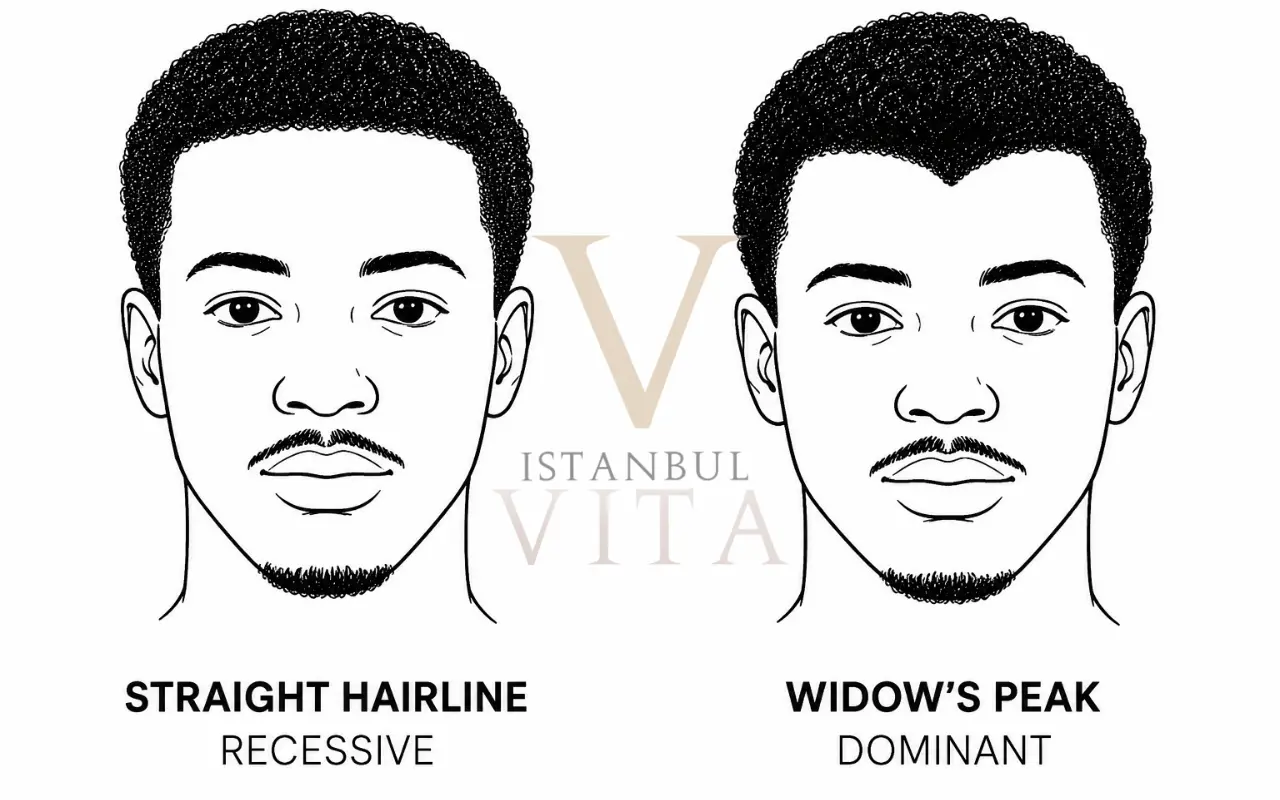
Picture the scalp's frontal outline forming a V instead of a straight line, dipping lowest right at the middle of the forehead. That's the textbook definition, and plenty of people are born with it. Genetics can reshape it later. So can hormones. So can pattern loss.
Coily texture softens that V quite a bit. On tightly coiled growth this characteristic rarely reads as sharply as it would on straight hair. Which is exactly why designing this feature for coily texture needs its own playbook, not a borrowed one.
Can an Afro Hair Transplant Create or Restore a Widow's Peak?
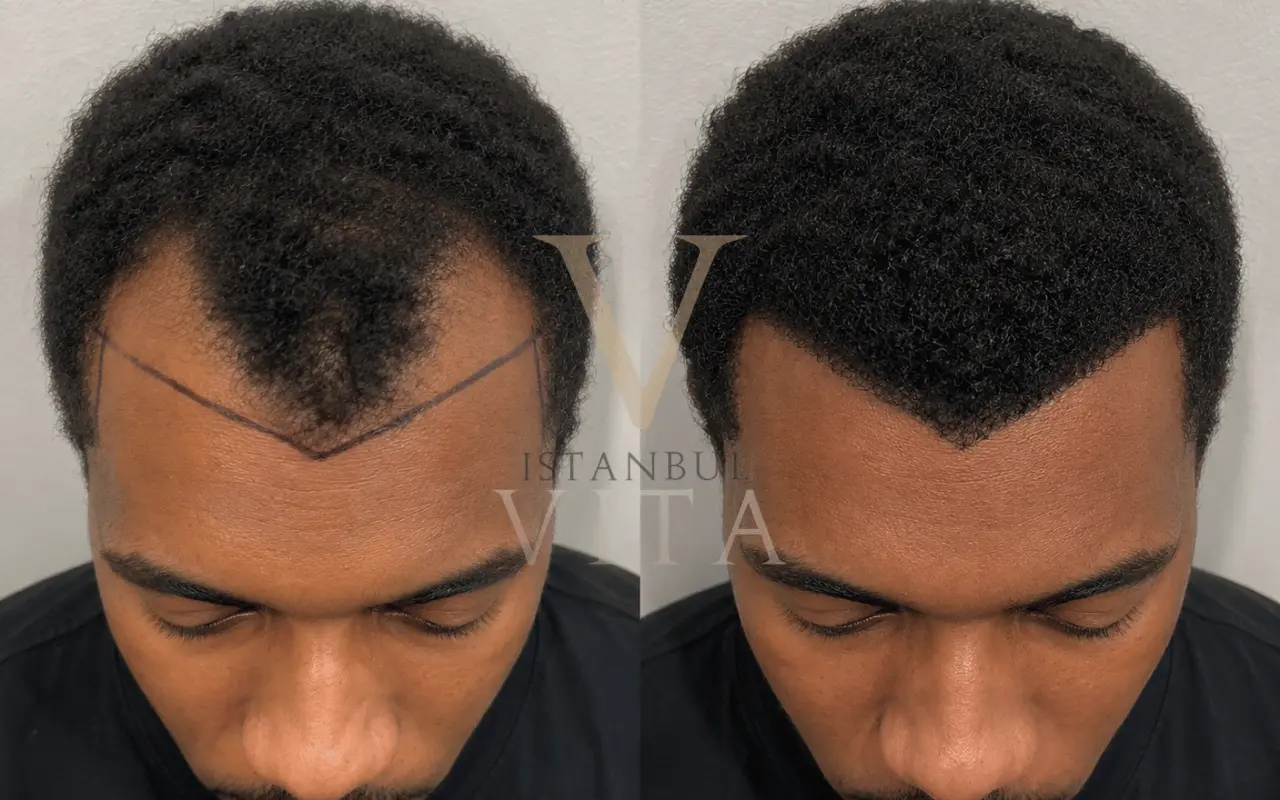
Yes, in short. A skilled team can rebuild a central section that's thinned or receded. Restore one that's been lost to pattern loss entirely. Or design a brand new one for a patient who never had a defined central dip but wants one now.
Grafts go in one follicular unit at a time, each angled to match the direction the surrounding growth already takes. Coiled follicles curve beneath the skin before they ever surface, so extraction takes a steadier hand than most people assume. Get that step wrong and transection risk climbs fast, along with the odds of an inconsistent pattern along the front edge.
Should You Preserve, Recreate or Remove a Widow's Peak?
Facial structure plays the biggest role. Personal taste comes right after it, and so does how much loss has already crept in around the temples.
| Goal | Best Suited For | Planning Focus |
|---|---|---|
| Preserve existing feature | Stable central dip, thinning elsewhere | Match density and texture of the original |
| Recreate a lost feature | Receded or disappeared with hair loss | Rebuild using donor grafts angled to natural growth |
| Soften or remove | V-shape feels too pronounced | Blend the middle into a straighter, rounder line |
Nobody's face stays the same for thirty years, that's just how it goes. A central dip that flattered someone at twenty might look out of place on the same bone structure at forty five. A solid plan reflects the face in the consultation chair today, not an old photograph from a decade back.
Why Hairline Design Matters More in Afro Hair
Straight strands are forgiving. They lie flat. They catch light evenly. They mask small placement errors most people would never even notice. Coily growth offers none of that cover, volume, shrinkage, and the way light bounces off tightly coiled strands all conspire to make an uneven front edge painfully obvious.
Facial Proportions
Forehead width matters here. So does the space between the brows, and so does overall bone structure, all of it dictating where a central dip should actually sit for balance. Set it too low, or too central, and it can look stranded, disconnected from everything else on the face.
Curl Pattern
Tight coils shrink once dry, sometimes by half their stretched length. That single fact changes how low the frontal outline appears from one day to the next. Planning purely off wet, elongated measurements is a rookie mistake, one experienced surgeons learn to avoid early on.
Temple Points
Two temple corners anchor either side of the V. Place them asymmetrically, or too far back on one side, and the whole shape can look crooked, even when the central dip itself was executed perfectly.
Hairline Density
A soft, well-defined V-shape needs slightly heavier graft density right at the middle of the frontal hairline. Skimp there and the outline blurs into something closer to a flat line, no matter how carefully everything else was mapped out beforehand.
Widow's Peak vs. a Receding or Maturing Hairline
Confusion between these two happens all the time. If what's showing up looks less like a defined central dip and more like an even pullback across the whole front, understanding how a mature hairline develops can help clarify which pattern is actually at play. A mature hairline recedes gradually and uniformly with age, while genuine loss at the central section tends to hit that spot first, leaving the temples comparatively full. Knowing the difference changes not just the surgical plan, but whether surgery is even the right call yet.
Have Questions? Let's Chat on WhatsApp!
Get instant answers 24/7. Receive your doctor-led hair analysis within 1 day, plus pricing and booking support.
Start WhatsApp ChatHow Doctors Create a Natural-Looking Widow's Peak
Planning starts with mapping whatever growth remains, including any faint traces near the central dip that can serve as a natural guide. Grafts get extracted one at a time, sorted by direction and shaft thickness, before anyone even touches the recipient area.
Right at the central transition, single grafts go in at a shallow angle. That softens what would otherwise be a hard, artificial-looking line. Move outward toward the temples, though, and both density and angle steepen a bit, letting the natural contour taper instead of looking stapled on.
Here's a case from the clinic floor. A patient in his early thirties came in with the central section receded, temples still fully intact. Rather than redrawing his whole front edge, the surgical focus stayed narrow. Just that middle section got rebuilt, texture matched closely enough that the new growth blended straight into what was already there.
Who Is a Good Candidate?
Donor supply at the back and sides matters most, full stop. Beyond that: realistic expectations about how coily texture behaves, and a scalp free of active conditions that could complicate healing.
Anyone still early in the loss process, where the pattern hasn't fully revealed itself yet, is usually better off waiting and watching before locking in a permanent shape.
How Does Istanbul Vita Design a Widow's Peak for Afro Hair?
Istanbul Vita works through the Afro Technique®, weighing curl pattern, donor characteristics, and facial proportions before a single graft goes in. Doctors stay hands-on through the planning stage. They personally open the channels that dictate graft angle, since this step influences the final result more than nearly anything else in the procedure.
No two patients share identical texture or bone structure, so this stays individual, not a fixed template pulled off a shelf. Anyone weighing a widow's peak afro hair transplant, whether the goal is to keep, rebuild, or soften that central contour, is welcome to book a personalized consultation built around their own face.
FAQ
Can a fully disappeared central dip come back?
Usually, yes, provided there's enough donor supply and the surrounding hairline can support a defined V-shape again.
Does tighter coil pattern make this harder to plan?
Not harder. Just different. Shrinkage and direction both need factoring in so the V-shape reads correctly once everything dries and coils up.
Can this feature be softened without erasing it completely?
Yes. Adjusting density and angle rounds out a sharp central contour while keeping a subtle trace of the original.
How long before the final shape settles in?
New growth follows its own timeline. The frontal outline gets clearer gradually as grafts mature.
Isn't this just a receding hairline?
Not quite. One's a defined central dip at the middle of the frontal hairline. The other's a broader, more even pullback across the whole width.
Can the temple corners get addressed at the same time?
Yes, that's standard practice. Treating them separately tends to look disjointed.
Who makes the final call, preserve, rebuild, or remove?
That's a joint decision, patient and surgeon together, after reviewing facial structure, loss pattern, and personal preference.
 conversation


