
 English

Table of Contents
Your edges have been receding for years.
You've stopped the tight styles.
You've tried oils, biotin, and every "edge-restoring" product on the market. Nothing grew back.
Now you're wondering if a hair transplant for traction alopecia is actually the answer, or whether you've waited too long.
Here is something that no clinic website will tell you from the start: it is not the technique but the timing of the surgery that is essential in cases of traction alopecia. Choose incorrectly and be ready to invest thousands of dollars on implants that won't survive.
Does a Hair Transplant for Traction Alopecia Actually Work?
Absolutely. The hair transplant procedure for traction alopecia is effective and safe. Nevertheless, the success of the surgery depends entirely on one condition.
Traction alopecia occurs when the hair follicles endure too much pulling due to various hair styling practices such as braiding, weaving, corn rows, and tight ponytails.
If this pulling pressure is stopped timely, the follicles will recover by themselves. In case of extended pulling pressure, the hair follicles will scar, and the traction alopecia is considered irreversible. It is here when the hair transplant for traction alopecia is needed most.
Is Your Traction Alopecia Ready for Surgery? The Stability Test
Operating on active hair transplant for traction alopecia is like planting seeds in burning soil.
The clinical standard: wait 6 to 12 months after stopping the causative hairstyle, with no active inflammation, before a surgeon will consider you a candidate for hair transplant surgery.
| Status | Can You Have a Transplant? |
| Still wearing tight styles | No — must stop first |
| Stopped styles but still inflamed | No — wait for full resolution |
| Stopped styles, no inflammation, loss stable 6–12 months | Yes — strong candidate |
| Stopped styles, fibrosis/scarring confirmed | Yes — with specialist experienced in scarred scalp |
| Early stage, some follicles may still recover | Consider non-surgical treatment first |
Can Traction Alopecia Be Reversed Without Surgery?
In early stages, yes. If follicles haven't scarred over, stopping the tension is often enough. Minoxidil for treating traction alopecia helps stimulate hair growth by increasing blood flow to the hair follicles. Platelet-Rich Plasma injections serve as an additional remedy that is administered at the early or middle stages of alopecia.
But here's the honest answer on timing: traction alopecia, when it's too late, doesn't respond to topical treatments. If the follicle has been replaced by fibrotic scar tissue, no serum restores it. That's the point where a hair transplant for traction alopecia transitions from optional to necessary.
The most common mistake patients make: spending 12–18 months cycling through products before accepting that the follicle is gone and surgery is the only path forward. Every month of delay doesn't change the outcome, but it does delay recovery.
How a Traction Alopecia Hair Transplant Actually Works
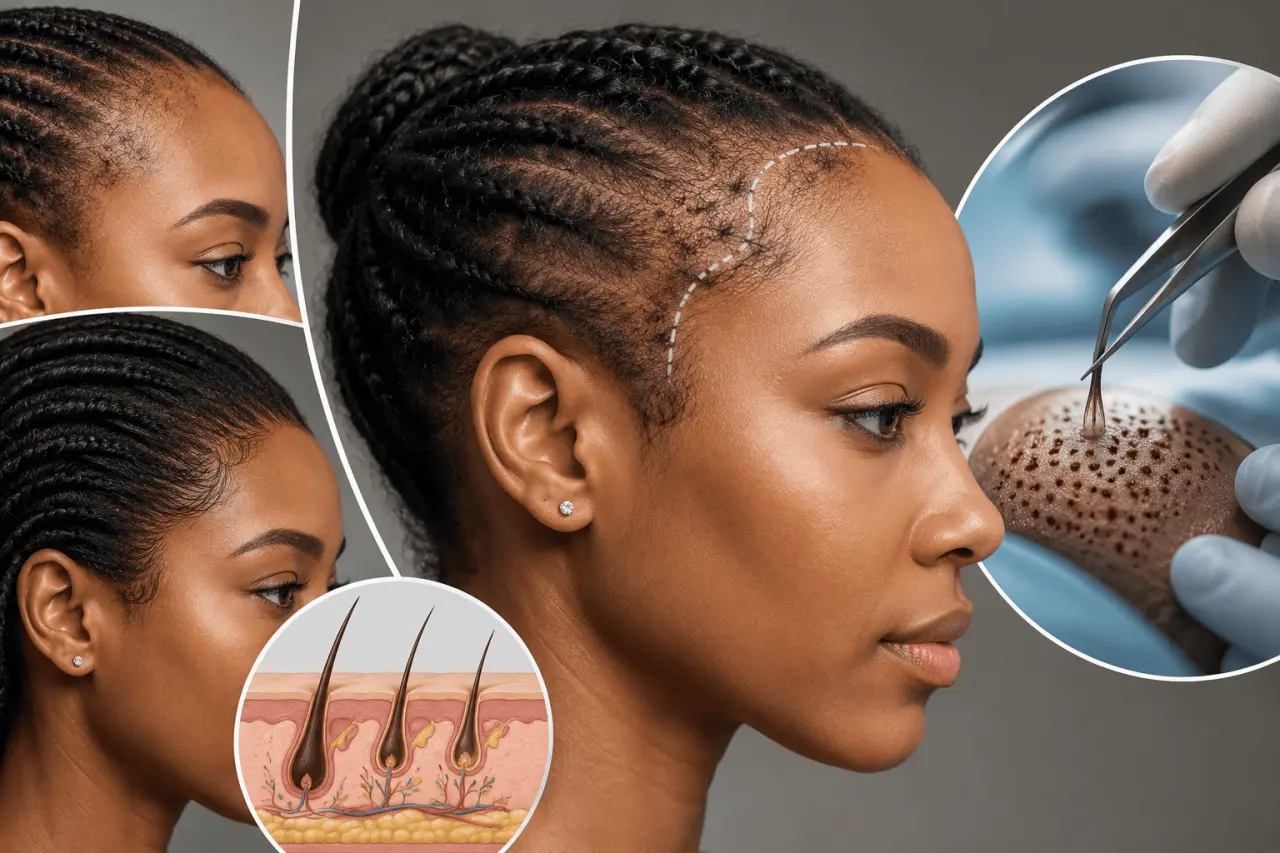
The procedure itself is a standard FUE (Follicular Unit Extraction) but with one important difference. The recipient area in traction alopecia often involves scar tissue, which has reduced vascularity. Surgeons experienced in traction alopecia hair transplant surgery adapt by:
- Creating smaller, more precise recipient channels to reduce trauma to already-compromised tissue
- Spacing grafts to ensure adequate blood supply to each follicle
- Compensation in implant depth for fibrosis in the scalp
The majority of traction alopecia cases involve problems with the hairline, temple areas, and the edges, as they are the most common areas affected. In traction alopecia repairs, between 2,000 and 2,250 grafts can be transplanted, depending on how much hair is missing and available donors.
The DHI (Direct Hair Implantation) technique is more frequently used for restoring the hairline and edges because the Choi implanter pen provides accurate implantation by degree in terms of the angles and direction required for the hairline.
Traction Alopecia Hair Transplant Cost in 2026
Hair transplant for traction alopecia cost depends on graft count, technique, and location. Here's a realistic comparison:
| Location | Graft Range | Estimated Cost (2026) |
| Istanbul, Turkey (specialist clinic) | 1,500–2,500 grafts | €1,800–€3,800 all-inclusive |
| UK (London) | 1,500–2,500 grafts | £5,000–£9,000 |
| USA | 1,500–2,500 grafts | $8,000–$14,000 |
| Mexico | 1,500–2,500 grafts | $3,500–$6,000 |
The main reason why Istanbul continues to draw international tourists for their hair transplant treatment involving traction alopecia is the huge price savings that are achieved despite all the expenses on transport and lodging.
The majority of the Istanbul packages offer all-inclusive services including surgery, stay in hotel rooms, post-op product kits, and consultations at a flat rate price.
The estimated size of the global hair transplant industry as of 2026 was at around $6.98 billion.
What Real Results Look Like: A Scenario
Consider a case study involving a lady of 34 years, who was always braiding and weaving from when she was young until her late 20’s.
Her temples started to recede considerably by her late 20’s and the edges around her ears disappeared.
She stopped braiding at 31 years and did minoxidil treatment for 18 months but showed little progress.
Her frontal hairline never improved. At 33 years, she underwent hair transplantation for traction alopecia (1,900 grafts using the DHI method).
At six months, initial growth was visible. At twelve months, the hairline was fully restored with natural density and direction. She's now 34 and wearing her natural hair with no further styling restrictions.
This is a common presentation. That is how the traction alopecia hair transplant success rate is high on the condition that candidates have been screened thoroughly, the hair loss pattern identified, the donor site healthy, and the source (tension) eliminated.
Have Questions? Let's Chat on WhatsApp!
Get instant answers 24/7. Receive your doctor-led hair analysis within 1 day, plus pricing and booking support.
Start WhatsApp ChatHair Transplant for Traction Alopecia in Turkey: Why Istanbul?
No other nation carries out more hair transplant surgeries per year than Turkey.
Where traction alopecia is concerned, Turkish clinics specializing in women’s and African American hair transplantation have established highly effective procedures for reconstructing hairlines that have been damaged, something which many general clinics struggle with.
Important questions to ask when considering traction alopecia hair transplant surgery in Turkey:
- Are there any ‘before and after’ photos of traction alopecia hairline transplants available at the clinic?
- Will the surgery be performed by a doctor, not a technician?
- Is there a follow-up program in place for international patients?
- How will they deal with scarred/fibrotic recipient areas?
When It's Time to Stop Waiting and Get a Real Assessment
If after one year of abstaining from tight hairstyles your edges have not yet come back, no product will be able to bring them back because the hair follicle is now missing.
For cases of hair transplant for traction alopecia, a hair transplant is the right treatment, even if not the final treatment.
The professionals at Istanbul Vita frequently work with traction alopecia patients and can evaluate your images and advise you based on your stability and whether surgery is necessary.
Frequently Asked Questions (FAQ)
Can a hair transplant permanently fix traction alopecia?
Yes, a hair transplant permanently restores hair lost to tight styling. However, success depends entirely on stopping the damaging hairstyles to ensure the new grafts survive.
When is it too late for non-surgical treatments like Minoxidil?
If your hair follicles have been replaced by fibrotic scar tissue due to long-term pulling, topical treatments will not work. At this stage, surgery becomes the only viable option.
How long do I need to wait after stopping tight hairstyles before getting a transplant?
The clinical standard requires waiting 6 to 12 months after stopping the causative hairstyles. The scalp must be completely stable and free of active inflammation before surgery.
Why is the DHI technique preferred for traction alopecia repairs?
Traction alopecia mostly impacts the hairline and edges. The DHI (Direct Hair Implantation) technique provides extreme precision over the exact angles and direction needed for a natural-looking hairline.
 conversation


