
 English

Table of Contents
Most people consider hair loss a genetic or age-related problem; however, it is not always the case, and there are cases where hair loss is the consequence of certain diseases that destroy hair follicles. Frontal fibrosing alopecia (FFA) is among such diseases.
In contrast to ordinary hair loss, FFA belongs to the category of scarring alopecia when inflammation leads to the destruction of hair follicles and their replacement by scars. After that, hair follicles are no longer able to produce hair. Frontal fibrosing alopecia occurs mainly in the frontal part of the hairline and eyebrows; however, sometimes it affects other parts of the head and body.
In the last 20 years, dermatologists noticed a significant rise in the number of cases with diagnosed FFA. Scientists still study the reasons for this phenomenon, but an increased awareness and improved diagnostics methods also play a role in it.
The following is a comprehensive guide to FFA. It includes everything you should know about frontal fibrosing alopecia:
- symptoms
- possible causes
- diagnosis
- treatment options
- long-term outlook
- whether hair transplantation may be considered after the disease becomes stable
What Is Frontal Fibrosing Alopecia?
This is an autoimmune condition resulting in the permanent loss of hair from the forehead and temple areas. It is in the category of cicatricial alopecia. It means that there is an inflammation that results in damage to hair follicles followed by their replacement with scar tissues.
The slow onset of the condition is one of the unique features associated with FFA. In this regard, patients do not experience sudden bald patches but rather see their hairlines moving back over a period of several months or even years. Thinning of eyebrows is another common feature which occurs even prior to any noticeable hair loss from the scalp.
Contrary to other hair loss problems such as stress alopecia, the problem is characterized by the inability to regenerate follicles that have been affected since the process is permanent.
Early Stage Frontal Fibrosing Alopecia
The onset of frontal fibrosing alopecia is quite deceptive at the outset. Most individuals think that they are just undergoing the effects of aging or a mature hairline. At this point, the hairline only recedes by a few millimeters every year. The slow pace of the disease is what makes it hard to identify because comparisons must be made using previous pictures.
The first signs to appear would be:
- Receding frontal hairline
- Outer eyebrow thinning
- Itching or burning sensation along the hairline
- Red pimples on hair follicles
- Tenderness of the scalp
- Shiny patches on areas where hair has been lost
There are some cases when there is observable pain in the scalp, but some individuals only experience hair loss. This is the reason why, even without having symptoms like pain, one should see a dermatologist when this happens.
| Early Sign | What You May Notice |
|---|---|
| Receding hairline | Hairline slowly moves backward over months or years |
| Eyebrow thinning | Often begins from the outer edges |
| Redness | Around individual follicles |
| Mild itching | Intermittent irritation near the frontal scalp |
| Burning sensation | Low-grade inflammation in affected areas |
| Smooth skin | Loss of visible follicle openings due to scarring |
Symptoms of Frontal Fibrosing Alopecia
Despite each patient having a different experience with FFA, there are some symptoms that seem to be present in all cases of diagnosed FFA. FFA is a disease that develops gradually, thus, it is not always possible to notice any changes at an early stage.
These are some of the symptoms of FFA:
- Recession of the frontal hairline
- Hair loss around the temples
- Partial or complete eyebrow loss
- Loss of sideburns or fine facial hair
- Redness surrounding hair follicles
- Small blemishes similar to acne that appear on the hairline
- Itching, burning, or mild pain
- Shiny or tight skin where the follicles have been lost
With the progression of the disorder, the skin becomes smooth due to the fact that the holes in the damaged follicles can no longer be seen. That is what differentiates FFA from other forms of hair loss that do not scar.
It does not necessarily cause any pain. Occasionally, patients become conscious of the disease only through comparison between current photographs and previous ones.
What Does Frontal Fibrosing Alopecia Look Like?
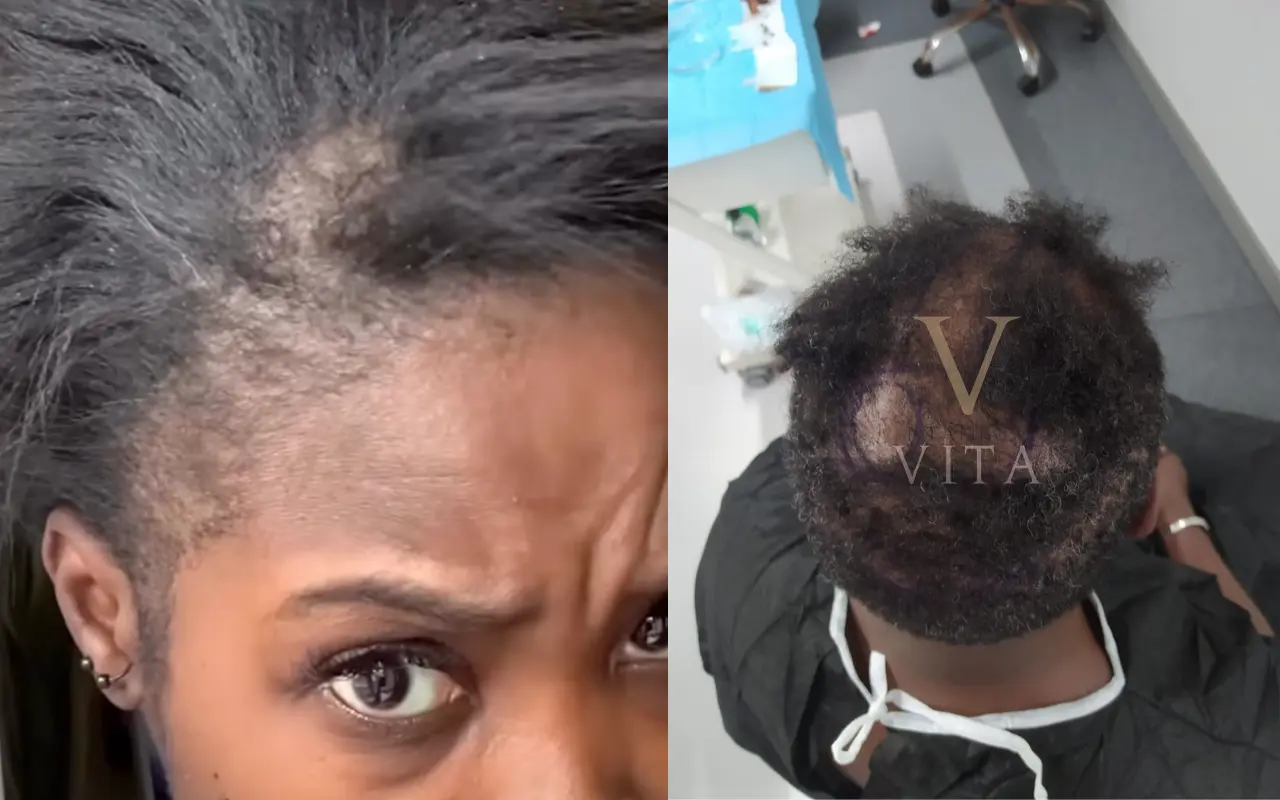
Frontal fibrosing alopecia will show progression in its presentation as the disease progresses. At its early stages, all that will be seen is a marginally elevated hairline compared to previously. Eventually, though, other symptoms will become evident.
Some common characteristics are:
- A symmetrical band of hair loss across the forehead
- Thinning or complete loss of the eyebrows
- Pale or shiny skin replacing normal hair-bearing scalp
- Tiny red dots around remaining follicles
- Fine scaling surrounding individual hairs
- Reduced density around the temples
There are many other conditions affecting hair that can be mistaken for FFA in their early stages. So, a visual assessment is not enough to make an accurate diagnosis. Dermoscopy is usually combined with scalp biopsy by the dermatologist, if required, in order to make the diagnosis and exclude other diseases such as androgenic alopecia and traction alopecia.
What Causes Frontal Fibrosing Alopecia?
The most frequent question that people ask is "What are the causes of frontal fibrosing alopecia?" No one knows what causes this disease. However, years of clinical studies have identified several factors that appear to contribute to the development of the condition.
Rather than being triggered by a single event, frontal fibrosing alopecia (FFA) is believed to develop through a combination of:
- immune system activity
- hormonal influences
- genetic susceptibility
- possibly environmental factors
This relationship may explain why some individuals suffer from it and some do not. It is now believed that the immune system attacks hair follicles which are actually healthy. The inflammation causes destruction of the follicle and forms scar tissue where the hair once was.
Once scar tissue forms, the follicle does not recover and results in permanent hair loss. Scientists still study the cause of this reaction of the immune system; however, some factors leading to it have been identified.
| Possible Cause | Current Evidence | Explanation |
|---|---|---|
| Inflammation mediated by immunity | Strong | Immune cells attack the hair follicle, which results in permanent scarring. |
| Hormonal changes | Moderate to strong | Most commonly diagnosed after menopause, suggesting hormones may influence disease development. |
| Genetic predisposition | Moderate | Family history has been reported in some patients, although inheritance patterns remain unclear. |
| Environmental factors | Under investigation | Researchers continue studying whether external triggers contribute to susceptible individuals. |
| Skin barrier changes | Limited evidence | Some researchers have begun to investigate the possible role of the integrity of the skin barrier on inflammation. |
While this condition is often identified post-menopause, it cannot be classified as a hormone-related condition. Hormones may have a critical role in the development of this disease; however, they do not control the immune attack on the hair follicles.
What Causes Frontal Fibrosing Alopecia in Women?
It is mostly common in women, specifically those who have gone through menopause. Scientists theorize that reduced estrogen affects the body's immune system near the hair follicle and increases the chances of inflammation among people with certain genes.
However, menopause is not the reason behind FFA. A lot of women go through menopause but yet they are not affected by scarring alopecia; this indicates that there are lots of things that need to happen before the disease can be developed.
Is Frontal Fibrosing Alopecia an Autoimmune Disease?
The reason for asking whether FFA is an autoimmune disease is the way this condition behaves similarly to other diseases caused by the body attacking its own tissues.
The answer is more complicated than a simple one.
It should be noted that FFA is considered to be a variant of LPP - an inflammatory scarring alopecia associated with an autoimmune destruction of hair follicles. The key role played by immune cells is the main reason for thinking about the autoimmune nature of this condition.
Nevertheless, like other conditions associated with the attack of the immune system, FFA cannot be included in the list of autoimmune diseases.
What doctors know for sure is the important part played by inflammation, as it is the reason for follicles' death. That is why all therapies aim at stopping the process of inflammation and not on activating the development of hairs.
Some patients with FFA have other disorders related to the immune system, such as thyroiditis or vitiligo, but this connection varies from one study to another.
| Feature | Frontal Fibrosing Alopecia | Male/Female Pattern Hair Loss |
|---|---|---|
| Immune involvement | Yes, significant | No |
| Scarring | Yes | No |
| Permanent follicle loss | Yes | No |
| Inflammation | Common | Minimal |
| Potential hair regrowth | Limited after scarring | Often possible with treatment |
Frontal Fibrosing Alopecia in Men
Although frontal fibrosing alopecia primarily affects women, particularly after menopause, it can also occur in men.
Because male pattern baldness is so common, FFA in men is often overlooked during its earliest stages. A slowly receding hairline may initially appear identical to androgenetic alopecia, delaying diagnosis until additional signs become apparent.
Men with frontal fibrosing alopecia may experience:
- Progressive recession of the frontal hairline
- Loss of eyebrows
- Patchy beard thinning
- Redness around hair follicles
- Burning or itching of the scalp
- Loss of sideburns
FFA is distinguished from common male pattern baldness by the presence of inflammation and scarring. Diagnosis can be easily done through the help of a dermatologist based on physical exams, dermoscopic evaluation, or biopsy of the scalp if needed.
It is especially crucial at an early stage as treatments seek to protect follicles from further harm.
How Is Frontal Fibrosing Alopecia Diagnosed?
Unlike common male pattern hair loss, FFA causes inflammation and scarring. It is easy for a dermatologist to differentiate the two by physical examination, dermoscopic findings, and even scalp biopsy when needed.
Proper and timely diagnosis is very essential since management through medications intends to save follicles before permanent injury occurs.
| Diagnostic Method | Why It Is Used |
|---|---|
| Medical history | Understand symptom progression and possible risk factors |
| Physical examination | Evaluate the hairline, eyebrows, and scalp changes |
| Dermoscopy | Magnifies follicles to detect inflammation and early scarring |
| Scalp biopsy | Confirms the diagnosis when uncertainty remains |
| Blood tests | Rule out other medical conditions when clinically appropriate |
When Is a Scalp Biopsy Needed?
All patients do not need biopsy procedures; there are cases in which a diagnosis can be established by the visual appearance of the area and the dermoscopy alone, even in an experienced dermatologist's hands.
However, when another disease, such as traction alopecia, androgenetic alopecia, or chronic telogen effluvium, cannot be ruled out, a skin biopsy should be considered. This is when the tissue is studied under the microscope to reveal the features of inflammation and scarring characteristic for FFA.
Even though the procedure seems scary, it is done under local anesthesia.
Frequently Asked Questions
What causes frontal fibrosing alopecia?
The cause is unknown, but it is thought that it has something to do with immune disorders, hormones, and genetics.
Have Questions? Let's Chat on WhatsApp!
Get instant answers 24/7. Receive your doctor-led hair analysis within 1 day, plus pricing and booking support.
Start WhatsApp ChatIs frontal fibrosing alopecia an autoimmune disease?
This condition is viewed as a form of scarring alopecia that is primarily an immune mediated process and considered a variant of lichen planopilaris.
Can frontal fibrosing alopecia be reversed?
Not really, however, but the disease may be stopped from progressing if caught at an early stage.
How fast does frontal fibrosing alopecia progress?
The disease progresses at highly variable rates, from a very slow progression of the hairline over many years to visible changes in a matter of months.
What does frontal fibrosing alopecia look like?
It generally presents itself with a slowly receding frontal hairline along with eyebrow thinning and, usually, with smooth, shining skin in the involved region.
How long does frontal fibrosing alopecia last?
The active stage may persist for several years or even longer, but the process will eventually diminish or cease.
Early Evaluation at Istanbul Vita Hair Transplant Clinic
When you suspect that you might be suffering from frontal fibrosing alopecia, getting yourself evaluated early by an expert team of physicians is one of the best actions you could do. Getting diagnosed early on would help stop the progression of the disease and preserve the health of the follicles before any irreversible scarring occurs.
Hair transplant in Turkey at Istanbul Vita, our highly skilled physicians will examine your scalp and recommend a treatment accordingly after thorough evaluation. When a hair transplantation surgery is needed, it is done after the disease becomes stable.
Book your appointment with us now to talk about your condition and treatment.
 conversation


