
 English
Table of Contents
Will Your Hair Still Curl the Same Way After an Afro Hair Transplant?
If you're researching an Afro hair transplant, one question probably keeps coming back: will the transplanted strands actually look like the rest of your head, or will they come in differently once moved?
Fair question. Tightly coiled, springy strands don't get much specific coverage in the usual transplant guides. So let's actually go through it: what happens during and after curly and coiled hair transplant in Turkey, and where the real variables sit.
Short version: transplanted follicles generally keep behaving the way they always have. What changes the outcome isn't the strand itself. It's how carefully those follicles get extracted, oriented, and placed.
Does Transplanted Afro Hair Keep Its Natural Curl Pattern?
In most cases, yes. A follicle carries its own behavior with it, whether it's moved two centimeters or twenty. Coiled on the back of the scalp, coiled at the hairline. That doesn't change just because the location did.
Basic transplant biology, and it applies across every type, not only Afro-textured cases. Surgeons aren't reprogramming a follicle. They're relocating it.
People sometimes assume that because the biology holds, the final look sorts itself out automatically. It doesn't, not entirely. A follicle can keep its characteristics and still sit at an odd angle, or face a way that clashes with what's around it, or look slightly "off" next to the rest of the scalp. That's not a biology issue. That's placement.
Can a Hair Transplant Change Hair Texture?
Not by design. A lot of marketing language dances around this without quite saying it outright: the procedure isn't built to turn coily strands into wavy ones, or curly into straight. No responsible clinic should claim otherwise.
What it can influence is how naturally the pattern reads once it's growing in its new spot. Density, positioning, spacing, all of it shapes how the eye reads the result. Two patients with near-identical donor characteristics can end up with visibly different outcomes depending on how their grafts were handled.
Early growth can also look a little different from the final result. That settles as the area matures. It doesn't mean the underlying type has changed.
Biology stays mostly fixed. Execution shapes what you actually see.
Why Does Graft Placement Matter for Curly and Coily Hair?
This is really the core of the whole conversation. Preserving the follicle's natural characteristics is only one part of the result. Where each graft is placed, the angle it follows, and how it sits alongside the surrounding strands can all affect whether the transplanted area looks like a natural continuation of the existing hair.
Implantation Angle and Growth Direction
Curly and coily follicles don't come straight out of the scalp the way straighter strands often do. They tend to exit at an angle, and that interacts with the coil to build the shape you see on the surface. Get the angle wrong, or point it the wrong way relative to what's nearby, and the curl can sit differently than expected. Even while the strand itself behaves exactly as it always has.
Patients rarely think about this detail going in. It's one of the more technical parts of the whole procedure, and it carries more weight here than with straighter types.
Why a Curly Graft Can Still Look Unnatural in the Wrong Position
Picture one coily strand placed at a slightly wrong rotation, facing away from its neighbors. Nothing biologically wrong with it. Visually, though, it can stand out, break up the flow around it, create a small patch that doesn't blend.
Multiply that across thousands of grafts.
Does the Donor Area Determine the Final Curl Pattern?
Largely, yes. Its characteristics are usually the strongest predictor of how the transplanted area behaves afterward. Tight, dense coils in that zone, tight dense coils showing up later on.
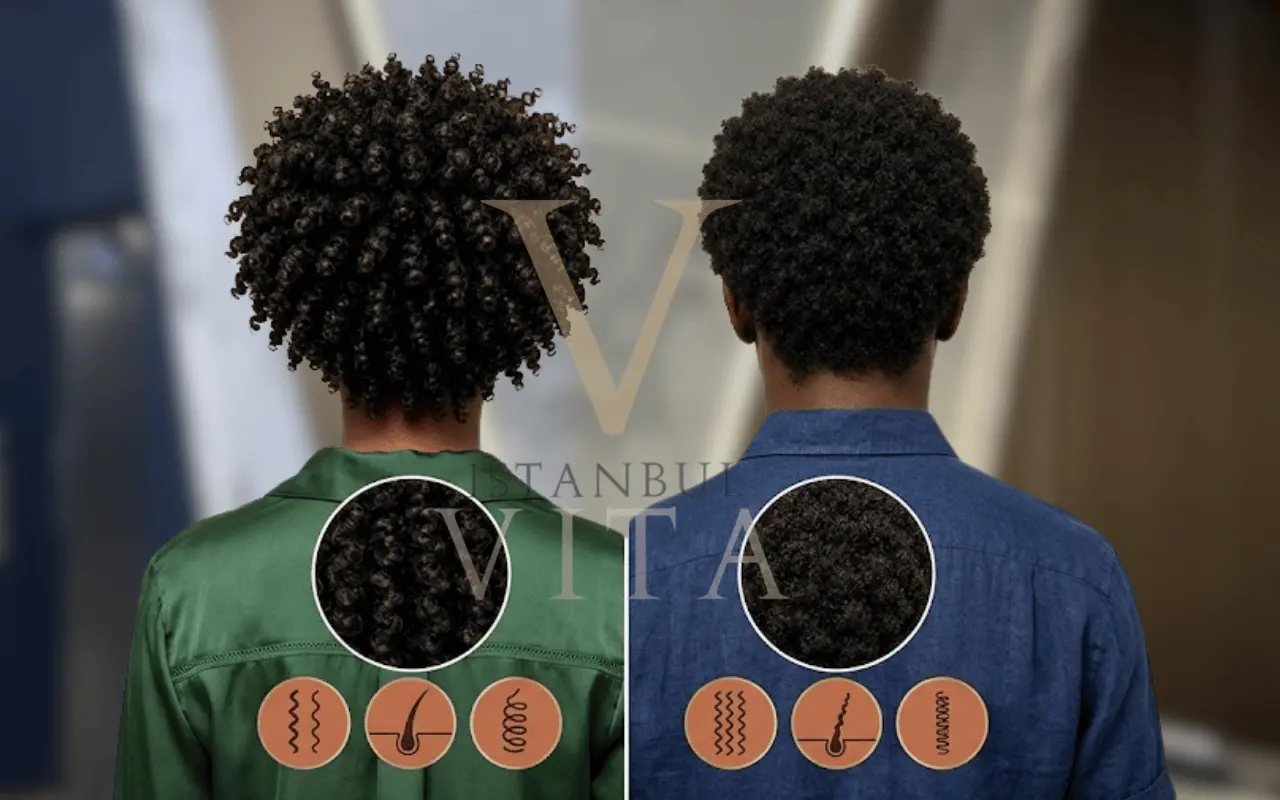
Evaluating it isn't something to rush through. Thickness, tightness, even curvature beneath the skin can vary a fair amount between patients, and Afro-textured cases often need a more detailed read than a quick visual check allows. No two heads of coily hair are identical, either. Someone with looser 4A coils and someone with tighter 4C coils can need noticeably different approaches, which is part of why Type 4 hair transplant planning looks at curl category specifically rather than treating all coily patients as one group.
| Factor | What It Influences | Why It Matters for Curl Preservation |
| Donor characteristics | Baseline growth behavior | Sets the starting point for every graft |
| Graft integrity | Whether the follicle survives intact | Damaged follicles can grow unpredictably |
| Implantation angle | Visual positioning | Misalignment can look unnatural even with correct biology |
| Placement orientation | How strands blend with existing coverage | Prevents patchy or mismatched sections |
| Recipient-area design | Overall hairline and density flow | Supports a cohesive, natural appearance |
How Are Natural Curl Direction and Hairline Design Planned?
Front Hairline and Temple Transitions
Hairlines are rarely uniform on purpose. Growth doesn't move in one single path across the whole scalp. It shifts subtly around the temples, softens near the frontal zone, changes density toward the crown. Ignore those transitions and the result tends to look arranged instead of grown.
Why Curly and Coily Hairlines Aren't Treated Like Straight-Hair Templates
A hairline template built for straighter types doesn't translate well to coily or tightly curled cases. Spacing, density expectations, even how light catches the coils, all of it behaves differently. Applying a generic layout and hoping everything adjusts around it usually doesn't work.
Have Questions? Let's Chat on WhatsApp!
Get instant answers 24/7. Receive your doctor-led hair analysis within 1 day, plus pricing and booking support.
Start WhatsApp ChatHow Istanbul Vita Plans for Curl Pattern Preservation
At Istanbul Vita, Afro-textured and coily cases get planned around, not adjusted for after the fact. Donor zones are examined under microscopic analysis, which helps identify variations in thickness, tightness, and structure across different sections before extraction even starts.
This is part of what the clinic calls the Afro Technique®, built around the specific demands of curved and coiled follicular anatomy.
Doctors stay involved in decisions around positioning, since those choices have an outsized effect on how naturally the grafts settle in with what's already there. The Afro Technique® doesn't promise identical behavior in every strand. No honest approach can promise that. It aims to keep those calls in the hands of people who've actually worked with this type before.
| Common Question | More Accurate Answer |
| "Will transplanted hair become straight?" | No, that's set by the donor follicle, not the procedure |
| "Can surgery create a new curl type?" | No, surgery relocates follicles, it doesn't change their biology |
| "Does every graft need the same angle?" | No, natural scalps vary, and planning should reflect that |
| "Does donor texture matter?" | Yes, it's typically the strongest predictor of the final result |
What Should Patients Ask Before Choosing a Clinic?
A few questions worth asking directly if this matters to you, and for most people, it does:
- How is my donor area evaluated before the procedure is planned?
- Who determines the implantation angle, and how?
- Has the team documented experience with types similar to mine?
- How will the treated area be blended with what I already have?
Not just formality questions. The answers tend to show whether curl-aware planning is actually built into the process or bolted on afterward.
Natural-looking integration takes more than moving grafts from one part of the scalp to another. It takes understanding how those follicles behave and where they point, which matters more with Afro-textured and coily cases than most people expect. If that level of detail is what you want addressed before choosing a clinic, Istanbul Vita builds its consultations around exactly that kind of individualized assessment.
Frequently Asked Questions
Will transplanted Afro hair stay curly?
Generally, yes. The follicle typically keeps what it had at the donor site, so coily strands usually stay that way afterward.
Can a hair transplant change my hair texture?
Not by design. The procedure relocates existing follicles rather than altering their underlying characteristics, though early growth can look a little different before it settles.
Does donor hair keep its original curl pattern?
Mostly, yes. Its characteristics are the main factor carrying over into the recipient area.
Can placement angle affect how curly hair looks?
Yes. Even naturally curly grafts can look misaligned if the angle doesn't match what's around them.
Will transplanted hair match the surrounding texture?
Usually, assuming donor characteristics are consistent and placement gets planned carefully around the existing coverage.
Does 4C hair keep its curl after transplantation?
Typically. 4C follicles carry their tight coil with them, though careful extraction and placement still matter given the added complexity.
Can transplanted hair grow differently at first?
Some early variation is common across all types. Not unusual before the final result settles in.
 conversation


