
 English
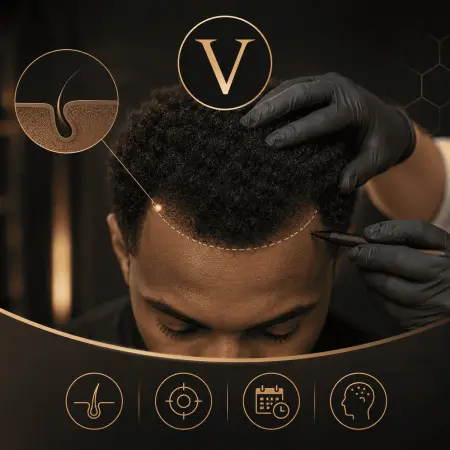
What Makes Black Hair Transplantation Different in Turkey?
Most clinics advertise the same FUE package to every patient, regardless of hair type. That is the first mistake many people make when researching a black hair transplant in Turkey: assuming a technique built for straight hair will work the same way on afro-textured hair.
It won't, and the difference isn't cosmetic. Afro hair follicles curve beneath the skin before they ever reach the surface, which changes how they must be extracted, handled, and implanted. Choosing a clinic that treats every hair type identically is how patients end up with low graft survival, visible scarring, or a hairline that never quite looks natural.
Why Do Curved and Curly Follicles Change the Rules?
A straight hair follicle runs in a fairly predictable line under the scalp, so a standard punch can follow it with minimal risk. Afro hair follicles curve, sometimes sharply, beneath the dermis before they emerge as visible curls.
That curvature means the extraction angle has to be adjusted follicle by follicle, not estimated once for the whole session. A surgeon who doesn't account for this curve risks cutting through the follicle root, which lowers graft survival before the graft is even implanted.
The Risk of Choosing the Wrong Clinic for Black Hair Transplantation
The real risk isn't the surgery itself; it's booking with a clinic that has limited experience in afro hair cases. Patients sometimes discover this only after the procedure, when grafts fail to grow in patches or the donor area shows more scarring than expected.
You deserve better information before you commit money and travel to a decision like this. That starts with understanding exactly what makes your hair type more technically demanding.
What Makes Black Hair Follicles More Difficult to Transplant?
Black and afro-textured hair follicles are harder to transplant because of three physical traits: curved follicles, tighter curl patterns, and thinner-walled hair shafts that are more prone to transection during extraction.
Curl Pattern and Subdermal Follicle Curvature
Hair typing systems classify tightly coiled hair as type 4, and this is the pattern most associated with African and Afro-Caribbean ancestry, though many people of mixed or other backgrounds share it too. The tighter the curl above the skin, the more pronounced the curve tends to be below it.
This subdermal curvature is invisible during a standard visual exam. It can only be accounted for through careful, doctor-led extraction technique and experience with this specific hair type.
The Importance of Preserving Hair Follicles During Extraction
Transection refers to accidental damage or cutting of the hair follicle during extraction. Because afro-textured hair follicles naturally curve beneath the skin, preventing this requires a more careful and precise extraction technique.
Since each follicle follows a different curved path, the extraction angle should be adjusted to match its natural direction. This helps preserve the follicle's integrity and increases the likelihood of obtaining healthy grafts for transplantation.
For this reason, success in afro hair transplantation depends not only on the number of grafts extracted but also on how well those grafts are preserved throughout the procedure. Organizations such as the International Society of Hair Restoration Surgery (ISHRS) emphasize that curved follicles require specialized planning and extraction techniques to achieve the best possible outcomes.
The Importance of Punch Size for Black Hair Transplant in Turkey
Punch size directly affects how much of the curved follicle the surgeon can safely capture. A punch that's too large or too shallow for a curved follicle increases both transection and visible scarring in the donor area.
This is why experienced clinics adjust punch size specifically for textured hair rather than using one setting for every patient. Smaller, more precise punches paired with careful angle control tend to produce better graft survival in curly and coily hair cases.
FUE, Sapphire FUE, or DHI: Which Technique Gives the Best Results for Black Hair?
Standard FUE can technically be used on afro hair, but it isn't always the best fit. Because afro follicles curve beneath the scalp, clinics experienced with this hair type often turn to a dedicated approach at Istanbul Vita, this is called Afro Technique® built specifically around curly, coily, and kinky follicles rather than adapting a straight-hair protocol.
Comparison Table: FUE, DHI, and Afro Technique® for Black Hair
| Technique | Punch Size | Typical Density | Recovery Time | Best Suited For |
| Classic FUE | 0.9–1.0 mm | 35–40 grafts/cm² | 10–14 days | Straighter hair, larger sessions |
| DHI | 0.8–0.9 mm | 40–45 grafts/cm² | 7–10 days | Precise implantation, less trauma |
| Afro Technique® (Sapphire-based) | 0.6–0.7 mm | Up to 80–100 grafts/cm² | 5–7 days | Curly, coily, and afro-textured hair |
These figures aren't universal for every patient; density and healing also depend on donor quality and scalp condition. But the pattern holds: smaller, sharper instruments combined with curl-specific angle orientation consistently perform better on curved follicles than a generic straight-hair protocol.
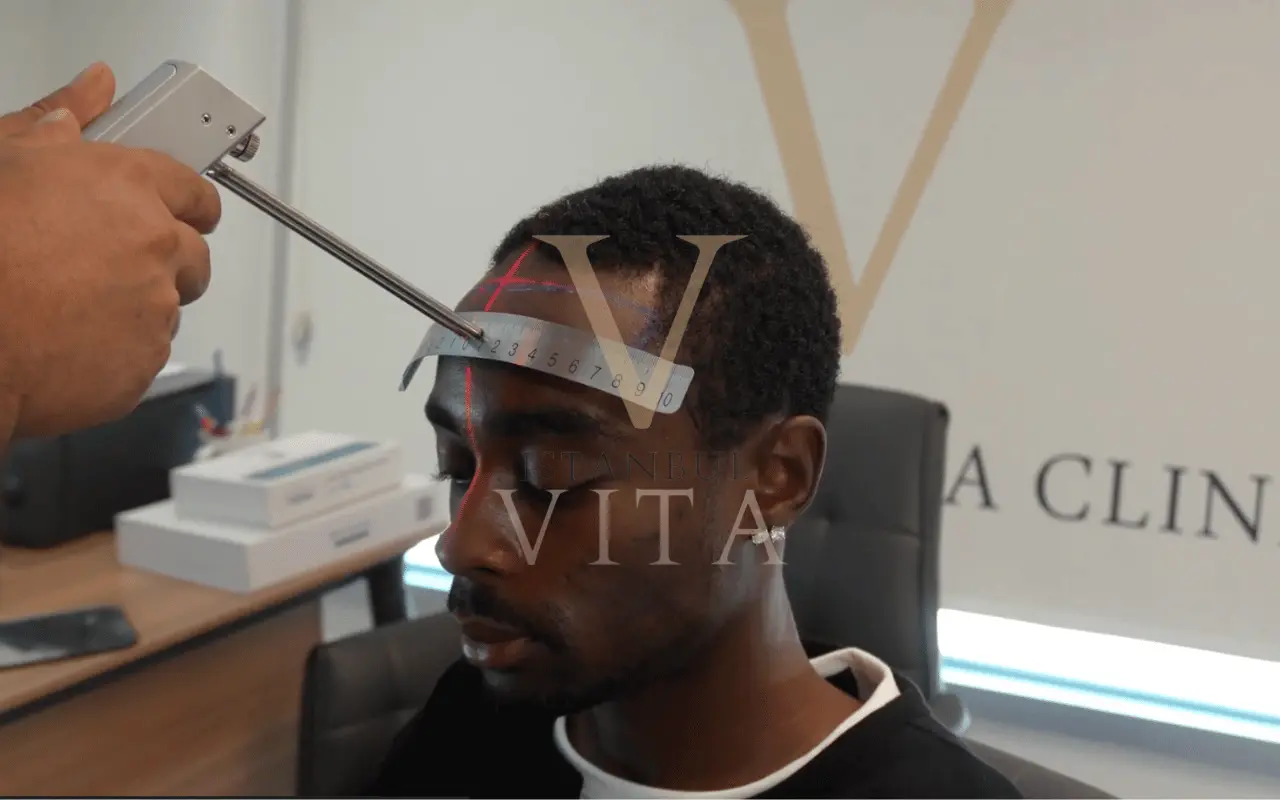
The Importance of Extraction Performed by a Doctor for Curly Hair
When a doctor personally performs channel opening and closely oversees extraction, angle adjustments happen in real time as the follicle curvature becomes apparent. A technician following a fixed protocol cannot make that same judgment call mid-procedure.
At Istanbul Vita, for example, doctors themselves handle channel opening on every case, including afro hair transplant procedures. Dr. Mustafa Ayhan Balcı and Dr. Harun Eymen Alakaya specialize specifically in afro cases and take part directly in planning and treatment, while extraction and implantation are carried out by an experienced supporting medical team under their direct planning. You can see how this technique is applied in more detail on the clinic's afro hair transplant Turkey page.
How is the Donor Area Analyzed Before Black Hair Transplantation?
The donor area is evaluated under microscopic analysis before any grafts are removed, so the surgical team can map hair thickness, curl pattern, and density zone by zone rather than treating the whole area as uniform.
Microscopic Donor Analysis and Graft Classification
In more advanced protocols, the donor site is divided into zones sometimes labeled something like D1 through D4 each containing grafts with distinct thickness and growth characteristics. The recipient area is mapped in a similar way, since the hairline needs finer single-hair grafts while the crown and mid-scalp can support denser multi-hair grafts.
This zone-based planning matters even more for curly hair, since curl pattern can vary noticeably across the same donor area. Skipping this step is one of the quieter reasons some black hair transplant results look uneven months later.
How Many Grafts Can Be Transplanted?
The number of usable grafts depends on donor density, hair caliber, and how well the extraction technique protects curved follicles from transection. There is no fixed number that applies to every patient, and any clinic promising a precise graft count before an in-person or high-quality virtual consultation is guessing.
What matters more than a headline number is graft survival: 3,000 well-preserved, well-placed grafts on curly hair can outperform 5,000 grafts extracted carelessly.
What Results Can You Expect After a Black Hair Transplant?
Patients can expect a natural-looking hairline that follows their existing curl pattern, provided the clinic planned graft direction and density with that curl type in mind from the start.
Natural Hairline Design for Curly Hair Types
A hairline that ignores curl pattern often looks transplanted, even with technically sound surgery. Implantation angle needs to mirror how the patient's natural hair grows out of the scalp, curve and all, not sit at a generic forward-facing angle.
This is one of the reasons afro hair transplant results vary so much between clinics with similar equipment. The equipment isn't the differentiator; the planning and hands-on doctor involvement are.
Recovery Process and Recovery Time
Recovery generally mirrors the technique used, so patients treated with smaller sapphire-based punches tend to see less redness and a shorter visible healing window than those treated with Classic FUE. Most patients can expect initial scabbing to clear within 10–14 days, with final density becoming visible over 8–12 months as transplanted hair cycles through its natural growth phases.
You'll likely feel more self-conscious in the first two weeks than at any later point, and that's completely normal. It gets easier from there.
How Much Does Black Hair Transplantation Cost in Turkey?
A black hair transplant in Turkey typically costs between $3,200 and $9,000, with the final price shaped by technique, number of surgical days, and the size of the medical team involved rather than by graft count alone.
What Affects Black Hair Transplant Prices?
Pricing structures vary by clinic, but the honest ones base cost on procedure complexity and time, not on how many grafts get extracted. This matters specifically for afro hair cases, since achieving good density often takes more careful, time-intensive extraction per graft than it would for straight hair.
All-Inclusive Packages vs. Hidden Costs
All-inclusive packages that cover accommodation, transport, translation, and post-operative care tend to protect patients from unexpected charges once they've already traveled to Turkey. Ask specifically what's included before booking; "all-inclusive" means different things at different clinics.
| Package Element | Often Included | Sometimes an Extra Charge |
| Hotel accommodation | Yes, in most packages | Upgrades to higher-star hotels |
| Airport transfers | Yes | Additional family member transport |
| PRP or mesotherapy add-ons | Sometimes | Often billed separately |
| Post-op medical kit | Yes, in most packages | Rarely extra |
| Multilingual coordinator | Yes, at established clinics | Rarely extra |
How to Choose the Right Clinic for Black Hair Transplantation in Turkey?
Choose a clinic that can show specific, verifiable experience with afro hair cases, not just a general hair transplant portfolio. Ask directly how many afro hair procedures the doctor has performed, who handles channel opening, and what punch size they use for curly hair specifically.
A short consultation, a rushed graft estimate, or a technician-only workflow are all warning signs. A clinic confident in its afro hair results will walk you through donor analysis and technique choice before ever mentioning price.
Istanbul Vita approaches afro hair cases through this kind of doctor-led model. Several of its physicians, including Dr. Mustafa Ayhan Balcı, Dr. Harun Eymen Alakaya, and Dr. Özge Miray Gültekin, specialize specifically in afro hair transplantation, and doctors personally perform channel opening on every case as part of the clinic's Vita Technique®, which uses 0.6–0.7 mm sapphire punches designed to reduce trauma on curved follicles. The clinic operates on a boutique model of one to three procedures a day, offers 40–60 minutes of consultation time per patient, and supports international patients in 13 languages. If you're comparing options for an afro hair transplant in Turkey, it's worth asking any clinic you're considering the same questions this article just walked through.

Have Questions? Let's Chat on WhatsApp!
Get instant answers 24/7. Receive your doctor-led hair analysis within 1 day, plus pricing and booking support.
Start WhatsApp ChatFrequently Asked Questions
Is a black hair transplant in Turkey different from a regular hair transplant?
Yes. The core surgical steps are similar, but extraction angle, punch size, and implantation direction all need to be adjusted for curved, curly follicles to protect graft survival and achieve a natural result.
Can afro hair be transplanted using FUE?
Yes, FUE-based techniques including Sapphire FUE and DHI are commonly used for afro hair, though smaller punch sizes and doctor-led extraction typically produce better outcomes than Classic FUE alone.
How long does recovery take after a black hair transplant?
Most patients see initial scabbing clear within 10–14 days, with visible density building over 8–12 months as transplanted grafts complete their natural growth cycle.
What does a black hair transplant in Turkey typically cost?
Prices in Turkey generally range from €2,000 to €4,000, depending on the clinic, technique, and treatment package. More comprehensive, all-inclusive packages may cost more.
How do I know if a clinic has real experience with afro hair?
Ask how many afro hair cases the doctor has personally performed, who does the channel opening, and what punch size is used for curly hair vague answers are a red flag.

 conversation


