
 English
Table of Contents
Afro hair loss sneaks up on people. The curls hide it well, until they don't. By the time you notice, it's already been happening for months. Sound familiar? It usually does. You're not the only one dealing with this. Afro hair needs its own rules, not a copy-paste plan built for someone with straight hair. Here's what actually works, and what to expect along the way.
What Is Afro Hair Density Restoration?
This treatment rebuilds thickness in curly, coiled, or tightly textured hair.It's not a regular hair transplant. Afro hair grows in a curve under the skin. That curve changes everything about extraction and placement.
A copy-paste approach usually fails here. Grafts get damaged. Results look flat or unnatural. Doctors who understand curl direction do better work. They study the scalp first. Then they plan density, zone by zone. The goal is simple: hair that moves like the patient's own hair always did, not hair that just sits there.
Why Afro Hair Needs a Different Approach
Straight hair grows in a straight line. Easy to extract. Afro hair curls and coils under the surface. Sometimes it wraps back on itself. Regular tools weren't built for that shape. Used carelessly, they damage follicles before they're even out. Skin elasticity varies more in afro hair too. So does curl tightness. That means no two treatment plans should look the same. Every scalp tells its own story, and a good doctor listens to it.
How Does Afro Hair Density Restoration Work
It starts with a close look at the scalp and donor area. Afro hair often grows in a curve, like a question mark. Surgeons follow that curve during extraction. Rush it, and follicles get damaged before they're even removed.
Once grafts come out safely, they get sorted. By thickness. By curl strength. By growth direction. Implantation follows the same logic. Each graft goes in at the right angle. That angle has to match the patient's natural curl. Skip this step, and the result looks off. Get it right, and it blends in completely.
Signs You May Need Afro Hair Density Restoration
Hair loss in afro hair hides well. The curl pattern covers the scalp. So thinning often goes unnoticed for a while. Some changes happen slowly. Others show up fast, after stress or illness or hormone shifts. Either way, catching it early helps. Wait too long, and the donor area loses potential. Check your scalp every few months. It's worth the habit, even if nothing seems wrong yet.
Thinning Hair Patterns in Afro Hair
Thinning in afro hair often starts at the crown. Or the temples. Same as other hair types. But tight curls hide it well. A thinning crown can still look full, until the hair gets wet. Patients notice their styles need more product. Or more time. Edges recede slowly too, especially with years of tension styling. None of this is dramatic by itself. Together, it's worth a real look from someone who knows what to check.
Hair Volume Loss: What to Watch For
A drop in hair volume afro hair often shows up first at the crown. Or under bright light, where the scalp peeks through. Ponytails feel thinner in your hand. Braids too. Some people just say their hair feels "tired." Nothing changed in their routine, yet something's different. These signs aren't dramatic. But they're real. A scalp check can confirm what's going on, before it gets worse.
Afro Hair Density Restoration with FUE
FUE technique stands for follicular unit extraction. It's one of the better methods for curly, coiled hair. Single grafts come out, one at a time. No large strips of tissue. For afro hair, that precision counts even more. Every follicle has its own curve, its own direction.
A trained team follows that curve instead of fighting it. Less damage. Stronger graft survival. At Istanbul Vita, doctors handle channel opening themselves. That keeps things consistent from the first graft to the last, and patients notice the difference in the final result.
Why FUE Suits Afro Hair Structure
Curved follicles need careful hands. FUE gives that control. Smaller punches mean smaller wounds. Smaller wounds heal faster.
For thick hair afro hair transplant cases, FUE also supports higher density without crowding the scalp. Patients with tight curls often see strong results here.
There's no single straight angle to rely on. Each follicle gets approached on its own. That patient-by-patient method is why specialized clinics get more consistent outcomes with textured hair.
The Vita Technique® and Afro Hair Expertise
Hasan Başol,Istanbul Vita's Medical Director and founder, created the Vita Technique®. The method starts with microscopic donor analysis. Grafts get sorted by thickness, texture, and growth pattern, before anything gets transplanted.
That matters, because not every graft behaves the same once it's placed. The technique uses sapphire punches as small as 0.6 to 0.7 mm. In the right cases, that can support density up to 80 to 100 grafts per square centimeter, with low trauma. Doctors, Dr. Mustafa Ayhan Balcı and Dr. Özge Miray Gültekin focus specifically on afro hair cases. Years of hands-on practice back up the method, case after case.
Thick Hair Afro Hair Transplant: What Patients Can Expect
A lot of patients with thick hair afro hair transplant need to worry about one thing: Will it look thinner than before? Usually, no. Thick, coiled hair covers more scalp per graft than straight hair does. That's an advantage, not a problem.
The real challenge is direction. Matching angle so new grafts blend in, instead of standing apart. A good team studies growth direction across the whole scalp first. Not just at the hairline, but everywhere density needs to look consistent.
Achieving Natural Hair Density Afro Hair Restoration Results
Good hair density afro hair restoration results come from planning. Not just graft count. Doctors split the donor and recipient areas into zones. Each zone gets matched to a specific graft type.
Single grafts go along the hairline. Soft edge, natural look. Denser grafts go toward the crown. That's where coverage needs to be strongest. This zone-based plan avoids the "pluggy" look that comes from placing grafts without a real map.
Best Afro Hair Density Restoration Clinic: What to Look For
Picking the right clinic changes everything for afro hair cases. Look for real experience with textured hair, not just transplant volume in general. Ask who handles channel opening and extraction and how.
At Istanbul Vita, doctors are personally involved at every stage, including channel opening, which other clinics often leave to assistants.
The clinic also caps itself at one to three patients a day. A boutique model, not a high-volume one. That changes how much attention each graft actually gets.
Doctor Experience and Specialization
Istanbul Vita's medical team has four licensed doctors. Each one specializes differently.
Dr. Harun Eymen Alakaya works with the Vita Technique®, combined methods, and afro hair procedures.
Dr. Tuğçe Yılmaz Arslan handles the Vita Technique®, combined techniques, and stem cell therapy.
That kind of focus matters for textured hair. General experience isn't always enough, especially with curl patterns this varied.
Personalized Planning for Every Patient
A real consultation means real time with a doctor, not just a coordinator.
Istanbul Vita gives patients 40 to 60 minutes with their doctor. Enough time to talk about curl pattern, donor strength, and what's realistic.
Pricing matters too. At Istanbul Vita, cost depends on technique, days, and staff involved, not on graft count. That removes pressure to limit grafts just to hit a lower price, which protects the final result.
Afro Hair Density Restoration for Black Men
Pattern hair loss in Black men follows similar stages to other groups. However, density planning looks different. Coiled hair hides early recession at the temples and crown.
So many men notice it only once it's already visible. Hairline design needs extra care here. Curl direction at the front isn't the same as at the sides. A natural result depends on getting that direction right, graft by graft.
Beard and eyebrow work are common add-ons too, and Dr. Harun Eymen Alakaya performs these alongside scalp procedures when patients ask for both.
Afro Hair Density Restoration for Women
Women usually lose hair differently than men do. More spread out. Less of a defined line.
For women with afro hair, that means coverage matters more than a sharp new hairline. Hormones, tight styling, and postpartum shedding all play a role, and they're worth bringing up at consultation.
Dr. Mustafa Ayhan Balcı and Dr. Harun Eymen Alakaya both handle female hair transplants at Istanbul Vita. Planning gets adjusted for finer density needs and a more natural part line.
Afro Hair Density Restoration Timeline
Results take time, which is normal. Afro hair grows in cycles, same as any other hair type. But textured hair sometimes shows thickness changes a little later. Set realistic expectations early. It saves a lot of worry in the first few months, when not much seems to be happening yet.
Density Restoration Recovery Process
The density restoration recovery process follows a fairly predictable path. Scabbing fades in the first one to two weeks. Transplanted hair often sheds around weeks three to four. That's expected. Not a failure. New growth usually starts around month three or four. Thickness builds steadily from there, month after month.
First Two Weeks
Mild swelling and redness show up in the first few days, mostly around the hairline. Most patients get back to light activity within a week. Sleeping at an angle helps. So does avoiding direct contact with the scalp during those early days.
Long-Term Growth Timeline
By month six, density improvement is usually clear. Final texture and curl pattern settle in around month nine to twelve. Some patients with thicker starting hair get there faster. Patience matters. Judging results too early, at month four or five, usually leads to worry over nothing.
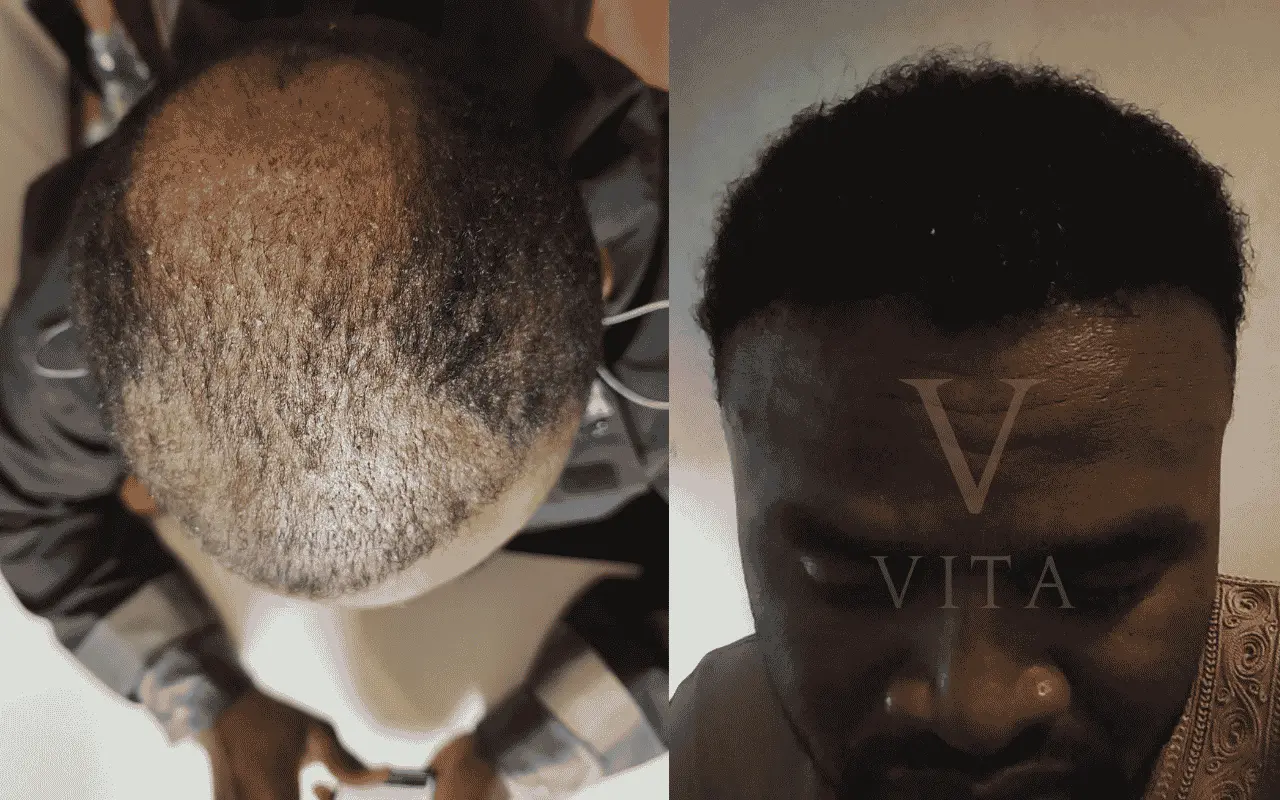
Afro Hair Density Restoration Before and After Results
Photos taken under the same light and angle tell the real story. A lot of patients shave or trim before the procedure. That makes early comparisons sharper, more honest too.
Coverage at the crown and temples shows the biggest shift by month six. New growth usually matches the donor hair's curl pattern closely. Makes sense, it's the same hair, just moved. Real patient photos beat stock images every time. They show what's actually possible for your hair type, not someone else's.
Afro Hair Density Restoration Cost in Turkey
Turkey is one of the most searched destinations for hair restoration. Afro hair cost is a big reason. Skilled teams are another. The price depends on technique, number of days, and staff involved, not on graft count. That means patients aren't pushed to cut graft numbers just to save money. Packages usually cover the procedure, an after-care kit, and coordinator support during the stay.
Have Questions? Let's Chat on WhatsApp!
Get instant answers 24/7. Receive your doctor-led hair analysis within 1 day, plus pricing and booking support.
Start WhatsApp ChatFrequently Asked Questions
How long does it take to see real results?
Most patients see real thickness by month six. Full results settle in by month nine to twelve. Patience pays off here, more than people expect.
Is FUE better than DHI for afro hair?
Both can work well. FUE often suits thick hair afro hair transplant cases needing more density. DHI offers tighter control over placement. The right pick depends on your scalp and curl type, which a doctor should check in person.
Can women have this treatment too?
Yes. Female hair loss usually needs a different density map. Even coverage matters more than a sharp hairline, and planning reflects that from the start.
What does the procedure cost in Turkey?
Price depends on technique and procedure length and graft count.
Will curly hair look natural after a transplant?
Yes, if the angle and direction are exactly right. Specialized teams plan around your natural curl pattern, during both ex
 conversation


