
 English
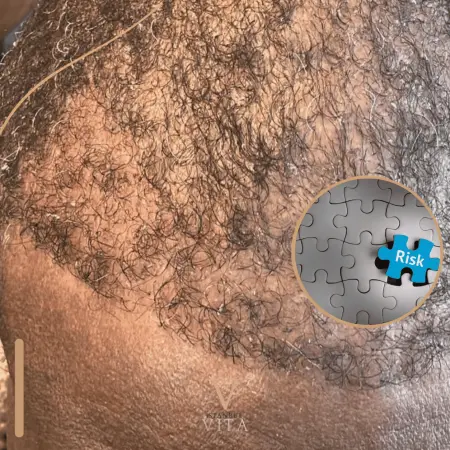
Table of Contents
What Transection Actually Means (And Why It Happens)
Surgeons who specialize in Afro hair transplant procedures often describe the same recurring challenge: the part of the follicle they can see tells them very little about the part they can't. A strand exits the skin at one angle, but the structure beneath it may curve, twist, or double back before it settles into the tissue. That mismatch between what's visible and what's actually there is where most of the transection risk in Afro-textured procedures originates.
Transection is the term used when this underlying structure gets partially cut or separated during removal, rather than released whole. It's a recognized possibility in any FUE procedure, but the odds shift meaningfully once tightly coiled anatomy enters the picture. Working through why that happens, and what actually changes the odds, matters more than treating the word itself as alarming.
None of this means outcomes are left to chance. It means the planning stage carries more weight than it would with straighter hair types, and that weight shows up in how a clinic approaches the work before a single tool touches the scalp.
What Increases the Risk of Follicle Damage?
Several variables influence transection risk, and isolating any one of them oversimplifies the picture. The angle of entry matters. So does the width of what's being removed, the tension of the surrounding skin, and probably most significantly the experience of the person holding the tool. A team that has spent years on textured cases reads warning signs faster than one encountering this anatomy for the first time, but skill doesn't cancel out the underlying complexity; it manages it.
| Variable | Effect |
| Subsurface curvature | Straight tool paths can miss a bending structure |
| Width and density | Wider or tightly packed units respond differently to a given tool size |
| Entry angle | Small deviations compound quickly on curved anatomy |
| Skin tension | Influences how cleanly a unit separates from surrounding tissue |
| Operator experience with coily cases | Faster recognition of curvature cues before problems occur |
Instrument sizing is one part of that same equation, not a separate topic. A tool that's too narrow for a wider or more sharply curved structure can cause more harm than one chosen deliberately with that anatomy in mind which runs counter to the common assumption that smaller automatically means safer. Sizing decisions tend to shift across the scalp itself, since the crown and the nape rarely present identical characteristics even in the same patient.
Can Transection Affect Graft Survival or Future Sessions?
A few isolated incidents during a large session rarely change the overall result. An isolated technical event of this kind is different from a consistently elevated transection risk across an entire session, which is where the concern actually grows: when the rate climbs enough to noticeably reduce usable density, or when it affects how much can be drawn from a given region in the future. Significant damage to a unit can lower its chances of surviving transplantation, though how much depends heavily on the degree of harm and where along its length it occurred.
This is part of why how a team distributes their work across the scalp matters as much as how carefully each individual pass is executed. Concentrating too heavily in one zone can limit what's available for a later session, even if the immediate result looks fine. Donor area safety in Afro hair transplant goes into more depth on how that balance gets managed over time.
Patients sometimes come in after a prior procedure that didn't go well, and extensive, poorly distributed harvesting is often part of that story. A single affected unit isn't evidence of a failed procedure. A pattern across an entire session is a different situation, and one that failed Afro hair transplant repair addresses in more detail for anyone trying to understand what went wrong the first time.
Have Questions? Let's Chat on WhatsApp!
Get instant answers 24/7. Receive your doctor-led hair analysis within 1 day, plus pricing and booking support.
Start WhatsApp ChatHow Istanbul Vita Plans Around Curved Follicle Anatomy
Work on a coily or tightly curled case at Istanbul Vita starts with a microscopic look at the scalp before anything is removed, building a picture of how units are actually oriented beneath the surface rather than relying on what's visible from above. That assessment shapes tool size and entry angle from the outset, and both continue to shift as the team moves across different areas rather than staying fixed for the whole session.
This approach forms the basis of what's called the Afro Technique® internally, built specifically around the demands of textured anatomy instead of adapted from a method designed for straighter cases. Transection risk is treated as a technical factor to be anticipated and managed through planning, not something addressed only after it shows up. Direction gets reassessed continuously, since curvature can change within a small span, and natural growth direction is factored back in during placement a unit removed cleanly can still look wrong if it goes in at the wrong angle later.
Doctors stay involved through the stages where these calls actually get made, rather than handling only the opening and closing of the procedure. That doesn't make the underlying complexity disappear. It gives the team a structured way to respond to it as it shows up in each case, which is the most any team can honestly offer.
Why Choosing a Clinic Experienced With Afro Hair Matters
- How is the treatment area assessed before anything is removed?
- How many coily or tightly curled cases has the team actually handled?
- Does tool size change mid-procedure, or is it fixed in advance?
- Who's responsible for the more technically demanding stages?
- What's the plan if the anatomy turns out more complex than expected going in?
Vague answers to these questions usually point to limited experience with this specific anatomy, whatever else a clinic might claim. Teams that can walk through their process in concrete terms tend to have actually thought it through. If you'd like to talk through what this would look like for your own case, Istanbul Vita's coordinators can go over the specifics before you commit to anything.
Have Questions? Let's Chat on WhatsApp!
Get instant answers 24/7. Receive your doctor-led hair analysis within 1 day, plus pricing and booking support.
Start WhatsApp ChatFrequently Asked Questions
What does transection mean, exactly?
It describes a unit that's been partially or fully cut during removal, rather than released intact.
Is this more of an issue with Afro-textured hair specifically?
Yes, largely because of how often the subsurface path curves or shifts direction in ways that aren't visible from outside.
Does a damaged unit still grow back?
It depends on the extent of the damage. More significant harm tends to reduce or eliminate viability, while minor cases may still succeed.
Can the risk be completely eliminated?
No clinic can honestly promise zero risk. Careful assessment and technique reduce unnecessary risk, but manual extraction carries some inherent variability
How can someone tell if a clinic actually has experience with this anatomy?
Ask about their assessment process and who performs the harder technical stages. Specific, detailed answers usually mean real experience behind them.
 conversation


