
 English
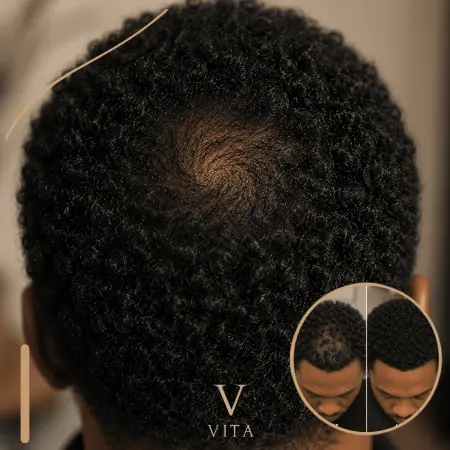
Table of Contents
Can a Hair Transplant Fix Crown Thinning in Afro Hair?
If you've caught a photo from behind lately and noticed more scalp showing through than you remember, you're probably not imagining things. Crown thinning is one of the most common reasons Afro-textured, curly, and coily patients start looking into transplant options.
The short answer: yes, in most cases this can be restored. But it's rarely as simple as filling a visible patch with as many grafts as possible. The vertex sits at a natural whorl point on the scalp, so growth there radiates outward rather than falling in one straight direction. Combine that with the curved follicular structure typical of Type 4 texture, and you've got a region that needs different planning than the hairline does.
Some readers want the fuller picture before getting into vertex-specific detail. Our Afro hair transplant Turkey guide walks through the broader process, from consultation through recovery.
Why Is the Crown Different From the Hairline?
Hairline work is mostly about framing a face. The vertex is a different animal entirely. It's a circular zone, and growth around it naturally fans outward from a central point instead of falling in one uniform direction.
There's also a visibility gap patients tend to underestimate. Thinning back there is often more obvious to everyone else than to the person it's happening to, since nobody checks the back of their own head in a mirror each morning. By the time it gets noticed and a consultation gets booked, the pattern has usually had time to progress further than expected.
None of this makes restoration riskier. It just means treating the area as its own planning problem instead of an extension of frontal technique.
How Does the Natural Crown Whorl Affect Hair Transplant Planning?
Every scalp has a whorl at the vertex, sometimes called a vortex. Strands grow outward from this central point in a spiral, and the direction is unique to each person. Some sit slightly off-center. Some spin clockwise, others counterclockwise. A few patients even have two whorls, which adds another layer to the planning.
Recreating that pattern isn't optional if a natural look is the goal. Grafts placed in one uniform direction, ignoring the spiral, tend to look flat once they've grown in, especially from above or under bright light. A surgeon needs to find the whorl center, trace how the spiral moves outward, and shift the angle gradually as placement moves away from that point.
How Curl Direction Interacts With the Crown Whorl
In Afro texture, this gets more layered. Visible curl direction above the skin doesn't always match the angle a follicle actually grows at beneath it. A strand might curl one way on the surface while its root sits at a completely different angle underground. Planning around the whorl means accounting for both, not just what's visible.
Why Is Crown Restoration More Technical in Afro-Textured Hair?
Coily, tightly curled follicles are structurally curved beneath the surface, sometimes fairly sharply. That curvature affects extraction, since a root curving underground needs a different angle of approach than a straight one to avoid unnecessary transection. It affects placement too. Angle and rotation of each graft need to match surrounding native growth or the result won't blend convincingly.
Type 4 Variations: Why 4A, 4B, and 4C Hair Can Behave Differently
Type 4 isn't one category. 4A usually has a more defined curl pattern. 4B is looser, less uniform. 4C tends toward the tightest coil with the most pronounced curvature. These differences matter when deciding how grafts should be angled through the vortex, since a 4C vertex and a 4A vertex can call for noticeably different handling even on the same scalp.
| Planning Factor | What It Affects | Why It Matters in Afro-Textured Cases |
| Follicular curvature | Extraction angle, graft survival | Curved roots need angle-matched extraction to reduce transection risk |
| Whorl direction | Implantation angle across the area | A mismatch can make the spiral look unnatural once growth develops |
| Curl type (4A/4B/4C) | Visual coverage, density perception | Tighter coils can change how much apparent density a given count provides |
| Donor consistency | Graft matching | Grafts moved into this zone should reflect the same curl behavior as surrounding growth |
None of this is meant to sound intimidating. It's just why this specific combination benefits from a surgeon who's handled it repeatedly, rather than someone applying a generic transplant approach to a case that needs more nuance.
How Many Grafts Are Needed for a Thinning Crown?
Probably the most searched question on this topic. Also one of the hardest to answer honestly with a single number. It depends on the size of the thinning zone, how much native coverage is still present and healthy, donor capacity, curl characteristics, and how much density the patient wants versus what's realistic long-term.
A small, early patch might need meaningfully fewer grafts than a vertex that's been thinning for years and expanded outward. A larger area doesn't automatically call for maxing out a single session, either. Sometimes conservative, staged planning makes more sense than trying to reach peak density all at once, especially if surrounding loss is still likely to continue.
| Common Assumption | More Accurate Explanation |
| More grafts always means a better result | Past a certain point, additional grafts can strain donor supply without meaningfully improving coverage |
| Afro texture automatically needs fewer grafts | Curl and volume can improve apparent coverage, but needs still depend on the individual pattern and area size |
| Vertex density should match the hairline | This zone is viewed from different angles and distances, so expectations are usually planned separately |
Does Afro Hair Need the Same Density as Straight Hair?
Not necessarily. Coil and volume can create the appearance of fuller coverage at a lower graft count than straight strands would need for the same visual effect. That's a tendency, though, not a rule. It's genuinely difficult to give a reliable estimate without seeing the actual pattern, donor supply, and curl type in person or through detailed photos.
Should Crown Thinning Always Be Transplanted Immediately?
Depending on the overall pattern, some patients are actually better candidates for frontal or mid-scalp work first, with vertex restoration planned for later once the pattern is clearer. Not a universal rule. Plenty of people move forward with this area as a first step successfully. The point is that it should come from individual assessment, not from treating visibility as an automatic priority.
What Happens If Thinning Continues Around the Transplanted Area?
Native loss doesn't stop just because a procedure happened nearby. If it continues in the untreated zone surrounding the treated one, the contrast can become more noticeable over time, sometimes years down the line.
Donor Area Planning: Why Preservation Matters as Much as Coverage
This is exactly why preservation matters as much as initial coverage. A surgeon planning conservatively, rather than pushing the maximum possible count into one session, leaves room for a future touch-up if needed, without running into scarcity later. Supply is finite. Treating it that way from the first consultation tends to produce better outcomes than an aggressive first pass.
Why Can Crown Hair Transplant Results Take Longer to Appear?
Results in this area genuinely tend to show up later than frontal ones for most patients. A few reasons. Blood supply here often behaves a bit differently than at the hairline, and the shedding phase that follows any transplant, where transplanted strands fall out before regrowing, can play out on its own timeline in this zone.
A Realistic Look at the Recovery and Growth Timeline
Generally, early shedding happens within the first few weeks. Then a quiet stretch where not much seems to be happening visually. Regrowth starts gradually after that, and density keeps building over roughly nine to twelve months, sometimes longer here specifically. Most surgeons wait until the twelve-month mark before calling a result final.
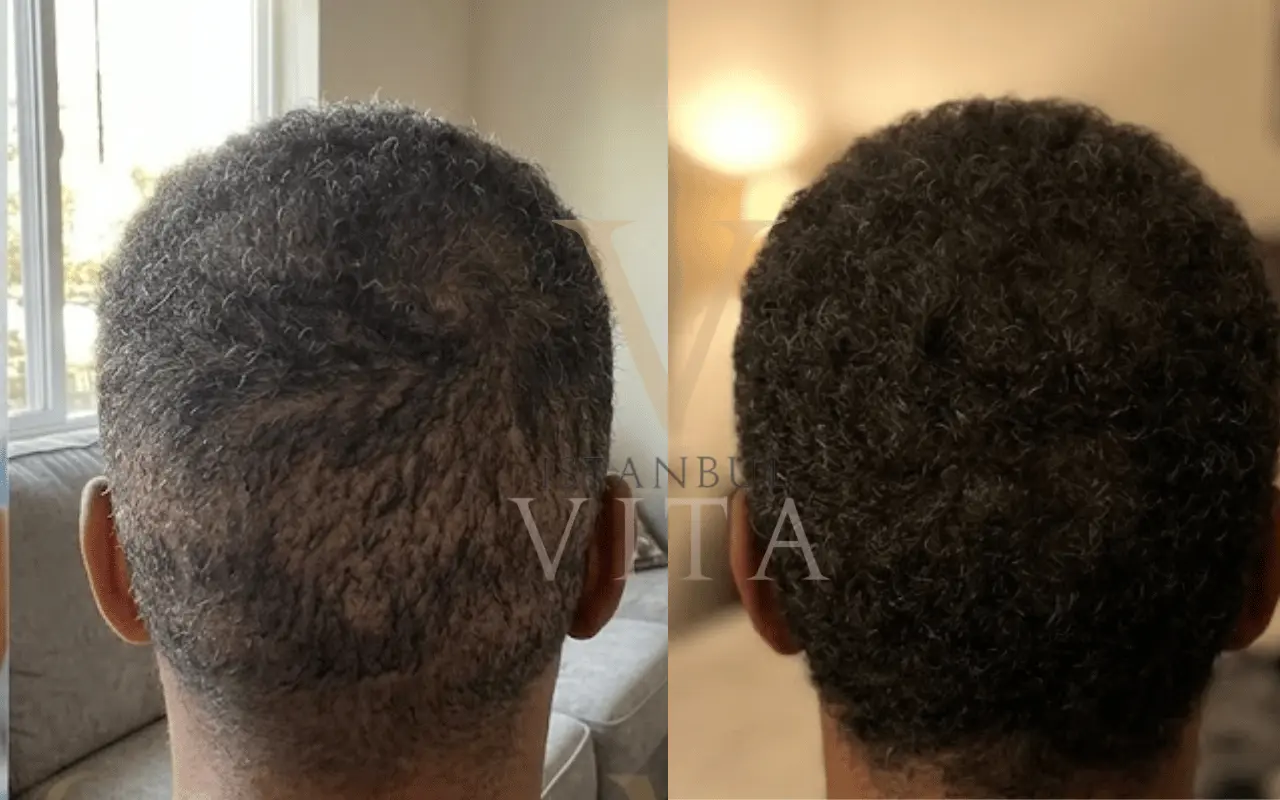
Anyone wanting a realistic sense of how this progression actually looks can review Afro hair transplant before and after results to see how density tends to develop in stages rather than all at once.
Healing rates, donor quality, and individual biology all play into it, so treat any timeline as a general guide, not a promise.
How Istanbul Vita Approaches Afro Crown Restoration
At Istanbul Vita, cases involving this area in Afro-textured patients go through planning built around this anatomy specifically, not a generic protocol. Donor analysis happens under microscope, examining curvature and curl behavior before any decision gets made about distribution.
This is where the Afro Technique® comes in. Developed for curly and coily follicular patterns, it factors in curl-aware extraction planning, whorl assessment, and graft angle matched to how growth actually happens beneath the surface, not just how it looks above it. Rather than a standard procedure with "Afro" tacked on, it's built around the reality that curved roots need curve-aware handling at every stage.
Doctors are directly involved in key decisions, including channel opening, which helps keep angle and direction consistent across the spiral zone. Combined with individualized distribution and a conservative approach to donor use, the goal is something that reads as natural from multiple angles, not just straight on.
Frequently Asked Questions
Can a hair transplant fix crown thinning in Afro hair?
In most cases, yes, provided donor supply is adequate, the pattern has stabilized reasonably well, and the natural whorl and curl direction get properly accounted for during planning.
How many grafts are needed for a thinning crown?
There's no single universal figure. It comes down to area size, existing coverage, donor capacity, and curl characteristics. An in-person or photo-based evaluation gives a far more reliable estimate than any generic number.
Why does crown hair transplant growth take longer?
This zone often has a somewhat different healing and shedding pattern than the hairline. Visible density typically keeps developing for up to twelve months, sometimes a bit beyond.
Can the natural crown whorl be recreated?
Yes, when the surgeon maps the whorl center and spiral direction beforehand, adjusting angle gradually as placement moves outward.
Is crown transplantation harder with coily hair?
More technical rather than simply harder. Curved anatomy calls for angle-matched extraction and placement, which takes more planning than straight-texture cases but is well within reach for an experienced team.
Can crown thinning continue after a transplant?
Surrounding native growth can keep thinning if the overall pattern hasn't stabilized, which is why some patients benefit from a staged approach rather than one large session.
Does Afro hair need fewer grafts for crown coverage?
Curl and volume can sometimes improve apparent density, but this varies by person and shouldn't be treated as a dependable rule across the board.
When can crown hair transplant results be evaluated?
Most surgeons recommend waiting at least twelve months, since density here tends to build gradually rather than appearing all at once.
Have Questions? Let's Chat on WhatsApp!
Get instant answers 24/7. Receive your doctor-led hair analysis within 1 day, plus pricing and booking support.
Start WhatsApp Chat
 conversation


