
 English
Table of Contents
What Makes Afro Beard Transplant Planning Different?
An afro beard transplant calls for a different level of planning than a standard procedure, because curly and coily facial follicles often follow a curved path beneath the skin rather than a straight one.
For how a beard session is planned and priced along the standard route, our beard and moustache transplant in Turkey page covers the ground.
Extraction and implantation need to be planned around this curvature, alongside donor quality, candidate selection, and the surgeon's experience with textured facial hair differences that matter when comparing clinics.
Results depend on several factors working together, not on any single technique or instrument: how carefully the donor area is assessed, how extraction is planned, and how grafts are placed to match natural curl direction.
For broader context on curl-aware planning, the clinic's curly and coiled hair transplant in Turkey page covers donor assessment in more detail. Readers looking for package and pricing information can find it on the clinic's dedicated beard transplant in Turkey page.
Curved Follicle Anatomy: Why Curly Facial Hair Grows Differently Beneath the Skin
Curly and coily facial follicles frequently follow a curved rather than a straight path beneath the skin. This subcutaneous curvature can vary from patient to patient, and even between different areas of the same jawline or chin, so surgeons generally assess it zone by zone rather than assuming one pattern applies throughout.
Curl Pattern and Follicle Curvature
Visible curl on the surface does not automatically predict how sharply a root bends underneath. Two patients with similar surface curl can still have different subcutaneous patterns, which is why a careful, individualized assessment before extraction tends to matter more than a fixed rule based on texture alone.
Scalp vs. Facial Hair Characteristics
Scalp and facial strands can differ in caliber, texture, curl pattern, and growth behavior, even within the same patient, and these differences affect how a graft is expected to look once it settles into the beard area.
For this reason, donor selection is generally based on an individual comparison of caliber, curl pattern, and expected blending with surrounding growth, rather than a fixed assumption about which source works best.
Extraction Angle and Transection Risk in Curly Grafts
Extraction tends to be more technically demanding when a follicle curves beneath the skin, since the instrument's path needs to follow the root's angle rather than move in a straight line. If this curvature is not accounted for, there is a higher chance a follicle is damaged or transected before it is fully removed, which can affect how many grafts survive for placement.
Why Careful Angle Planning Matters
Surgeons experienced with textured facial hair typically adjust their extraction angle graft by graft, rather than applying one fixed angle across the donor area, to reduce unnecessary trauma to the root. Experience with curly and coily texture, rather than any single instrument, is generally considered one of the more significant factors in extraction outcomes.
| Follicle Path | Extraction Complexity | Potential Transection Considerations | Main Planning Considerations |
| Straight | Generally direct beneath the skin | Typically lower in most cases | Fewer angle adjustments generally needed |
| Wavy | May show a mild curve beneath the skin | Moderate, and can vary by patient | Closer attention to angle during extraction |
| Afro / Coily | Frequently more pronounced and variable | Can be higher without individualized adjustment | Zone-by-zone curvature assessment and experienced, individualized planning |
What Makes Afro Beard Transplant Planning Different?
An afro beard transplant calls for a different level of planning than a standard procedure, because curly and coily follicles often follow a curved path beneath the skin rather than a straight one.
Extraction and implantation need to be planned around this curvature, alongside donor quality, candidate selection, and the surgeon's experience with curly grafts differences that matter when comparing clinics.
Results depend on several factors working together, not on any single technique or instrument: how carefully the donor area is assessed, how extraction is planned, and how grafts are placed to match natural curl direction.
Curved Follicle Anatomy in Afro Beard Transplant Planning
Curly and coily follicles frequently follow a curved rather than a straight path beneath the skin. This subcutaneous curvature can vary from patient to patient, and even between different areas of the same jawline or chin, so surgeons generally assess it zone by zone rather than assuming one pattern applies throughout.
Curl Pattern and Follicle Curvature
Visible curl on the surface does not automatically predict how sharply a root bends underneath. Two patients with similar surface curl can still have different subcutaneous patterns, which is why a careful, individualized assessment before extraction tends to matter more than a fixed rule based on texture alone.
Scalp Donor Hair vs. Natural Beard Characteristics
Scalp hair and natural beard hair can differ in caliber, texture, curl pattern, and growth behavior, even within the same patient, affecting how a graft looks once it settles.
For this reason, donor selection is generally based on an individual comparison of caliber, curl pattern, and expected blending with the surrounding area, rather than a fixed assumption about which source works best.
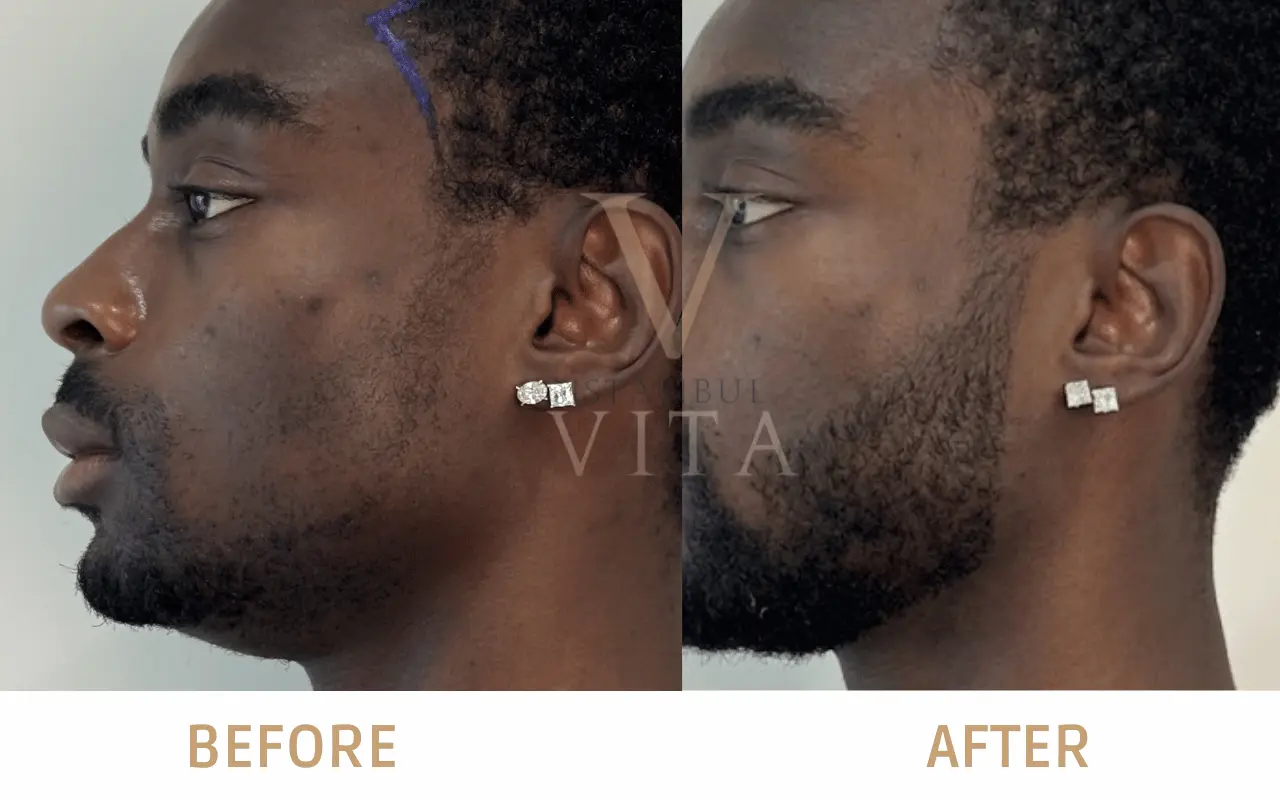
Extraction Angle and Transection Risk in Curly Beard Grafts
Extraction tends to be more technically demanding when a follicle curves beneath the skin, since the instrument's path needs to follow the root's angle rather than move in a straight line. If this curvature is not accounted for, there is a higher chance a follicle is damaged or transected before it is fully removed, which can affect how many grafts survive for placement.
Why Careful Angle Planning Matters
Surgeons experienced with curly grafts typically adjust their extraction angle graft by graft, rather than applying one fixed angle across the donor area, to reduce unnecessary trauma to the root. Experience with curly and coily texture, rather than any single instrument, is generally considered one of the more significant factors in extraction outcomes.
| Follicle Path | Extraction Complexity | Potential Transection Considerations | Main Planning Considerations |
| Straight | Generally direct beneath the skin | Typically lower in most cases | Fewer angle adjustments generally needed |
| Wavy | May show a mild curve beneath the skin | Moderate, and can vary by patient | Closer attention to angle during extraction |
| Afro / Coily | Frequently more pronounced and variable | Can be higher without individualized adjustment | Zone-by-zone curvature assessment and experienced, individualized planning |
Implantation: Matching Curl Direction for a Natural Beard Pattern
Grafts are generally placed to follow the natural exit angle and curl direction of surrounding growth, since a noticeable mismatch can make a section look uneven once it grows in. Because curl direction can vary across the jawline, mustache, and chin, implantation is typically planned area by area rather than applying one uniform angle to the entire area.
Beard Density Planning and Graft Distribution
Curly and coily texture tends to create visual coverage differently than straight strands, since curl clusters can appear denser at the surface. Density planning is therefore generally based on desired visual outcome and available supply, not graft count alone.
Donor Area Evaluation for Patchy Afro Beard Growth
A suitable candidate for afro-textured beard restoration typically has a stable, non-progressive pattern of patchy growth, sufficient donor supply, and realistic expectations. Scalp hair is typically the primary donor source; other areas are sometimes considered, but suitability depends on individual evaluation.
Signs You May Be a Good Candidate
- Uneven or patchy coverage along the jawline or cheeks
- A donor area with sufficient supply of suitably matching hair
- Stable, non-progressive patchiness rather than an active skin condition
- Realistic expectations about density and timeline
When Patchy Beard Growth Signals a Deeper Issue
Not every patchy pattern is a straightforward candidate case. Conditions such as alopecia barbae or scarring from ingrown curls may need to be assessed and stabilized first, so a proper consultation should come before any planning decision.
Understanding Cobblestoning and Other Risks in Curly Beard Planning
Cobblestoning refers to small raised areas of skin that can form around grafts during healing. It is generally associated with recipient-site technique, implantation depth, and tissue handling, rather than an automatic result of curly or coily texture on its own. Curved roots can still add complexity to depth and angle planning, which is why individualized, experienced technique remains especially relevant here.
| Risk | Why It May Occur | How Careful Planning May Reduce the Risk |
| Cobblestoning | Recipient-site or depth inconsistencies during healing | Individualized depth and angle planning based on surgeon experience |
| Patchy regrowth | Follicle damage during extraction, often linked to an unadjusted angle on curved roots | Zone-by-zone curvature assessment and angle adjustment during extraction |
| Unnatural growth direction | Grafts placed without matching surrounding curl direction | Area-by-area implantation planning based on natural pattern |
| Reduced graft survival | Extended handling time or inconsistent care outside the body | Attentive handling and shortened time between extraction and placement |
What Should You Look for in Afro Beard Transplant Planning?
When comparing clinics for an afro facial hair transplant, it helps to ask specific questions: how is curvature assessed before extraction, and how is the plan adjusted across different facial areas? A clinic experienced with curly and coily texture including cases such as a beard transplant for black men should explain its donor assessment process rather than describing the procedure in generic terms.
At Istanbul Vita Clinic, planning for these cases involves assessing the patient's donor area and curl characteristics before deciding on graft distribution. Dr. Harun Eymen Alakaya, who works with both Afro-textured hair restoration and beard transplantation, is one of the doctors involved.
The clinic follows a boutique model with a limited number of procedures scheduled per day, and doctors remain involved through planning and treatment rather than delegating the process entirely to a technician. Istanbul Vita is licensed by the Republic of Türkiye Ministry of Health and holds an International Health Tourism Authorization Certificate.
Frequently Asked Questions
Is this more difficult to plan than a standard beard transplant?
Planning is generally more involved. Curved roots require closer attention to angle, and outcomes depend on the surgeon's experience with curly and coily grafts, along with candidate selection and graft handling.
Can curly grafts be taken from a straight-hair scalp donor area?
Scalp hair is typically the primary source for a beard hair transplant, including for curly or coily cases. Suitability is assessed individually by comparing donor caliber, curl pattern, and expected compatibility with the target area.
How long until curl pattern results are visible?
Initial shedding is normal in the first few weeks. Early growth generally begins around month three, and results continue developing over the following months as grafts mature.
Does curly facial hair carry a higher risk of cobblestoning?
Cobblestoning is generally linked to recipient-site technique and implantation depth, not curl texture itself. Curved roots do add planning complexity, which is why individualized, experienced technique remains particularly relevant for these cases.
Should patchy growth always be treated with a full procedure?
Not necessarily. Some patchy growth relates to an underlying condition that should be evaluated first. A consultation can help determine whether a transplant or another approach is more appropriate.
Have Questions? Let's Chat on WhatsApp!
Get instant answers 24/7. Receive your doctor-led hair analysis within 1 day, plus pricing and booking support.
Start WhatsApp Chat
 conversation


